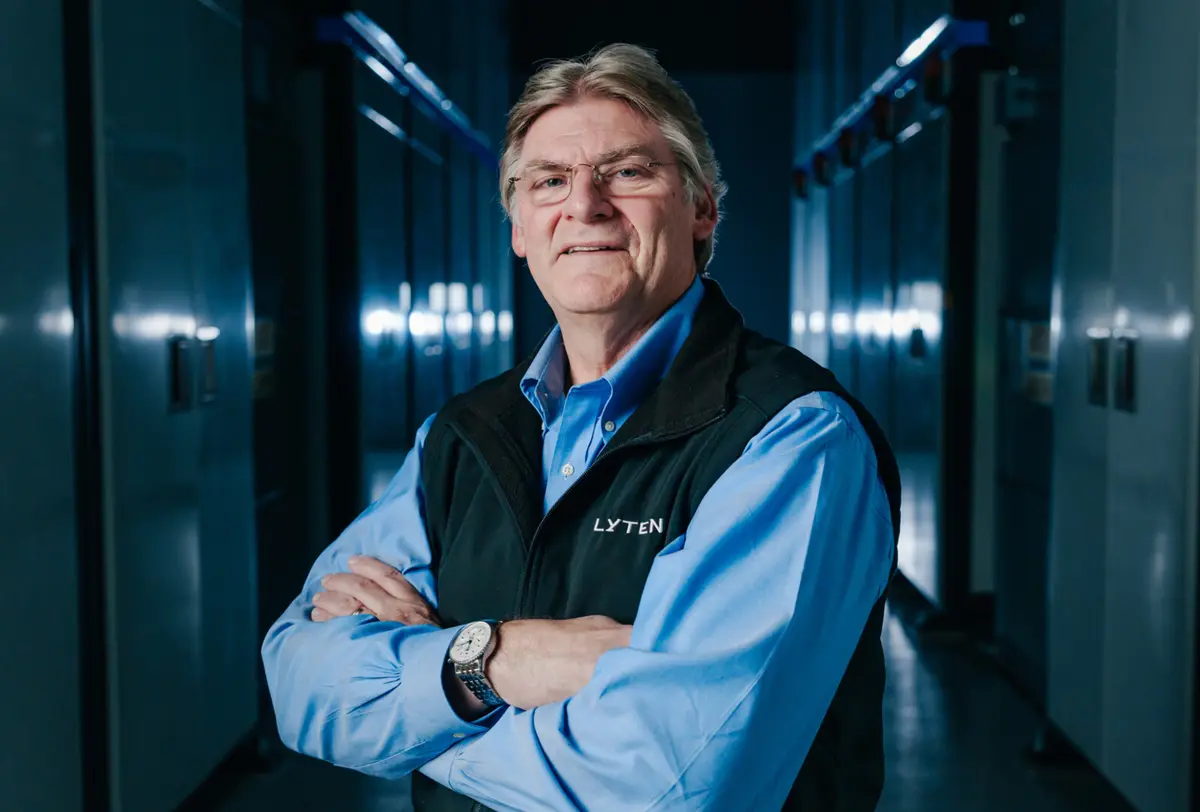
The discovery happened by accident. Dan Cook and his team at Lyten were not trying to build the world's most advanced battery. They were asking a different question entirely: what if you could heat methane and greenhouse gases and extract clean hydrogen without producing a single molecule of CO2? The answer, it turned out, was unexpected. When they ran the experiment, a strange carbon structure precipitated out - something nobody had seen before. A 3D arrangement of graphene. Infinitely tunable. Impossibly light. Stronger than steel. The hydrogen test had failed spectacularly. The supermaterial test had succeeded beyond anyone's imagination.
Cook's reaction to the discovery was shaped by three decades of manufacturing realism. He had worked assembly lines at General Motors, managed product operations under Steve Jobs at NeXT Computer, run M&A at Bay Networks and Nortel, founded a telecom startup, and spent nearly a decade restructuring companies from inside Cerberus Capital and Tenex Capital Management. He had acquired, integrated, and scaled more than 20 hardware and software startups. He knew exactly what it took to move something from a lab bench to a factory floor. And he knew, looking at that graphene structure, that this was worth betting on.
In 2015, Lyten Inc was officially founded. Cook became its CEO, co-founder, and investor. The company's operating principle was simple to state and brutally hard to execute: "For clean tech to deliver on its promise, it must have a pathway to deliver at a global scale." No moonshot without a manufacturing plan. No material without a market. No category without a customer.
"We did not set out to create 3D Graphene or a material at all. We set out to test, 'What if we could turn methane and other greenhouse gases into clean hydrogen without creating emissions?' Then something extraordinary happened."- Dan Cook, CEO of Lyten Inc
The Material That Changes Everything
Lyten's 3D Graphene supermaterial is not the two-dimensional graphene that has circulated in academic papers since 2004. That material - a single flat sheet of carbon atoms - is elegant in theory and nearly impossible to manufacture at scale. Lyten's version has three dimensions. It can be tuned at the atomic level for specific applications - dialed up for conductivity, adjusted for strength, engineered for permeability. Cook describes it as "infinitely tunable." His scientists describe it as something that falls outside every existing material category.
The material feeds three distinct product lines. First, and most lucrative: the battery business. Lyten's lithium-sulfur cells use 3D Graphene as a cathode scaffold, replacing the nickel, cobalt, and graphite that define conventional lithium-ion chemistry. The result is a battery that is roughly 40% lighter than its lithium-ion equivalent, with energy density approaching two times higher, and a supply chain that eliminates 85% of the mined minerals that currently create geopolitical chokepoints for the EV industry. Second: advanced composites for aerospace, defense, and now motorsports - ultra-lightweight components that outperform carbon fiber at competitive cost. Third: sensor materials, where 3D Graphene's unique electrical properties enable IoT and environmental monitoring applications across industrial verticals.
The Silicon Valley Years
Dan Cook's career is a study in operational range. He graduated from Vanderbilt with a BS in Mechanical Engineering, then completed an MS at Stanford specializing in digital controls and robotics. He spent his first six post-graduate years at General Motors in engineering and supply chain. Then Steve Jobs called - not personally, but through NeXT Computer, which was building a revolutionary workstation and needed serious operations talent. Cook spent five years there from 1988 to 1993, learning what it means to build hardware in a company led by a man who treats manufacturing as a design problem.
From NeXT, he moved through Radius Inc as VP and General Manager, then to Bay Networks and Nortel during the height of the networking boom, running operations and mergers and acquisitions during the years when Silicon Valley rewrote the rules of corporate scale. In 2002, he founded OperaNet Inc - his first turn as a CEO. When the telecom bubble burst, he pivoted into private equity, joining Cerberus Capital Management as an operating executive and later Tenex Capital as an operating partner. In those roles he applied the same discipline he had learned on factory floors to the messy work of buying, fixing, and scaling industrial and technology companies.
Shipping Atoms, Not Just Decks
The critical question for any advanced materials company is the same as it always is: can you actually make the thing? Cook has spent his career knowing the answer before anyone else does. In May 2024, Lyten shipped its first lithium-sulfur A-samples - production-intent cells in cylindrical and pouch formats - to customers in automotive, consumer electronics, and military sectors. Not prototype pouches from a lab. Real cells, built on the same automated manufacturing equipment used to make conventional lithium-ion around the world.
This was Cook's core thesis made physical. "Lyten now has demonstrated that lithium-sulfur batteries can be built in standard cylindrical and pouch formats, can be scaled to automated manufacturing, and can be done on the same equipment and processes already being used around the world to manufacture legacy lithium-ion." Translation: no alien factory required. The existing supply chain can be retooled. The transition cost is lower than everyone assumed.
"This material is what distinguishes us from others. Others do not have the ability to produce their own material at the atomic level."- Dan Cook on Lyten's competitive moat
The Northvolt Opportunity
In late 2024 and through 2025, Dan Cook made the most aggressive move of his career. When Northvolt - Europe's most celebrated battery startup, backed by billions in investor and government capital - collapsed into bankruptcy, Cook saw not a cautionary tale but a real estate transaction. The Swedish company had built world-class manufacturing infrastructure: gigafactories in Skelleftea, Sweden; labs in Vasteras; a battery energy storage facility in Gdansk, Poland. The assets were sitting at bankruptcy prices. The operational talent was still on site.
Cook acquired the Gdansk facility in October 2025. Then the entire Northvolt Sweden operation - factory, labs, expansion campus - in February 2026. In one move, Lyten went from a San Jose startup to one of Europe's largest battery manufacturing operations. Cook's diagnosis of Northvolt's failure was characteristically precise: "They tried to do a lot of different things at the same time, instead of focusing on a specific product and a specific customer." His prescription: ship a quality product to a specific customer. Many of the former customers will come back.
The transaction was made possible by $200 million raised in Lyten's latest funding round in July 2025, pushing the company's total capital raised above $1.2 billion. Investors in Lyten's cap table include Stellantis, FedEx, Honeywell, Prime Movers Lab, and the Luxembourg Future Fund 2. The U.S. Export Import Bank provided a $650 million line of intent in December 2024 - an implicit endorsement of Lyten's manufacturing credibility by the U.S. government.
Carbon That Stays Put
Buried beneath the battery story is a claim that few companies can make with a straight face: Lyten is permanently sequestering carbon at industrial scale, and getting paid for it. The 3D Graphene manufacturing process takes methane - a greenhouse gas - and locks its carbon atoms into a solid material that can be embedded in a battery, a composite part, or a sensor. The carbon does not re-enter the atmosphere. "At Lyten, we are removing carbon that could have entered the atmosphere as CO2, and instead we are permanently sequestering it in the form of a value-added material we call Lyten 3D Graphene, which is actually a foundational material technology that drives potentially large-scale decarbonization outcomes across countless industries."
This is carbon sequestration that generates revenue instead of requiring subsidies. The hydrogen byproduct of the Lyten process is commercially usable. The graphene is worth more per kilogram than the methane that went into it. It is, on its face, the kind of circular economy model that most clean tech only promises.
As of mid-2026, Lyten is building industrial hubs in Sweden and Poland designed to "combine advanced materials and battery energy storage systems with digital AI infrastructure." The battery-grade lithium-metal it now produces domestically in the United States means the entire lithium-sulfur supply chain - from raw material to finished cell - can be sourced and manufactured without touching the mineral extraction networks that create supply chain vulnerability for every lithium-ion manufacturer on earth. Dan Cook has been executing this plan for over a decade. The accident that started it all is now a $1.2 billion company with factories on two continents.