A kitchen’s water bill is an unlikely place to look for a chief executive’s philosophy. Yet when Chris O’Herlihy discussed ITW’s food-equipment business in May 2025, water and energy savings were among the opportunities he singled out. There is something pleasingly concrete about that. A customer can admire an invention and still ask what it will cost to run. In a working kitchen, the second question has a habit of outlasting the first.
O’Herlihy had good reason to know this territory. Years before becoming president and chief executive of Illinois Tool Works, he was responsible for its food-equipment operations around the world. His route to the top passed through businesses concerned with the decidedly physical problems of making things, keeping them working and helping customers get through the day.
He joined ITW in 1989. When he became CEO on January 1, 2024, he was the eighth person to hold the job in the company’s history. The interval between those dates is the heart of his story: a long preparation inside an organization whose operating habits he would eventually be asked to develop further.
A kitchen before the corner office
Food equipment can sound like a narrow assignment until one considers how many different businesses depend on it. The ITW group includes names such as Hobart, Traulsen, Baxter and Vulcan. The equipment has to earn its place in commercial operations where utility costs, productivity and reliability matter every day. A polished machine has limited charm if it is expensive to keep busy.
In 2013, while O’Herlihy was executive vice president of the worldwide food-equipment business, its North American companies received an ENERGY STAR Partner of the Year - Sustained Excellence award. They offered 512 qualifying units across the participating brands. The recognition belonged to the businesses and their teams; it also gives a useful picture of the work under his responsibility.
More than a decade later, his explanation of that business still turned on practical distinctions. In May 2025, he described roughly a third of it as service-related. He also pointed to institutional customers, which accounted for about 40 to 50 percent of the equipment business. Those details helped explain his confidence even as equipment sales were flat in the first quarter. He was looking at who bought, what they needed and what happened after delivery.
“In food there are some real tangible things to innovate around like energy and water savings, which really matter to our customers.”Chris O’Herlihy, May 2025
The years inside the machine
Before those operating responsibilities came two science degrees: a bachelor’s from University College Cork in Ireland and a master’s from the University of Massachusetts. They sit at the beginning of a career that would become international in scope. His later experience included overseeing operations in Europe, South America and Asia, bringing different markets within his working view.
At ITW, he served as a group president within Polymers & Fluids before moving to Food Equipment International in 2009. In 2010, he became group president of Food Equipment Worldwide and was elected executive vice president with worldwide responsibility for the segment. By then, he had spent 21 years at the company. Even the intermediate promotions had substantial careers behind them.
The sequence matters because a diversified manufacturer contains many versions of the same broad challenge. Customers need different things. Products face different demands. A leader moving between businesses has to learn which practices travel and which decisions require local knowledge. O’Herlihy’s appointments steadily enlarged the territory for which he was responsible, from a segment’s products to its international operations and then its worldwide business.
- 1989Joins ITW
- 2010Worldwide Food Equipment leadership
- 2015Becomes vice chairman
- 2024Becomes president & CEO
He became vice chairman in August 2015 and remained in that position through December 2023. It was an extended period alongside Scott Santi, the CEO he would succeed. By the time the handover was announced, the board was choosing someone who had helped carry out the strategy already in place. The next assignment would require him to bring fresh emphasis to work he knew closely.
The first day was a volunteer project
A smaller episode from 2014 adds another dimension to the progression of titles. O’Herlihy was executive sponsor of ITW’s Early in Career Program, an eight-month leadership experience for promising employees selected from its businesses. At the time, he described how the program began: company values, followed by a volunteer project.
The detail is modest enough to be revealing. An executive-development program can easily become an extended exchange of slides. Here, the opening also gave participants a shared task outside their usual work. The company was asking future leaders to encounter its values through an activity, as well as hear them discussed.
That has particular relevance in a decentralized organization. ITW gives its business teams room to make decisions for their own customers and markets. Much depends on the judgment of people beyond headquarters. A leadership program is therefore connected to the operating system: the company needs people who can exercise authority within a common set of expectations. O’Herlihy was involved in that work well before the CEO role became his.
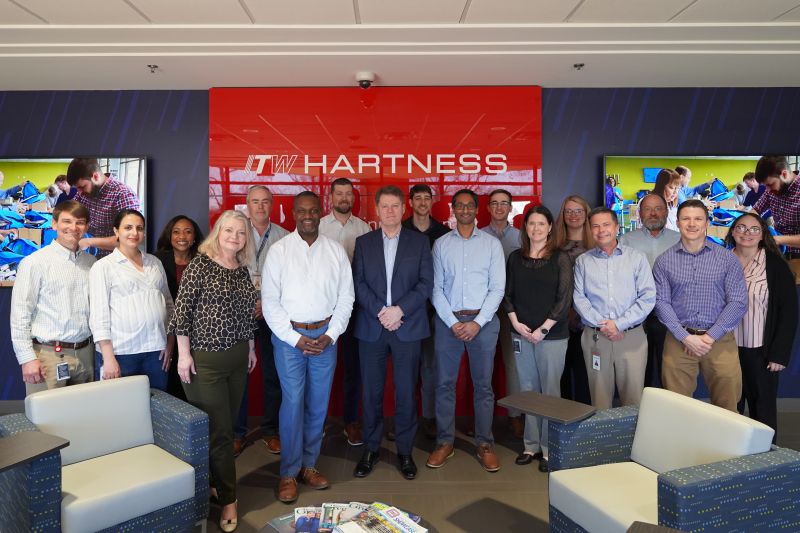
Later, as CEO, he visited ITW Hartness with executive vice president Kenneth Escoe and innovation director Danny Leitao. The division described discussions about innovation and leadership and shared a group photograph. Another visit, to ITW Construction Products Italy with Katie Lawler and Ken Dobson, included discussion of the division’s innovation framework. These are small windows into the job: colleagues, local businesses and the work of turning enterprise priorities into decisions.
A successor with unfinished work
The succession was announced in September 2023, with O’Herlihy due to take over at the start of the following year. Santi would remain on the board, becoming non-executive chairman in March 2024. The arrangement kept the chief executive and chair roles separate. O’Herlihy also joined ITW’s board when he became CEO; he serves on Masco’s board as well.
At ITW, the appointment followed a multiyear succession-planning process. It came with a defined strategic assignment. The company had spent years pursuing an enterprise strategy that began in 2012. Operational efficiency and financial performance were established priorities. The next phase called for a greater emphasis on organic growth and Customer-Back Innovation.
For a long-serving insider, this is an interesting kind of inheritance. O’Herlihy had participated in the work that brought the company to this point. Now he had to help move its attention toward the next demand. Familiarity offers an understanding of how decisions get made; progress still requires people to change what they spend time doing.
The business model ties these responsibilities together. ITW’s 80/20 process directs attention toward its most valuable opportunities and away from unnecessary cost and complexity. Customer-Back Innovation brings customer problems into product development. Decentralization gives teams flexibility in applying the framework. The vocabulary is corporate; the underlying questions are familiar. What deserves attention? What needs fixing? Who is close enough to decide?
Invention has to pay its way
The tension in O’Herlihy’s assignment is productive. Simplification asks a company to be selective. Innovation asks it to try something new. Both consume leadership attention, and neither succeeds simply because it appears in a strategy presentation. The company’s 2026 proxy describes an ambition to mobilize the organization around Customer-Back Innovation with the intensity previously applied to its 80/20 capabilities.
His earlier comments about kitchen equipment give that ambition a recognizable shape. A customer who can save water or energy has a reason to consider a different product. Service can keep the relationship going after the sale. An institutional customer may have different spending patterns from a restaurant chain. Understanding those distinctions is part of finding opportunities that an engineering team can address.
The same general approach must work across a portfolio spanning automotive components, welding, construction products, testing equipment and other industrial businesses. Each division has to find its own useful problems. O’Herlihy’s central challenge is to make that activity more consistent while preserving the local judgment on which the decentralized model depends. An invention needs a customer. A large company needs a way to keep finding both.
The next chapter has a date on it
On July 28, 2026, ITW reported second-quarter revenue of $4.30 billion, up 6.1 percent, with organic revenue growth of 4.5 percent. Operating margin was 26.7 percent. O’Herlihy highlighted stronger activity in capital-equipment-related segments, including Welding and Test & Measurement and Electronics, and the company raised its full-year guidance.
Those are company results, produced across its businesses. They provide a dated view of the organization under his leadership, with the longer task still unfolding. The 2030 goals remain ahead. New products must continue to find buyers, and divisions must keep translating customer needs into work worth doing.
O’Herlihy’s career makes the ordinary details worth watching: an equipment customer’s running costs, a program for future leaders, a discussion during a division visit. The apprenticeship was long. The job now is to help other people make sound decisions at scale, including decisions about ideas that have yet to earn their place. Somewhere in that process, a customer will ask about the water bill.