A bearing earns its living by helping something else move. It is an agreeable occupation for a component: essential to the proceedings, usually spared the speeches. Brian Parsons has built a career in the business behind those components, arriving at the leadership of NSK Americas by way of finance. His route offers a useful view of industrial management from the inside, where an impressive product still needs a workable supply chain, a customer and someone who understands the numbers.
Parsons is based in Ann Arbor, Michigan, and is president and CEO of NSK Americas. The regional title matters. NSK Ltd., the Japanese parent company, has its own president and CEO, Akitoshi Ichii. Parsons’s responsibilities belong to the Americas business, with its connections to the larger group. In April 2026, the Motion + Power Manufacturers Alliance also named him an at-large officer on its executive committee for 2026-2027. His work extends beyond a single company’s meeting rooms.
The career’s central turn came in April 2020, when NSK appointed him vice president and head of all Americas operations. He had joined NSK Americas in August 2009 and become CFO in April 2011. That sequence gives the promotion its character. He reached regional leadership after almost eleven years within the business, including nine as its finance chief. The person taking the broader job had already spent considerable time examining how the enterprise fitted together.
It is tempting to treat a finance background as a personality description: cautious, numerical, fond of saying no. That would be a poor substitute for looking at what Parsons actually chose to discuss when he took charge. People came first. He identified talent development as his leading priority, and linked that choice to opportunities and management support he had received during his own career. The balance sheet had brought him to a job in which other people’s development would occupy the foreground.
- 2009Joins NSK Americas
August - 2011Appointed CFO
April - 2020Heads Americas operations
April
Southampton, then the commercial education
His education includes the University of Southampton, where his LinkedIn profile lists attendance from 1988 to 1991. The same profile records his management-accounting qualifications: ACMA in September 1994 and FCMA in January 2015, both through the Chartered Institute of Management Accountants. These are useful anchors in a career that crossed several kinds of business before the Americas leadership role. The qualifications sit alongside experience in commercial decision-making rather than standing in for it.
Before NSK, Parsons worked in finance at Alcatel-Lucent UK and TI Automotive. His TI roles included commercial and purchasing finance, European pumps and modules, and global fuel systems. The changing remit is significant: finance accompanied buying decisions, manufacturing operations and an international product business. A purchasing decision has a price, but it also has a supplier, a delivery schedule and consequences for production. Those relationships help explain why a finance career can become preparation for an operating role.
A former colleague, Malcolm Higham, recalled working with Parsons at Alcatel around the dotcom boom. His recommendation praised Parsons’s “technical experience and common sense” and his ability to weigh a transaction’s detail against its strategic purpose. That is one colleague’s assessment, rather than a verdict on an entire career, but it provides a concrete glimpse of how Parsons was experienced at work. Amid entrepreneurial proposals, the useful skill was commercial judgment. Enthusiasm still had to survive examination.
The published NSK chronology makes an important distinction within the next chapter. Joining the company in 2009 and becoming CFO in 2011 were separate steps. His later move to regional leadership followed a substantial apprenticeship in the organization’s financial life. Read together, these dates show a progression through increasing responsibility, with the Americas business becoming familiar long before he was asked to lead it. There is no need to supply a dramatic conversion scene. The chronology supplies the movement.
A continent will not fit in a spreadsheet
NSK’s Americas operations had a history well before Parsons arrived. A US sales base opened in 1962. Bearing production followed in Brazil and the United States during the 1970s. A US technical center was established in 1988, and production of automatic-transmission components began at a new Mexican plant in 2017. This was a regional business with factories, technical capabilities and relationships accumulated over decades. Taking responsibility for it meant inheriting several different local histories at once.
In his 2020 account of the job, Parsons described an executive leadership team with representatives from the United States, Brazil, Mexico and Canada. He emphasized local management and exchanges between countries. His stated aim combined knowledge of customers, local cultures and the company itself. That combination has practical weight. A regional organization needs people who can understand a customer nearby while also explaining that customer’s requirements to colleagues working elsewhere in the group.
The geography also shaped his thinking about supply. He connected lengthy international supply chains with complexity and working capital, and argued for stronger local capability and flexibility. For a former CFO, this joins two views of the same material: a component moving through a supply chain and money committed before that component reaches its purpose. Distance has financial consequences as well as physical ones. A cheaper purchase price can be only the opening line of the calculation.
Parsons also wanted information to travel well. He described the Americas operation communicating technical trends to business headquarters in Tokyo and working with manufacturing sites, suppliers and research centers across the group. The ambition was a useful regional voice within a global organization. Customers could bring new requirements in one market; the response could involve colleagues in several others. His account placed the regional leader at that junction, responsible for making local knowledge useful at a greater distance.
Giving the next person room
Parsons’s attention to talent had a specific form. He participated in executive question-and-answer sessions for the Americas Regional College and the NSK Americas Women’s Development Program. He described those encounters as opportunities to share experience and hear what future leaders were finding difficult. The exchange matters. A development program offers something different when senior managers listen to questions as well as deliver their prepared views. The executive gets information; participants get access to the person making decisions.
His own explanation was rooted in reciprocity. Managers had given him support as he took on unfamiliar responsibilities, and he wanted that experience to inform how others developed. He put the operational principle plainly: “Having talented people in the correct roles”. The wording is unornamented. It concerns assignment as much as ability. Hiring capable people is one task; putting them somewhere their judgment can be used is another. His account treated both as part of management.
The approach leaves a useful question hanging over his career: what does a former specialist owe the next specialist who wants to grow? Parsons’s answer, in the programs he described, involved access to experience and a chance to ask questions. His own move from finance to regional leadership illustrates why those opportunities can matter. A person’s existing function may be a starting point for broader responsibility. Whether that happens depends partly on the assignments and support available around them.
“Having talented people in the correct roles”
Brian Parsons · 2020
In a room with the competition
A photograph from the March 14-16, 2024 ABMA and AGMA meetings in Napa Valley places Parsons among executives from across the bearing industry. He stands in the back row, fourth from the left, alongside representatives of businesses including Schaeffler, Nachi, JTEKT and NTN. It is a group picture rather than a solitary executive portrait, which makes it useful here. The industry contains competitors who also have reasons to gather around shared technical, educational and organizational concerns.
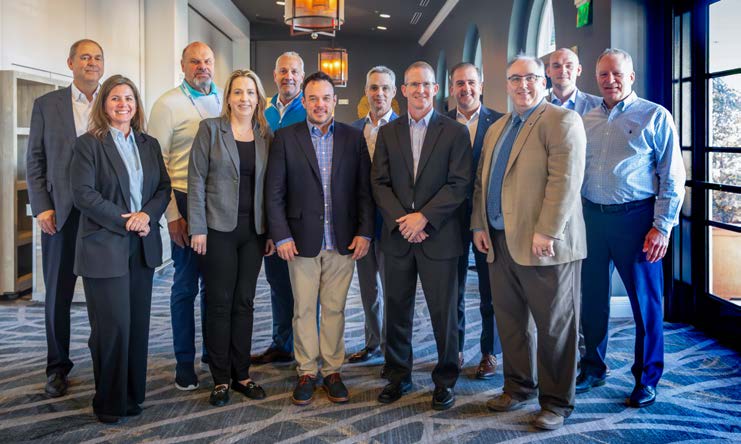
The 2026 executive committee role gives that photograph a later chapter. The Motion + Power Manufacturers Alliance brings together the former American Gear Manufacturers Association and American Bearing Manufacturers Association. Parsons serves alongside leaders with responsibilities spanning business, technical work and association governance. The appointment places him within an industry institution concerned with the manufacture and application of power-transmission components. It is a different setting for the same work of connecting organizations and people.
There is a boundary to collaboration, and the ethics policy signed by Parsons as NSK Americas CEO addresses it directly. It supports fair competition and says loyalty to the company must remain within ethical and legal limits. Its closing invitation is restrained: “Together, we can help NSK be a positive example for all to follow.” This is a statement of expected conduct, rather than proof of an outcome. It nevertheless belongs in the portrait of the responsibilities he publicly accepts. Read alongside his finance career, the statement draws attention to the conditions under which commercial judgment operates. Customers, suppliers and competitors all appear in a regional executive’s working world. A policy on competition sets expectations for those relationships, including occasions when the desire to win might make restraint inconvenient.
The thread through Parsons’s career is the widening field of view: from a transaction to an operation, from finance to regional leadership, from one company to an industry committee. The numbers remain part of the picture, joined by questions about where materials come from, who understands the customer and who should receive the next opportunity. Bearings spend their working lives inside larger assemblies. Parsons’s account of leadership pays similar attention to how the parts fit, and to the people expected to keep them moving.