A long career inside a company usually teaches a person how to defend it. Vimal Kapur's taught him where to draw the dividing lines. After joining a Honeywell joint venture in India in 1989, he worked through businesses that controlled industrial processes, managed buildings and developed materials technologies. In June 2023, he became chief executive. The institution he had spent decades learning would soon undergo a separation on his watch.
There is a pleasing awkwardness to that sequence. An outsider arriving with a restructuring plan is a familiar corporate character. An insider who has occupied so many rooms deciding that the house needs dividing is more interesting. Kapur's career makes the decision worth examining: he knew the operating businesses before he had authority over the whole collection.
By June 29, 2026, the aerospace spin-off was complete. Solstice Advanced Materials had already become independent the previous October. Kapur remained chairman and chief executive of Honeywell Technologies, the automation company. Three businesses now had separate public identities, separate priorities and separate opportunities to prove the logic of the change. The paperwork could establish independence. The following years would have to establish its value.
An engineer finds his speed
Kapur graduated from the Thapar Institute of Engineering in Patiala in 1986. His training was electronics engineering, with a specialization in instrumentation. It is an education concerned with measurement and control: understanding what a system is doing, then helping it behave as intended. Years later, those questions would provide a useful way into his explanations of industrial AI.
His first experience of working life offered a less satisfactory match of temperament and pace. Recalling the limited job opportunities in India in the mid-1980s, he described an early employer whose speed frustrated him. Honeywell, which he joined in 1989, suited him better. He called his own style intense, with an inclination to “go, go, go.” A technology business with urgency gave that energy somewhere to go.
His account of those early years includes an acknowledgment that rarely survives the polished executive biography: challenging assignments helped because leaders and mentors supported him through them. The assignment alone was only part of the education. Someone also had to make the stretch possible.
That is a more useful career anecdote than a tale of inevitable ascent. A young engineer found an organization whose tempo fit his own, then kept accepting work that required him to learn. There was no chief executive's chair waiting at the end of an instrumentation syllabus.
“go, go, go.”Vimal Kapur, on his own working style
Thirty-four years of preparation
By 2006, Kapur was managing director of Honeywell Automation India. Global responsibilities followed. He became president of Honeywell Process Solutions in 2014, then led Building Technologies from 2018 to 2021. Performance Materials and Technologies came next, followed by the presidency and chief operating officer role in July 2022. The CEO appointment took effect on June 1, 2023.
Read quickly, the sequence resembles the usual collection of impressive business cards. Read more slowly, it is a succession of different operating problems. Process Solutions had to contend with an oil-and-gas downturn. Buildings involved another set of customers and economics. Materials and process technologies brought another kind of technical knowledge into view. He reached headquarters carrying experience of several businesses that headquarters was expected to understand.
The geographic changes mattered too. In an August 2026 conversation, Kapur described spending roughly twenty years in India, four in Britain and then moving to the United States. Leaving India with his family in his forties was, he said, a difficult decision. He connected that personal experience with learning to make difficult professional choices. He also described himself as a U.S. citizen.
His career advice gives breadth a place alongside depth. The larger point is visible in the route itself. Staying at one employer can contain several careers, especially when the work, country and customer change. Institutional longevity need not mean standing in the same place.
The arithmetic of three
Honeywell announced its intention to separate automation and aerospace on February 6, 2025. The materials separation had been announced earlier. The plan placed Kapur at the center of a question facing a familiar industrial company: which activities still belonged together, and which would have more room with their own management and capital priorities?
There was shareholder pressure. Elliott Investment Management had disclosed a stake of more than $5 billion and pushed for a separation. Honeywell's board had also been examining strategic options during 2024. Both facts belong in the story. Corporate changes of this scale rarely arrive with a single author or a single cause, however convenient that might be for a headline.
On October 30, 2025, Solstice Advanced Materials began independent life. The aerospace separation followed on June 29, 2026. Honeywell Technologies retained the HON ticker; Honeywell Aerospace began trading as HONA. The familiar Honeywell name now attached to two distinct public companies, while Solstice carried the specialty-materials business into a different identity.
A smaller collection of activities still presents a substantial management task. Building, process and industrial automation span customers with different equipment, constraints and investment cycles. The argument for the new arrangement is that those differences can sit inside a more coherent purpose. Independence gives each company greater freedom to allocate resources. It also gives investors a clearer view of who is responsible for the decisions.
A founder’s question, inside an old company
In October 2026, Kapur discussed the change with Penny Pritzker and Andrew Edgecliffe-Johnson. His formulation was that “the CEO should have a founder's mindset.” For someone whose defining qualification is a long apprenticeship inside a large company, that is a revealing aspiration. He wants the curiosity and product attention associated with building a business to survive the routines of managing one.
He described the continuing challenge as preserving the benefits of scale while gaining focus. He also emphasized customer contact, aiming to spend roughly a third of his time with customers. Those conversations are a way to test a strategy against something less accommodating than an internal presentation: another person's operating problem.
The phrase earns its keep only when it changes a decision. A founder's mindset could mean questioning a product, looking again at where the company competes or asking whether an established process deserves to continue. In Kapur's case, the separation supplies a concrete example of his willingness to reconsider an inherited arrangement. The harder, less photogenic work is to keep that willingness alive once the new arrangement becomes familiar.
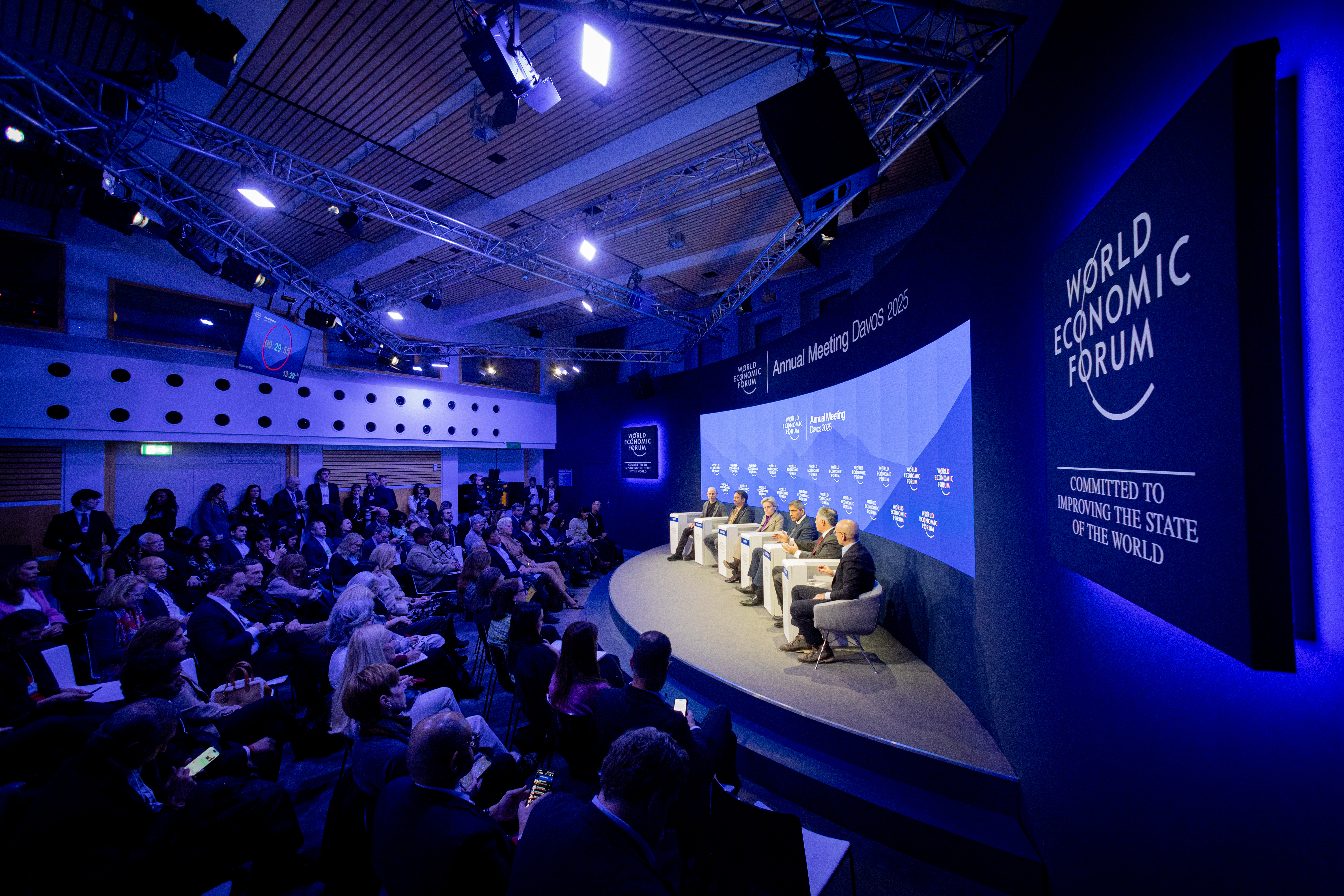
Photo: World Economic Forum / Benedikt von Loebell · CC BY-NC-SA 2.0.
AI earns its place on the factory floor
Kapur's public writing on AI is full of physical settings. He asks readers to picture a worker getting guidance through a complicated repair, stores adjusting energy use across a network, or a refinery drawing on industry-specific applications to improve operations. These are proposals for how tools might be used, rather than claims that every outcome has already been delivered.
The emphasis suits his engineering background. A useful system has to connect information to an action someone needs to take. In an industrial setting, the relevant question can be as prosaic as which alarm deserves attention first. Prosaic questions become expensive when equipment runs continuously and skilled people are difficult to replace.
In a September 2025 letter, he described a field trial of autonomous control-room operations at an integrated ethylene plant. Honeywell reported monitoring more than 2,000 sensors and handling more than 100 abnormal situations per unit. Those figures describe a company-reported example, with a particular customer and setting. They give his ambitions some operational texture without establishing a universal result.
He has also stressed that industrial autonomy can leave final judgment with people. In his 2025 Davos reflections, he described systems that give workers guidance and help them undertake higher-value tasks. The prospect is more capable operators, supported by information they can use. Anyone who has been given another dashboard when they needed an answer may appreciate the distinction.
The clock gets a vote
For all the scale of his corporate decisions, Kapur's description of his working day is strikingly ordinary. He tries to arrive two or three minutes before meetings, reviews his calendar every ninety days and tracks how his time is allocated. He has said he packs his bag and leaves the office at six. An executive calendar, apparently, is allowed a closing time.
He treats punctuality as a management signal. A leader who cannot organize a meeting invites questions about how the larger organization is being organized. The principle is small enough to sound obvious and inconvenient enough to be neglected. It also fits his broader preference for asking what work actually adds value, a concern sharpened by decades spent receiving instructions from headquarters.
There is another glimpse of his interests in his reading list: The Prize, Chip War and Winning Now, Winning Later. Energy, semiconductors and the tension between present performance and future investment make fitting company for an industrial executive. Books offer a quieter portrait than a conference stage. Here is someone reading about the systems, resources and choices that sit behind corporate results.
What remains to be built
The July 2026 results supplied an early view of the automation company following the separation. Excluding Aerospace Technologies, Honeywell Technologies reported quarterly sales of $5.2 billion and organic sales growth of 4 percent. Those numbers describe a specific reporting period and business perimeter. They are an early checkpoint, with much of the strategy's eventual outcome still ahead.
Kapur's ambition has a longer horizon. When he became CEO, he said he wanted Honeywell to be known for sustainability and digitization fifteen years into the future. The organization pursuing that ambition has since changed substantially. Its products still have to work in the unglamorous places where energy is consumed, processes are controlled and maintenance decisions accumulate.
That continuity gives his story its shape. The instrumentation graduate learned to measure and control systems. The operating executive learned how different businesses behaved. The chief executive helped change which businesses shared a corporate home. Now he has to make the focused company productive enough to justify the exercise. Taking things apart was the decision everyone could see. What he builds from here will give it meaning.
Honeywell Technologies sales excluding Aerospace Technologies. Organic sales grew 4% in the same reporting period.
Follow the next chapter
- Honeywell · Vimal Kapur’s official biography ↗
- Vimal Kapur on LinkedIn ↗
- Watch · Kapur in conversation with John Waldron ↗
- Listen & read · The Long View with Eric Veiel ↗
- Watch · The founder’s mindset, CEO Signal ↗
- Read · Honeywell’s completed aerospace separation ↗
- Read · Kapur’s automation letter ↗
- Explore · Interviews and reading list ↗
Profile updated October 21, 2026.