Rob Goldiez was on a Caribbean cruise with his family when a factory problem interrupted his holiday. It was the summer of 2015. He woke in the middle of the night and began making notes. Uber and Airbnb had made access to expensive assets feel ordinary. Cloud connections were becoming routine. Meanwhile, a manufacturer could still buy a robot and discover that its first assignment was to create several more problems.
What should go on the end of the arm? Who would teach it a task? Who would answer when it stopped? Goldiez had been running a manufacturing business. These were familiar questions, and buying the equipment answered remarkably few of them. His idea was to make the transaction resemble something a factory already understood: hiring someone to do a job.
A decade later, his company would be selling welding systems operated through an app. The original rental model had evolved, but the persistent question was recognisable. How much machinery, software and specialist knowledge should a customer have to wrestle with before useful work begins?
The education of a factory customer
Goldiez came to robotics by way of electrical engineering, IBM and manufacturing management. An Orlando native, he studied electrical engineering at the University of Florida and earned an MBA at Duke’s Fuqua School of Business. His career included investment banking at Edgeview Partners and roles at Gencor and Permco. By the time he started Hirebotics, he had seen businesses from the engineering desk, the financial side and the factory floor.
That route matters. Industrial automation is easy to admire from a demonstration booth. A general manager has to fit it into a budget, a production schedule and a workforce that already has plenty to do. Goldiez’s later emphasis on ease of use makes more sense when you remember that he had occupied the customer’s chair.
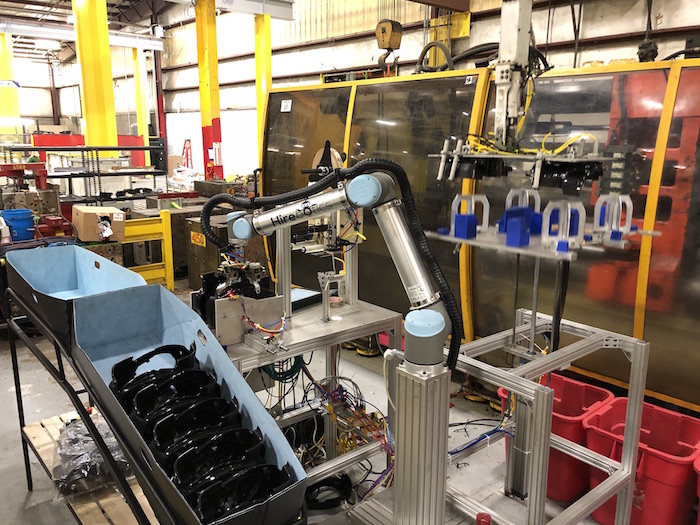
At Scott Fetzer Electrical Group in Tennessee, a Berkshire Hathaway business, he was general manager and Matthew Bush was director of operations. During 2014 and 2015, they helped deploy 14 Universal Robots arms. Their products included electric motors and neon power supplies. Competition from China made productivity a daily concern.
The applications were workaday: moving material, handling repetitive steps, clipping wires. There is little glamour in a wire that has been clipped correctly. There is considerable value in having it happen reliably, while an employee handles work requiring judgement or dexterity. Goldiez and Bush had a chance to see that distinction in practice before turning it into a business.
A time card for a robot
Hirebotics launched in December 2015. Goldiez and Bush began with their own money, buying the robots they would put to work for customers. Their early base was a garage. The modest setting concealed an awkward financial commitment: somebody still had to own the machines, even if the customer no longer did.
The company took responsibility for installation, teaching the task, tooling and support. Cloud monitoring supplied the usage data for billing. Customers could inspect production through a mobile app. In the early offering, the agreement resembled an employment contract, with a minimum of 80 hours a week. A manufacturer could try automation without first assembling an automation department.
There was a useful discipline hidden inside the arrangement. Hirebotics earned money when a robot produced. A machine standing idle was the supplier’s problem too. The incentive was easier to explain than most industrial finance: useful work generated a bill.
“We charge by the hour, we bill by the second.”
Rob Goldiez, describing the early rental model
The language was deliberately familiar. A robot had hours. It had a job. The customer could give it a name. Goldiez encouraged that last detail because employees had to live with the purchase after management finished discussing it. Introducing a mechanical colleague with a name was one way to make an unfamiliar piece of equipment less forbidding.
He also described an intriguing change in the conversations around installations. Initial concern about jobs could give way to requests for help with another repetitive task. That observation belongs to his experience with customers; it is no universal promise about employment. It does show the adoption problem he was trying to solve. People needed a reason to welcome the thing.
When the customer is also the investment thesis
In 2017, a Washington Post story followed an installation at a customer’s factory in Wisconsin. The attention helped introduce Hirebotics to a much wider audience. Mark Cuban contacted the company after the story appeared and joined its $2.4 million funding round.
The celebrity investor makes an easy headline. The less decorative detail is what the money followed: a business already installing equipment in working factories. Goldiez and Bush had spent the early period doing the deployments themselves. They now had to teach other employees how to repeat the work. Scaling meant transferring practical knowledge as well as purchasing more arms.
By August 2018, Hirebotics had seven full-time employees, most working virtually. Goldiez was based in the Nashville area. Geography had a practical appeal: the city offered access to manufacturers across the Southeast and Midwest. For a company whose product had to arrive at a real production line, a central location meant something more tangible than a fashionable mailing address.
The connection with Cuban continued beyond the funding announcement. In November 2020, Goldiez was scheduled alongside him and OnRobot chief executive Enrico Krog Iversen for an Association for Advancing Automation panel about manufacturing. The conversation had moved from a garage operation to an industry stage, with the same question underneath it: how could more factories actually use this equipment?
The screen mattered as much as the arm
Goldiez’s public writing offers another view of the founder. In February 2016, he published a Medium post about learning React Native and shipping an app in fewer than 90 days. In July, he wrote about a Salesforce IoT Cloud hackathon. Those subjects sit rather neatly beside his electrical engineering background. The robot business also required someone to care about what happened on a phone.
At IMTS in 2016, he demonstrated Hirebotics’ cloud app for monitoring and controlling robots. By 2020, his writing on Beacon described remote access to robot information, cloud backups and file versions. The useful details were decidedly uncinematic: checking status, seeing messages, recovering a file. A factory manager looking for a missing backup is unlikely to complain about the absence of theatre.
The company’s own design process used cloud tools too. Goldiez and Bush appeared in the National Association of Manufacturers’ Makers Series to discuss using PTC Onshape with their design teams. The connection is telling. They were asking manufacturing customers to work with connected equipment while using connected design software within their own operation.
Give the welder the controls
The move into welding gave the company a more specific user to design for. Its BotX Welder was already part of Goldiez’s public discussion by 2020. The Beacon-powered Cobot Welder followed in 2021. The focus became teaching welding tasks through a familiar app rather than requiring the operator to master a specialist robot interface.
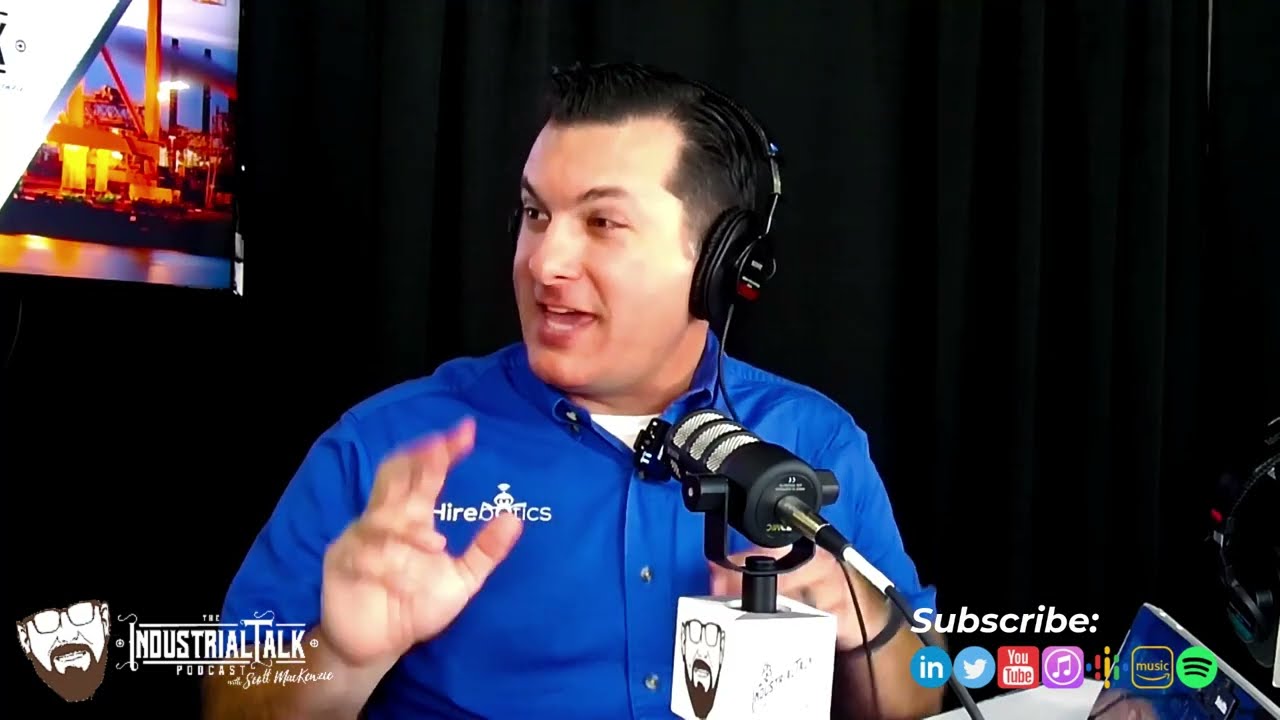
At FABTECH in Atlanta, Industrial Talk host Scott MacKenzie tried the system and arrived at his interview with Goldiez pleased with his new competence. Goldiez used the demonstration to explain the product’s intended audience. The joke worked because the design challenge was serious. A welding shop buying help with production could hardly welcome a second recruitment problem: finding someone to program the help.
 ▶ Watch the conversation
His design brief was plain: “we focus on the welder, not the robot programmer.”
Goldiez also wrote about the subject for the American Welding Society, discussing customers such as Advanta Southeast and IMS. His examples dealt with throughput, repetitive work and the range of jobs shops could accept. The writing stayed close to the commercial consequences of a machine on the floor. Welding quality and the person responsible for it remained part of the conversation.
An exit in February
On February 20, 2026, Matthew Bush became Hirebotics’ chief executive. The company announced the change on March 3: Goldiez was retiring after more than a decade of leadership. Bush had overseen electromechanical development, manufacturing operations and customer success. The handover went to the co-founder who had shared the factory experience that preceded the business.
During Goldiez’s tenure, Hirebotics had moved from general robot rentals toward fabrication systems, launched Cobot Welder and received Universal Robots’ Global OEM of the Year recognition multiple times. His departure left a company with a more focused product than the one he first imagined on holiday. The route from idea to product had required narrowing the question.
That is what makes his story interesting. A factory operator noticed the distance between buying automation and getting work done, then spent years trying to shorten it. The rental contract addressed the money. The app addressed the controls. Designing around a welder addressed the person who would have to use both. The robot still needed teaching. Goldiez wanted its arrival to require rather less explanation.
Keep the conversation going
Interviews, writing and the company he co-founded.