When Aamir Paul said goodbye to Schneider Electric, he reached for a unit of measurement that rarely appears in a corporate farewell: weeks. He reckoned a career at roughly 2,000 to 2,500 of them. He had invested about 700 at Schneider. There was something disarming about the arithmetic. A working life, presented that way, looks less like a ladder stretching into the clouds and more like a calendar with a definite last page.
“Time is our most important investment,” he wrote. His farewell dwelt on colleagues, customers, shared work, and gratitude. The measure he chose invites a fairly awkward question for anyone with a full diary: what, exactly, are all these meetings adding up to?
On July 1, 2026, Paul became Regal Rexnord’s sixth chief executive. The Milwaukee manufacturer makes the components that power, transmit, and control motion. Its products belong to the physical economy of motors and machinery, a place where a clever idea eventually has to make something move. For Paul, the appointment connects several occupations that might once have looked like separate careers.
A commuter, a chemical engineer, a Nissan Sentra
His route began well before the executive committee. An immigrant from Pakistan, Paul entered Northwestern in 1995 while living on Chicago’s North Side. He commuted to campus. Chemical engineering challenged him, and the university encouraged the curiosity that made those challenges useful. Its cooperative education program, alternating coursework with paid work, helped him test where he belonged.
He graduated in 2000, loaded his Nissan Sentra, and drove to Austin to join Dell. By 30, he was in London, responsible for a $1 billion sales business and a team of 300 serving smaller companies in Britain and Ireland. The student who had traveled to Evanston for an engineering education was now learning how businesses buy technology.
The unglamorous detail is the car. Business biographies tend to travel by appointment: promoted here, appointed there. A packed Sentra restores some human scale. There was a graduate, a destination, and a job worth driving toward. The rest still had to be worked out.
The server room had another door
Paul’s early experience also included process engineering at AlliedSignal, now part of Honeywell. At Dell, his responsibilities eventually extended to global server solutions, data center solutions, and high-performance computing. He had worked on both sides of a familiar industrial division: making a process function and persuading a customer that a technical system would do something useful.
That combination helps explain the continuity beneath his changes of employer. A server is sold for its capabilities; its usefulness depends on the infrastructure around it. Computing requires power. Power has to be managed. Equipment has to operate reliably. The connections become especially conspicuous when one part is missing.
In 2013, Paul returned to the Chicago area and joined Schneider Electric. He subsequently led its US commercial business and, in 2022, took charge of North America and joined the global executive committee. Canada, Mexico, Central America, and the United States were within his remit. The territory was wide; the recurring problem was practical: helping customers use energy and automation effectively.
- 2000 / DELLComputing and commercial leadership
- 2013 / SCHNEIDER ELECTRICEnergy management and automation
- 2026 / REGAL REXNORDThe components behind motion
The customer as an early warning system
Listen to Paul discussing sales and the conversation soon moves away from closing a transaction. At a 2019 executive forum, he argued that commercial leaders have to carry the customer’s changing requirements back into their own organizations. A business can become so absorbed in its acquisitions and marketing plans that it misses the reason someone wanted its products in the first place.
The warning is appealingly inconvenient. A healthy quarterly number can coexist with a customer beginning to look elsewhere. By the time a failed assumption reaches the accounts, a company may have spent months polishing the wrong answer.
He offered a concrete example of adapting the organization: experienced engineers approaching retirement could work remotely as advisers to newer hires. Schneider called the arrangement expert access. The younger employees brought software knowledge; the veterans supplied familiarity with installed infrastructure. A telephone conversation could connect things an organizational chart had kept apart.
There is a modest wit in that solution. Faced with a knowledge problem, a technology company found a use for asking somebody who already knew. It also gives substance to Paul’s public emphasis on teams and learning. Experience becomes more valuable when another person can reach it.
“Revenue leaders have to be the representative of the customer back to the organization.”Aamir Paul / 2019
Electricity enters the conversation
In a 2023 discussion about energy infrastructure, Paul compared changes in electricity to changes in computing. Computing had moved from centralized systems to distributed personal computers and back toward the cloud. Energy, he suggested, was also changing its architecture, with more decentralized sources working alongside the existing grid. His previous career supplied a vocabulary for understanding his new one.
In a separate interview that year, he discussed what increasing electrification meant for manufacturers and the role of microgrids. The interesting part of these conversations is the attention to arrangements: where energy comes from, how it is controlled, and how a customer makes the economics work. A transition becomes tangible when somebody has to order equipment for it.
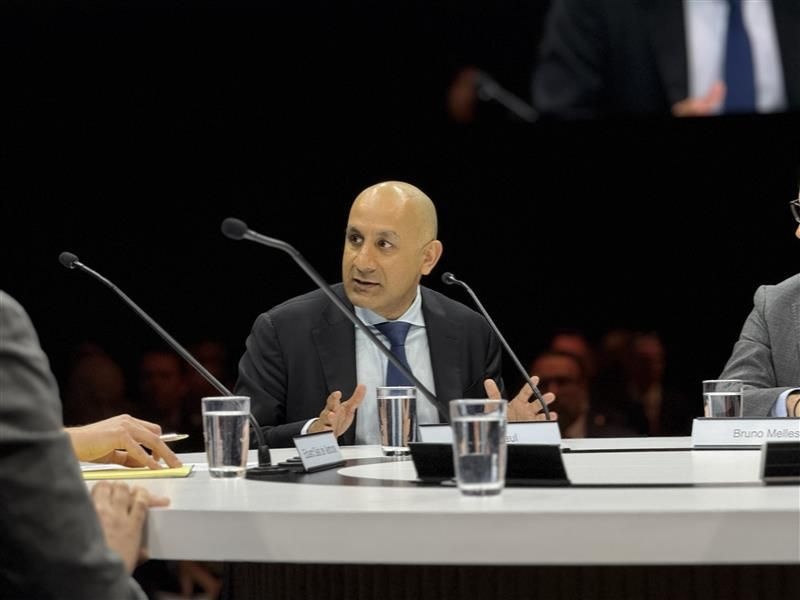
By CERAWeek 2026 in Houston, his questions were pointed. How could grid connections move faster? How should utilities and large electricity users plan together? How could the electrician workforce grow to meet demand? He also raised the role of public and private investment. An AI discussion, followed far enough, had arrived at the people and systems needed to supply its electricity.
This is where Paul’s experience becomes particularly relevant. His career has crossed the businesses that want more computing and the businesses supplying the conditions for it. The subjects can share a conference stage. Making their schedules agree is a rather more demanding exercise.
A factory needs more than a software update
Paul has made a parallel argument about automation. In an industry interview, he stressed experimentation, digital infrastructure, staff training, cybersecurity, and partnerships. He pointed to Schneider’s Lexington, Kentucky, facility as an example of an older manufacturing site being transformed. The emphasis was on making changes inside an existing operation, with its accumulated habits and constraints.
At Automate 2025, Schneider demonstrated software-defined automation, industrial AI tools, and motor-control equipment. Paul’s accompanying message concerned the possibilities created by AI, robotics, and software. The assortment itself was revealing: software and physical switching equipment occupied the same industrial conversation. A factory requires both the instructions and the hardware that acts on them.
The proposition behind software-defined automation is to loosen the connection between control software and particular hardware. That can make it easier to change and reuse industrial applications. The opportunity is attractive because manufacturing has to keep running while it modernizes. A plant manager cannot treat every new idea as permission to start the factory again from scratch.
There is a human requirement inside that technical ambition. Someone has to understand the old equipment, learn the new system, and take responsibility for the handover. The attractive diagram on a conference screen becomes a series of choices on a factory floor. Paul’s insistence on training and collaboration acknowledges the distance between those two settings.
His involvement extends into the institutions surrounding industry. In January 2025 he was elected to the National Association of Manufacturers board. He also serves on USG’s board, and his public biography records management studies at Chicago Booth and INSEAD. The engineer’s professional world has expanded to include customers, workers, building materials, policy, and management education.
A new chief executive starts by learning
Regal Rexnord’s board announced Paul’s appointment in April 2026. His preceding assignment had considerable scale: Schneider’s North American business generated more than $17 billion in revenue in 2025, employed over 43,000 people, and operated more than 35 manufacturing facilities. Those are figures for a regional business and its team. They provide context for his responsibilities, without turning every collective result into a personal trophy.
At Regal Rexnord, he has talked about applying the company’s 80/20 operating philosophy and building on its portfolio. Its markets include established industrial applications and developing opportunities in data centers, robotics, and electric vertical takeoff and landing aircraft. Each comes with customers, engineering requirements, and a delivery timetable. An emerging market still needs somebody to manufacture the parts.
His first public priorities were deliberately grounded. In the August second-quarter announcement, he said: “To start, I am spending my time learning the business.” He wanted durable growth and predictable delivery. For a new chief executive, learning is also a decision about where to spend those scarce weeks.
On the August earnings call, he described meeting customers, partners, and regional teams. He also addressed the internal work needed for different divisions to sell more easily across the company: access to product information, quotations, and colleagues with the right expertise. The mechanism matters. A large portfolio creates possibilities; someone still has to make those possibilities usable.
Outside work, Paul enjoys amateur photography and travel, and he lives with his family in Chicago. Photography is a pleasantly literal addition to a career spent considering how things are connected: somebody must decide what belongs in the frame. His professional frame now contains a different company and another set of people to understand.
The appealing thing about the weeks calculation is its refusal to leave time comfortably abstract. Seven hundred weeks can contain technical problems, long relationships, decisions that work, and decisions that need revisiting. Another appointment begins another count. Paul has already described how he intends to begin spending it: getting close enough to the business to learn something.
Continue the conversation
- Regal Rexnord ↗The company Paul leads.
- Aamir Paul on LinkedIn ↗Posts and professional profile.
- His Northwestern years ↗The student commute, the co-op program, and the drive to Austin.
- The 700-week farewell ↗Paul’s reflection on leaving Schneider Electric.
- Watch: a conversation with Enable ↗An interview about relationships, rebates, and trust. YouTube.
- Listen: leadership and purpose ↗A conversation with Henna Inam.
- The first Regal Rexnord results discussion ↗August 5, 2026: priorities at the beginning of his tenure.
- Customer listening and expert access ↗The 2019 executive interview.