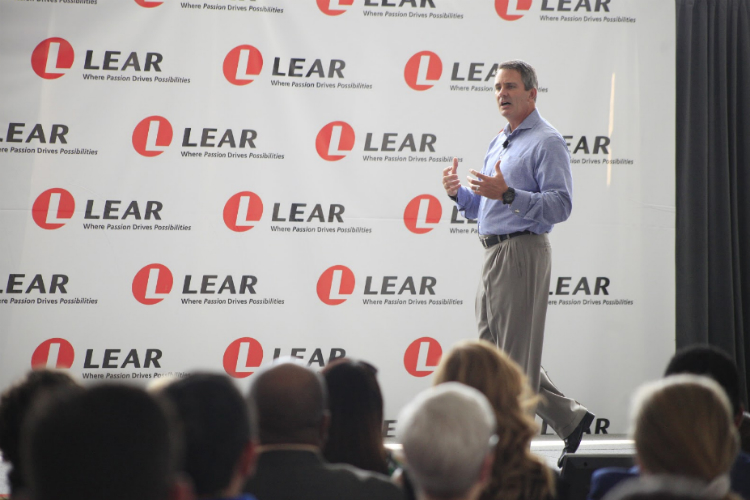
Raymond Scott has a problem with agreement. In a meeting, a colleague can offer a perfectly agreeable answer and still fail the test. Has that person reached a conclusion, or simply worked out where the chief executive is likely to land? For the president and CEO of Lear Corporation, the difference matters. A room full of people waiting for his opinion can be an expensive way of hearing himself think.
He has described catching himself closing down discussion, and learning to ask for a colleague’s reasoning before settling the matter. There is a small indignity involved in doing this properly: the boss must allow the possibility that somebody else has the better answer. Scott says listening has changed his mind. A title can secure the last word. It cannot make that word useful.
That is an interesting preoccupation for someone who has spent his working life accumulating authority inside one company. Scott arrived at Lear in 1988. He became CEO in March 2018, succeeding Matt Simoncini after roughly 30 years in the business. His route included sales, program management, customer divisions and responsibility for both of Lear’s principal businesses. By the time he took the top job, he had seen the company from several different chairs.
Flint, with the doors open
One of those chairs was close to home. In 2018, early in his tenure as CEO, Scott helped open Lear’s seating plant in Flint, Michigan. The site stood in Buick City, a name with industrial history built into it. The project put a new factory into a landscape familiar with the consequences of factories disappearing. For Scott, who grew up in the Flint area, the occasion carried a personal charge.
“I’m a product of Flint,” he said at the opening. The remark was brief enough to fit comfortably on a corporate slide, but its setting gave it weight. Here was a hometown executive addressing people about work that would happen in their city. In that setting, an employment plan has a different audience from an investor presentation. The people hearing it may have relatives who remember the last plant closing.
The account of the new facility also followed some of its early employees. Ronnie Thompson, a lifelong Flint resident, talked about engaging with the surrounding community through his job. A mural by local artist Kevin Burdick connected the city’s manufacturing past with the new plant. Scott was part of an opening whose significance extended beyond his own promotion. A factory becomes real through the people who enter it each morning.
An education interrupted by Sweden
Scott’s education took a detour through a troubled business in Europe. While working toward his MBA at Michigan State, he accepted an assignment in Sweden. He and his wife moved with two small children. His wife had a career and a master’s degree in information technology; the decision required a substantial rearrangement of their shared life. Graduate school had to wait while he took on the turnaround.
The Swedish operation improved. Another assignment followed in Germany. Eventually Scott returned to complete his MBA, having acquired an education that no timetable had originally contained. In his 2021 Michigan State commencement address, he recalled the uncertainty of those moves and the experience of wondering whether he had made the right decision. Success, viewed afterward, can make a choice appear much tidier than it felt at the time.
The interesting detail is the unfinished degree. A conventional executive biography places university names in a neat row, as if learning were something efficiently collected before the serious work began. Scott’s account is messier. Work interrupted study; the interruption became part of what he learned. His advice to graduates was to accept difficult assignments and remain willing to learn. It came with a family’s moving boxes behind it.
- 1988Joins Lear
- 2011Leads global Seating
- 2018Becomes CEO
- 202638 years since joining
Two businesses, one education in the car
Lear’s products give Scott an unusually broad view of the vehicle. One business makes seating and its components. The other makes electrical distribution and connection systems, power distribution products and electronic controllers. His experience running both divisions matters because a modern seat is increasingly bound up with electrical functions. Comfort, assembly, wiring and cost meet inside an object the driver usually notices only when something feels wrong.
The work also spans places and customers. Before becoming CEO, Scott held positions involving General Motors and Fiat, North American seating, European customer operations and Lear-Saab. These were jobs with different operating pressures, rather than a succession of identical titles in larger type. Moving between them meant encountering the business through the requirements of particular customers and factories.
His training includes economics at the University of Michigan, an MBA at Michigan State and executive education at Stanford and Wharton. The resulting résumé combines formal business education with years inside a supplier. The combination helps explain the subjects he returns to in public: how work gets done, how customers decide, and how a company invests while still meeting the obligations already on its desk.
The factory gets a vote
By 2026, those questions had acquired a new vocabulary. On Autoline After Hours in February, Scott discussed automation, artificial intelligence and vertical integration alongside seating and E-Systems. The panel included John McElroy, David Welch and Gary Vasilash. The conversation placed him in the middle of an industry trying to change its products and the methods used to make them at the same time.
Vertical integration is an imposing phrase for a practical decision: which parts of the work should a company be able to do itself? At Lear, the question reaches beyond components into production equipment and processes. Owning more of those capabilities can give an operator more ways to change a factory. It also brings the obligation to make the investment earn its keep. A clever machine still has to survive a production schedule.
The Rochester Hills manufacturing project illustrates the ambition. Scott described it as a place to demonstrate automated modular systems to customers and investors. His argument for replication was explicitly commercial: customers wanted cost efficiencies that could be carried across programs. A demonstration line has to persuade an automaker that the method can travel. The attraction lies in repeatability, including the unglamorous details that make the second installation work.
That is where an executive’s enthusiasm meets the factory’s right of reply. Equipment must fit an actual process. A product must be built in quantity. A cost claim must hold beyond the presentation. Scott’s public emphasis on scaling provides a useful standard for judging the strategy: watch what can be repeated, where it is deployed, and whether the resulting business performs. The factory keeps a less forgiving score than a conference audience.
A clever machine still has to survive a production schedule.
A balance sheet can answer back, too
Lear’s second-quarter 2026 results put numbers against the discussion. Net sales were about $6.21 billion, compared with $6.03 billion a year earlier. Net income attributable to Lear was $192.8 million. The company reported adjusted earnings per share of $4.28, up from $3.47, and raised its full-year guidance. These are company results delivered by a workforce, rather than a personal score belonging to the CEO.
The distinction between adjusted and reported earnings matters. Adjusted earnings remove specified items; they should be read alongside the financial statements. In the same quarter, reported diluted earnings per share were $3.79. Neither figure describes everything a supplier is doing. Together they give the reader a firmer footing than a declaration that the strategy is working. Growth, profitability and the quality of the adjustments each deserve a look.
The company’s regional reporting adds another perspective. First-half 2026 sales included roughly $4.72 billion in North America and $4.63 billion in Europe and Africa, with further business in Asia and South America. Scott’s decisions therefore operate across several markets. An improvement in one place can coexist with difficulty elsewhere. The work of a global supplier is partly the work of refusing to mistake one region’s experience for the whole business.
The people beyond the conference table
Scott’s outside commitments extend his working circle beyond Lear. He serves as a director of Penske Automotive Group, placing him alongside a business that encounters vehicles through retailing and related services. He also serves on boards connected with Detroit’s civic life and education, including the Detroit Economic Club, Detroit Children’s Fund and Kettering University in Flint. The geography of those commitments returns repeatedly to southeastern Michigan.
These roles offer different vantage points on the same broad ecosystem. A supplier deals with the automaker’s production needs; a retailer sees the customer deciding what to buy. Education and civic organizations face another set of practical questions about opportunity and place. A board seat alone establishes no personal philosophy. The pattern of Scott’s commitments does show a career connected to institutions beyond the company whose results he presents.
There is a modest pleasure in finding a factory executive’s life still attached to a particular place. Global business can produce biographies that read like airport departure boards. Scott’s has its share of European assignments and international customers, but Flint remains a recurring point of reference. The city appears in his own account of growing up, in his university service and in the plant opening that brought him back as chief executive.
Leave a little room at the table
The thread connecting these episodes is the usefulness of an unfamiliar view. Europe interrupted Scott’s original plan for finishing school. Moving through Lear’s divisions exposed him to different parts of a vehicle and different customer demands. Automation now asks the company to reconsider how work is performed. Each episode involves a decision whose outcome could not be established merely by repeating an earlier success.
For someone with so much tenure, that is a consequential habit to keep. Long experience can supply context; it can also tempt an executive to answer before the question has finished arriving. Scott’s willingness to describe the problem publicly gives his leadership story some texture. The most revealing part of a polished career may be the point at which its owner admits that his own certainty requires supervision.
At Lear, the next answer may come from a customer, a production line, a regional team or a colleague with a different opinion. Scott’s job includes deciding which answer to act on. First, he has to make room to hear it. After nearly four decades at the same company, there is something quietly practical about treating that as work still worth doing.
Keep the conversation going
Read, listen and watch: