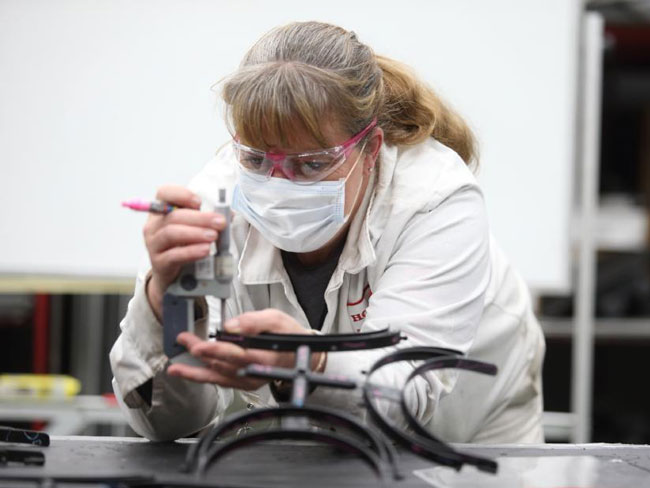
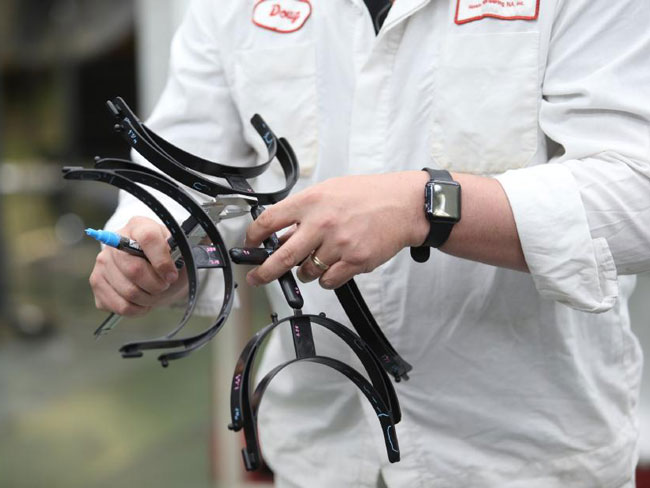
In March 2020, Honda began making face-shield frames with 3D printers at five manufacturing facilities. The machines could make the parts. They could not make enough. For the engineers confronting a shortage of protective equipment, that distinction mattered more than the novelty of the technology. A useful object was only the beginning. They needed a way to repeat it, quickly.
- The work: dies, molds, welding systems and assembly automation for Honda factories.
- The revealing moment: a pandemic project moved from printing toward injection molding.
- The corporate turn: EGA merged into Honda Development & Manufacturing of America in April 2021.
A working printer. The wrong volume.
Honda Engineering North America, known as EGA, helped make that switch. Its engineers developed special tooling for high-speed injection molding, with a stated capability exceeding 3,000 shields an hour. Healthcare professionals helped inform the design. The company was applying familiar manufacturing knowledge to an unfamiliar need.
“We make a car about every 50 seconds”Hugo Beltran · EGA associate chief engineer · June 2020
By August, Honda reported that EGA engineers had manufactured more than 136,000 donated shields, reaching 379 medical facilities in 45 states. Dealers helped locate recipients. Getting the product out of the building belonged to the problem, too.
The product before the product
EGA usually worked one step behind the vehicle everyone recognized. Its output included stamping press dies, plastic injection molds, welding systems and assembly automation. Think of a body panel: its shape must become something a press can reproduce. Or a plastic component: somebody must engineer the mold. The production equipment is itself a designed, manufactured product.
Honda’s 2017 FactBook connected EGA tooling with the Accord Coupe, Pilot, Ridgeline, Odyssey, Acura TLX and MDX. Those names make the otherwise abstract work legible. A minivan’s existence depends on many things, including equipment that most buyers will never see. EGA occupied that upstream position within Honda’s manufacturing network.
requirements
& systems
production
Its business was primarily internal: specialized equipment for Honda operations, rather than an offering a motorist could order. In market terms, it occupied territory also served by outside toolmakers and automation integrators. Its distinctive feature was organizational proximity: the equipment maker belonged inside the vehicle maker. The business case therefore concerns how well Honda could manufacture, alongside whatever equipment sales were recorded.
Why the engineers were next door
The American operation began as a branch in May 1985; the subsidiary followed in April 1988. Honda’s own history places that move within its SED system, joining sales, production engineering and development. Localizing car production required local technical capability as well. An assembly plant alone could not supply every answer to the question of how a new vehicle should be made.
Consider the arrangement: EGA’s headquarters stood adjacent to the Marysville Auto Plant, while other operations were near manufacturing sites in Anna, Lincoln and Alliston. The geography suggests a practical advantage. Engineers developing equipment could work close to its eventual use. That is an inference about the arrangement, rather than a measured claim about minutes saved or costs reduced.
Honda’s stated culture helps explain the preference for shared problem-solving. Its group philosophy emphasizes initiative, equality and trust; its management policies encourage open communication. Even the white work clothes have a declared purpose: making dirt visible and symbolizing equality. Clothes cannot establish a company’s actual culture, but the choice is an unusually tangible expression of its intentions.
The company changed. The problem stayed.
In November 2020, Honda announced a consolidation of American auto manufacturing and product development, effective the following April. EGA was among the companies involved. Honda’s subsequent regulatory filing confirms its merger into Honda Development & Manufacturing of America, or HDMA. The old name now describes a corporate chapter, rather than a separate present-day supplier.
Honda described the intended organization as a “one-floor” approach. Development, planning, purchasing, strategy and manufacturing would sit within one company. The stated aims included eliminating duplication and improving development speed, quality and cost competitiveness. Those are objectives, not proof that every handoff disappeared. Still, the direction was clear: bring the decisions about a car and its production closer together.
A billion-dollar reminder
The successor organization’s manufacturing challenge became visible in Ohio’s EV preparations. In February 2025, Honda described more than $1 billion in retooling across Marysville, East Liberty and Anna. The plan allowed gasoline, hybrid and electric vehicles on shared production lines. That figure belongs to Honda’s plant investment after EGA’s merger; it is not EGA revenue or a financing round.
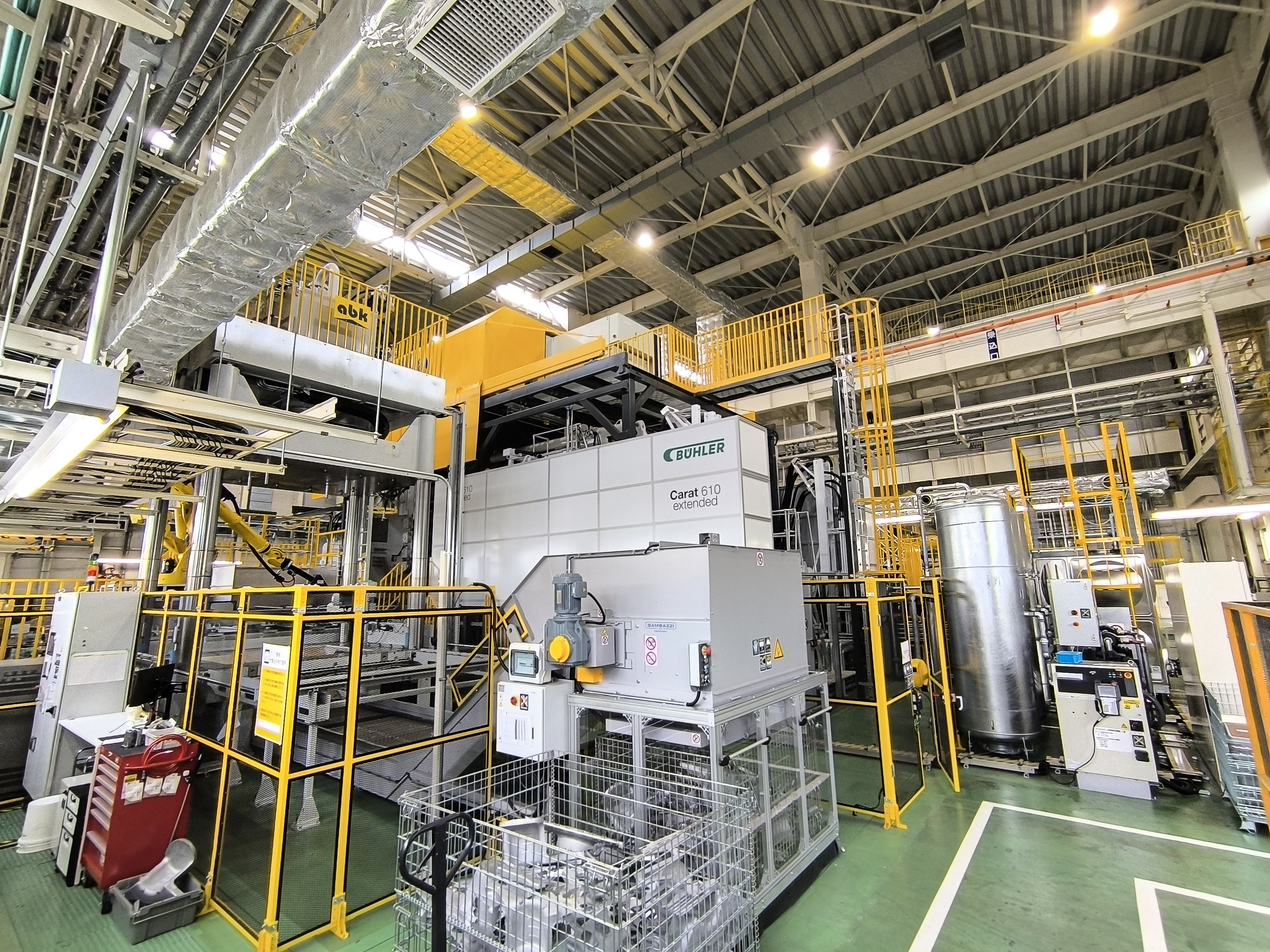
Bühler supplied large die-casting machines for Honda’s battery-case program. Its account describes research equipment in Japan and installations at Anna. This detail matters because keeping production knowledge inside Honda did not mean making every machine internally. Specialized outside suppliers remained part of the system.
Then the product assumptions changed. On March 12, 2026, Honda canceled the planned Honda 0 SUV, Honda 0 Saloon and Acura RSX electric models. It cited a changed business environment, including slowing American EV demand, revised incentives, tariffs and competitive pressure. No evidence here makes EGA’s tooling the cause. The narrower lesson is uncomfortable enough: manufacturing capability cannot create customer demand.
What an operator can borrow
The face-shield episode offers a useful operating habit. Define the required volume before becoming attached to a process. Ask users about the object, and ask the production team about repetition. Then include distribution in the design of the effort. Honda’s response required all three.
Dedicated tooling makes sense when the need justifies its preparation and the equipment and expertise are available. For small, changing batches, another process may fit better. EGA’s story rewards that kind of judgment: knowing what to build includes knowing how many, for whom, and what must change when the answer changes.