At fourteen, Carlos Tavares was volunteering at the Estoril circuit near Lisbon. The cars were the attraction; the executive suite was still a long way off. Decades later, he would name a corporate recovery programme Back in the Race. Some people carry a childhood enthusiasm into adulthood as a hobby. Tavares gave his a place in the business plan.
He wanted to race professionally. By his own account, talent and money put limits on that ambition. Engineering offered another way into the automobile. It also left the original appetite intact. By January 2023, his official biography credited him with more than 500 races. An executive who talks about competition can usually expect a polite nod. Tavares could produce an entry list.
This is the useful starting point for understanding a career that ended in a very public disagreement. His methods helped restore PSA and its acquired Opel business to profitability. He became the founding chief executive of Stellantis in 2021. The company reported €18.6 billion in net profit for 2023, then €5.5 billion for 2024. On 1 December 2024, its board accepted his resignation with immediate effect.
The results invite a tidy verdict, but tidy verdicts leave out too much. The same career contains patience and impatience, engineering and ambition, enthusiasm for individual cars and a determination to make the economics work. Following it means looking at the boy beside the circuit as well as the chief executive beside the balance sheet.
A hobby with a substantial entry list.
An engineer learns the size of the machine
Born in Lisbon on 14 August 1958, Tavares attended the Lycée français Charles-Lepierre before graduating from École Centrale Paris. His first car was a 1978 Alfasud Sprint, a gift from his father after his diploma. He used it for his first race in 1980. The choice has a pleasing circularity: Alfa Romeo would eventually become one of the brands under his management.
He entered Renault in 1981. His early work included test engineering, and he later directed the Mégane II project. That background matters. A car company can look like a collection of badges from the outside. For an engineer, it is also a collection of decisions: what to develop, what to share, what to make, and how to make it economically.
The Renault-Nissan alliance widened his working world. He joined Nissan in 2004 and became president of Nissan North America in 2009, alongside broader executive responsibilities for the Americas. In 2011, he returned to Renault as chief operating officer. He had travelled from vehicle development into the machinery of a multinational business without leaving the automobile behind.
Carlos Ghosn was the dominant figure above him at the alliance. Tavares wanted a chief executive position of his own, and in a 2013 interview he made that ambition public, discussing the possibility of leading another major manufacturer. He left Renault that August. There are diplomatic ways to announce that you would like the next promotion; discussing other employers gives the conversation a certain additional velocity.
A recovery with a racing name
PSA gave him the job he had been seeking. He joined its managing board in January 2014 and became chairman in March. Peugeot and Citroën offered familiar names, factories and engineering capabilities. They also offered an urgent financial problem. A celebrated badge cannot pay an invoice merely by reminding the creditor of its distinguished past.
Back in the Race made the priorities legible: reduce costs, simplify the model range and improve the industrial operation. The racing language had a practical use. It gave a complicated turnaround a name that employees could remember, and it made the desired movement clear. PSA was trying to regain the ability to compete from a position of financial weakness.
In 2015, the automotive division achieved a 5% operating margin. PSA reported €1.2 billion in net profit, against a €555 million loss in 2014. Those numbers gave the programme substance. Tavares had sought the authority to run a manufacturer; now he had evidence that his approach could change its results.
The next plan, Push to Pass, carried the same vocabulary into growth. There is something almost disarmingly literal about naming industrial strategy after an overtaking aid. Yet the sequence was coherent: first restore the business, then use its improved position to advance. His reputation began to rest on repeatable execution rather than on the promise attached to his appointment.
Engineering
Recovery
Founding CEO
1 December
Opel becomes a second test
PSA acquired Opel and Vauxhall from General Motors in 2017. The deal enlarged the group and tested whether the turnaround approach could travel. Tavares’s argument involved shared vehicle platforms and the cost advantages of greater volume, while retaining brands with different national identities. Customers could buy different stories; the factories could share more of the work underneath.
In the first half of 2018, Opel/Vauxhall reported €502 million in recurring operating income. That was an accounting measure, not a synonym for net profit, but it was evidence of a changed operating position. The acquired business helped turn Tavares from a successful recovery executive into someone whose method seemed applicable beyond his original assignment.
His enthusiasm for motor sport did not make racing budgets sacred. In a 2017 interview, he weighed the commercial return from competition against the effort employees put into saving money in factories. He asked whether large racing expenditure could be justified inside that company. Here was a racer willing to subject racing to the same arithmetic as everything else.
That is a more revealing detail than the usual portrait of an executive who enjoys fast cars. The pleasure and the business case occupied separate columns. He could value a brand’s passion while expecting common systems behind it. The challenge would grow considerably when those columns had to accommodate the creation of Stellantis.
“This is the engine: the passion of the people.”Carlos Tavares · 2017
Fourteen badges, one balance sheet
The merger of PSA and Fiat Chrysler Automobiles created Stellantis in January 2021, with Tavares as its first CEO and John Elkann as chairman. Peugeot, Citroën, Opel and Vauxhall joined a family that included Fiat, Jeep, Ram, Chrysler, Dodge and Alfa Romeo. The company brought together fourteen automotive brands. A showroom could display their differences more easily than an organisation chart could reconcile them.
The underlying industrial proposition was familiar: preserve the customer’s attachment to a brand while finding economies across the group. At this scale, however, the proposition reached across markets with different vehicles, prices and expectations. A European compact and an American pickup belonged to the same financial reporting perimeter. They did not necessarily respond to the same commercial decisions.
Dare Forward 2030, announced in 2022, added a demanding transition. It targeted a fully battery-electric passenger-car sales mix in Europe and a 50% battery-electric mix for passenger cars and light-duty trucks in the United States by 2030. These were goals set during his tenure, rather than descriptions of what Stellantis had already achieved.
He also pursued a partnership with China’s Leapmotor. In October 2023, Stellantis announced a planned €1.5 billion investment for approximately 20% of the company and a proposed international joint venture controlled 51% by Stellantis. Working with a Chinese electric-vehicle producer added a pragmatic strand to the strategy: competition could also produce a commercial partnership.
The year the numbers turned
For 2023, Stellantis reported €189.5 billion in revenue and €18.6 billion in net profit. Its adjusted operating margin was 12.8%. Those results made a powerful case for Tavares’s leadership. They also made the subsequent reversal harder to dismiss as a small fluctuation. The scale of the good year established the scale against which the next one would be judged.
By the first half of 2024, net profit had fallen 48%. The company identified operational challenges in North America, including market share and inventory performance. This was a concrete commercial problem: producing and pricing vehicles ultimately had to lead to customers buying them. A strong margin in an earlier period could offer no exemption from that requirement.
The full-year figures sharpened the picture. Revenue declined 17%, net profit fell 70%, and adjusted operating margin dropped to 5.5%. Industrial free cash flow was negative €6 billion. These measures describe different parts of the business, and deserve to stay distinct. Together, they show how quickly the operating conditions had deteriorated.
In October, Stellantis changed senior management and said Tavares would retire when his term ended in early 2026. Elkann publicly backed him and the changes. Less than two months later, the timetable disappeared. The board accepted his resignation immediately. Senior independent director Henri de Castries explained that “different views have emerged”. The company acknowledged his earlier achievements while bringing his tenure to an abrupt close.
The driver keeps his own timetable
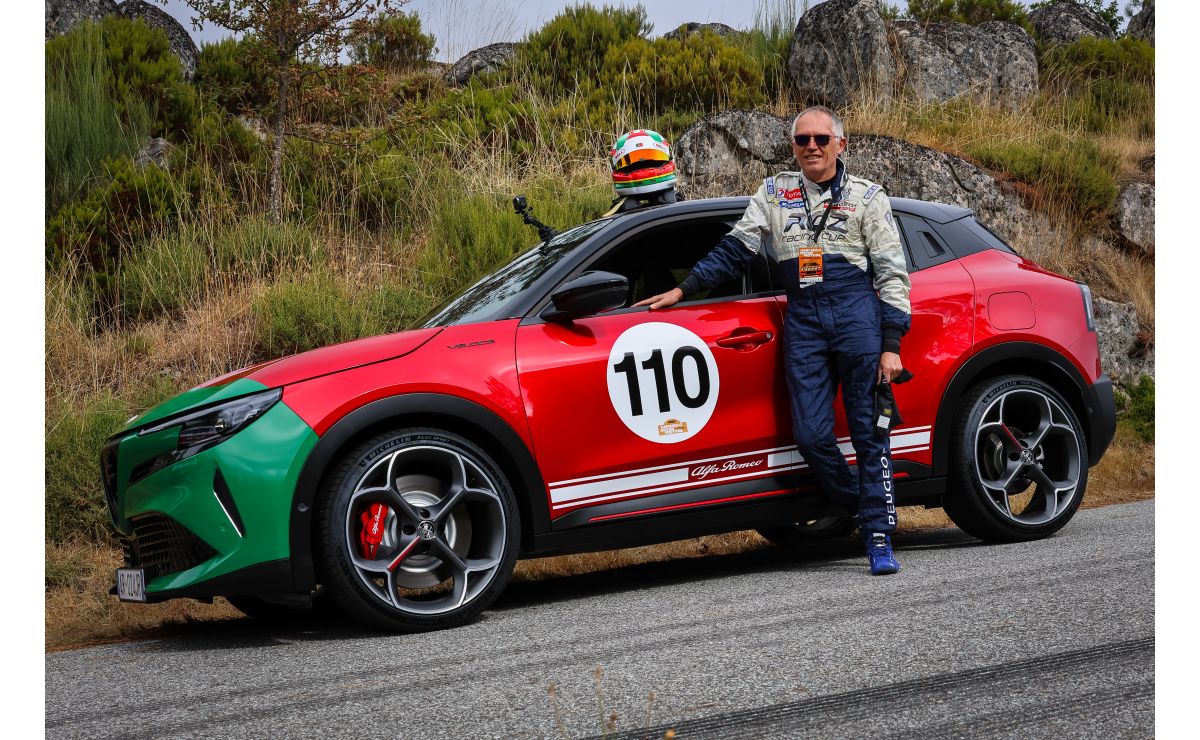
Tavares’s racing life continued alongside the corporate one. In September 2024, he drove the electric Alfa Romeo Junior 280 Veloce at Portugal’s Caramulo Motorfestival, taking it onto the historic hill climb. The photograph supplies a useful corrective to an account written entirely in euros: he was still interested in the actual machine, with its tyres on an actual road.
His team name, Clémenteam Racing, refers to his daughter. It is a small, personal detail in a career otherwise documented through appointments and financial reports. There is room in this story for a father’s pun, just as there is room for a racing suit beside the business suit. The cars were never merely units in a quarterly table.
In his later memoir, Tavares described discussing his departure by telephone with Elkann during a racing weekend at Estoril. That is his account of the circumstances, and it should be read as such. Still, the setting brings the career back to the circuit where his interest began. The location has outlasted several corporate job titles.
A smaller room in Portugal
His French memoir, Un pilote dans la tempête, appeared in October 2025. A Portuguese autobiography followed in January 2026. A book gives a former chief executive a different kind of control: the ability to select the sequence, explain decisions and set out his version of events. Readers can consider that version alongside the public record of what the businesses delivered.
On 27 February 2026, he presented his autobiographical book in Póvoa de Santarém, where he has a home. The event was held at the Centro de Solidariedade Social Nossa Senhora da Luz, with proceeds benefiting the centre. After a career conducted across multinational groups, this was a decidedly smaller room and a local purpose.
The change in scale makes a fitting last scene. Tavares got the leadership role he wanted, proved his turnaround abilities and helped assemble a company whose difficulties eventually overtook him. The achievements remain measurable. So does the reversal. His story leaves a question for anyone tempted to convert a successful method into a permanent rule: when the conditions change, how quickly can the winner learn again?