The email looked suspicious. The sender had a Chinese name, wrote immaculate Spanish, and used Gmail. Antonio Navarro, an engineer who had been developing motorcycles, told his colleague Estefanía Hernández not to worry. He would meet this apparent rival and dispose of the matter in two minutes. The scheduled courtesy stretched to five hours. The university closed around them, so the conversation moved to a bench. By the end, Navarro no longer saw Xulei Xu as a threat to the idea. He saw the business partner the idea had been missing.
It is a tidy origin story only in retrospect. At the time, two separate pairs were circling the same opportunity. Navarro and Hernández came from motorcycle competition. Their Guepardo Team work at Miguel Hernández University had earned an innovation prize at MotoStudent in 2016. Xu and his brother Ben brought another set of tools: finance, international trade, manufacturing relationships, and years of looking at the distance between Chinese and Spanish streets.
Xu later laughed about the spam-like introduction. More importantly, he recognized the fit. “Basically, we had very complementary profiles,” he said in a joint interview. The engineers understood how a motorcycle should behave. The Xu brothers understood how products, suppliers, and money cross borders. Hernández brought commercial psychology, marketing, and team leadership. Four people who might have remained competitors became a working division of labor.
“That day the NEXT Electric Motors team was born, and here we still are.”Xulei Xu
01 / The useful detour
An engineer who chose the balance sheet
Xu's path to a motorcycle company took the scenic route. He trained as a civil engineer but never practiced the profession. He studied business management at IE Business School in Madrid in 2010 and 2011, then worked around insurance and investment funds, looking at acquisition opportunities and monitoring portfolio companies. When NEXT divided responsibilities, that apparent zigzag became the point. Xu took charge of business development and financial control.
A motorcycle startup is a severe test of romantic ideas about entrepreneurship. The machine has to be designed, sourced, homologated, financed, shipped, sold, serviced, and trusted. Software can patch a rough edge after breakfast. A loose brake is less forgiving. Xu's finance experience did not make the scooter turn a corner, but it helped turn engineering into inventory and inventory into a company.
The founding insight was visible during Xu's family trips between Spain and China. Electric two-wheelers had been common in China for decades. Europe had the same congested streets, short urban journeys, and anxious neighbors, but far fewer electric scooters. Xu and his brother kept asking why the technology they saw abroad was missing at home.
The team did not answer with a manifesto. It answered with constraints. The bike had to look appealing, cost something close to a petrol alternative, and charge without a private garage. The first NX1 used compact, removable batteries. A rider could carry one into a home, office, or café and plug it into an ordinary socket. In apartment cities, a handle on a battery can be more useful than a heroic promise about charging infrastructure.
That practical brief also kept NEXT focused on city life rather than laboratory drama. The NX1 was homologated at 45 km/h, with a claimed range of 65 kilometers from one battery. Those numbers were modest by design. A commuter does not need a machine to win at specification sheets; a commuter needs it to start on Monday, fit the route, and be chargeable before Tuesday. The team was translating mature components into a European retail experience, then wrapping them in a shape that did not ask the buyer to advertise self-denial.
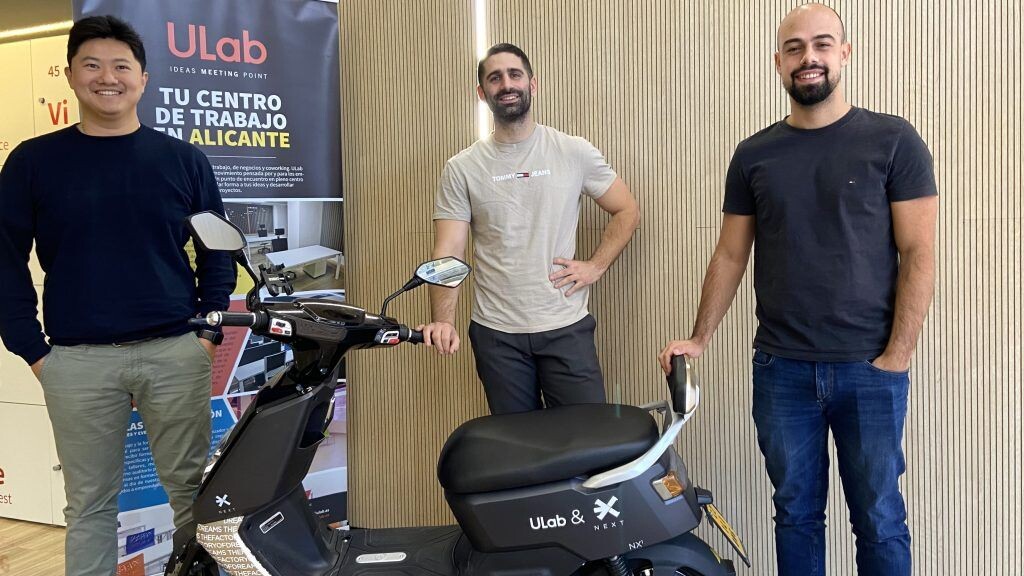
02 / Proof, one bike at a time
A PowerPoint, good intentions, and a paid order
NEXT entered Lanzadera, the Valencia startup program, in January 2018 with what the team later described as one PowerPoint and good intentions. The phrase is funny because it understates the dangerous part. The company had to learn whether strangers would pay for a new motorcycle brand before it had the comfort of scale.
The team opened pre-orders for roughly thirty NX1 units in June 2018. Within the first hour, a customer completed a full purchase. It was one transaction, not a market, but it changed the quality of the conversation. Someone outside the founding circle believed enough to pay.
The NX1 reached the Spanish market in 2019. NEXT arranged technical-service support through Norauto and built distribution in countries including the Netherlands and Germany. Lanzadera reported more than 400 units sold by 2020. None of those numbers makes NEXT a mass manufacturer. Together they show the slow conversion of an unfamiliar logo into a vehicle that people would register, ride, and bring in for maintenance.
Xu gave the problem a blunt name in a 2021 radio interview: “The principal challenge is credibility.” For a young manufacturer, performance claims are cheap and trust is expensive. Buyers are not merely choosing an object. They are betting that parts, service, warranties, and the company itself will still exist after the novelty wears off.
NEXT responded by accumulating evidence. It expanded beyond the low-speed NX1 to the Mojito, the business-oriented NXPlus, and the NX2. The electric NX2 moved the company into 125cc-equivalent territory with claimed figures of up to 130 km/h and 200 kilometers of range. A financing package in late 2022 and a one-million-euro round reported in May 2023 supported product development, international growth, and a larger team. Nearly half of production was already going outside Spain, the company said at the time.
The catalog became a record of the problems NEXT had learned to solve. A removable battery suited the person carrying energy upstairs. A higher-performance fixed pack suited the rider leaving the center for faster roads. Fleet products addressed businesses that cared about uptime and predictable costs more than novelty. Distribution answered a different kind of range anxiety: whether a buyer could find advice and maintenance after the sale. Xu's job sat between all of them, where a promising feature becomes a price, a production order, and a decision about which country to enter next.
03 / The awkward turn
When an electric company sells petrol
Then came the turn that makes the story more interesting. In March 2025, NEXT launched the NX2 125i, a petrol-powered version of its city scooter. A second combustion model, the NXCross 125i, followed in the range. The brand that had spent years arguing that electric motorcycles could be practical now offered customers a fuel tank.
The easy interpretation is contradiction. The more useful interpretation is an operator meeting the market where it is. Electric two-wheelers still contend with charging access, purchase price, unfamiliar resale value, and routes that do not fit a neat daily commute. NEXT's slogan for the expanded range, “Choose Your Way,” puts the decision with the rider. The same company website now places electric and petrol models side by side.
There is tension in that choice, and it should remain visible. Xu's stated ambition was cleaner, quieter cities. Petrol does not advance either quality. But a small manufacturer also needs sales, service volume, and a dealer network while the electric market matures. The move reveals a pragmatic streak that was present from the beginning. NEXT was never founded to make the most ideologically pure object. It was founded to make a credible alternative people would buy.
A founder's idea survives by changing shape. The trick is knowing which part is the shape and which part is the promise.
Xu's public comments keep returning to use rather than spectacle. He has described personal mobility as a complement to public transport because buses and trams cannot reach every street. In a 2025 partnership with Spain's motorsport federation, he framed sustainability and emotion as things that could coexist. The ambition is not to make movement abstractly greener. It is to make the cleaner option work in situations where people already need to move.
That is also why the founding anecdote matters beyond its charm. Xu did not build NEXT by insisting his original team had every answer. He built it by recognizing missing capabilities across the table. The supposed rivals had product and racing knowledge. He and Ben had business and cross-border experience. Suspicion gave way to fit.
Years after that overlong meeting, NEXT remains a compact Spanish manufacturer competing in a field full of giants. Its catalog is broader, its proposition messier, and its original problem unresolved: urban transport still needs to be cleaner, quieter, affordable, and easy to live with. Xu's work is less a victory lap than an extended operating argument. Build the team from complementary parts. Earn credibility in small increments. Change the route when the road requires it. Keep the destination in view.