Company Profile / Micromobility
Veo
The shared-scooter company that broke the industry's one rule: it decided to make money.
The shared-scooter company that broke the industry's one rule: it decided to make money.
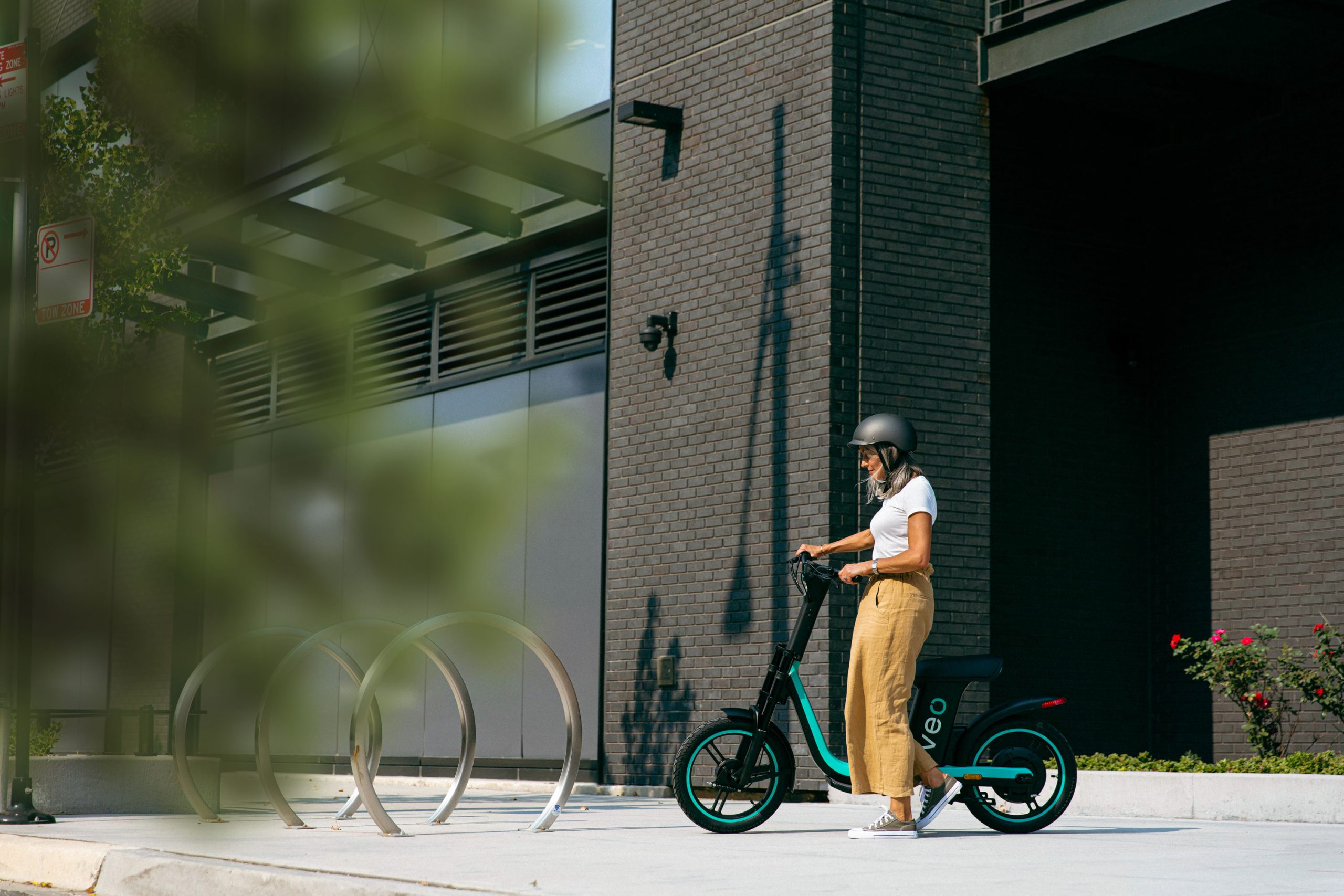
It is a Tuesday morning on a college campus, and a student taps a QR code on a seated scooter called the Cosmo, rolls past the bus stop, and disappears toward a lecture hall. No app drama. No surge pricing. No venture capital was lit on fire to make that ride happen. This is Veo at street level - unglamorous, on time, and faintly allergic to hype.
That last trait made Veo an outlier. While the rest of shared micromobility spent the late 2010s racing to flood cities with scooters and explain the losses later, Veo took the boring path: design durable vehicles, sign exclusive contracts, count the money. The result is a company that today operates across 50-plus cities and university campuses in North America, builds its own fleet of e-scooters, e-bikes and cargo bikes, and - this is the punchline - actually turns a profit.
Here is the awkward fact the micromobility boom preferred not to mention: the unit economics were terrible. Cheap scooters broke in weeks. Companies dumped them on sidewalks by the thousands, paid people to charge them overnight, and watched cities recoil. Riders loved the convenience; balance sheets did not. The dominant strategy was to grow first and find a business model never.
Cities, meanwhile, were drowning in cars. The first and last mile - the short hop too far to walk, too annoying to drive - was the exact gap scooters could fill. But a service that cannot survive financially cannot survive in a city's transportation plan either. The problem Veo saw was not "how do we put more scooters on the street." It was "how do we put scooters on the street in a way that still exists in five years."
Candice Xie was not an obvious candidate to run a scooter company. She had been a financial planner at Schneider Electric, with stints at the Bank of China and MassMutual behind her - a resume built on spreadsheets, not handlebars. Her co-founder, Edwin Tan, came from the bike industry and brought the engineering. In 2017, both Purdue graduates, they started VeoRide and launched their first bikeshare that fall on their old campus.
Xie's financial instincts became the company's strategy. Instead of chasing every market, Veo entered cities and campuses deliberately and stayed. Instead of buying off-the-shelf scooters, it designed and manufactured its own - controlling cost, durability and safety. The bet was that discipline, not blitzscaling, would win micromobility. It was an unfashionable position to hold while rivals raised hundreds of millions. It also happened to be correct.
By 2020, Veo did something none of its better-funded competitors had managed: it turned a profit. The company had raised roughly $16 million in total - a rounding error next to the war chests of Bird and Lime - and turned it into more than $50 million in annual revenue. In an industry that treated profitability as a someday problem, Veo treated it as the entire point.
Candice Xie and Edwin Tan start VeoRide and launch their first bikeshare market that fall.
Veo introduces its custom standing e-scooter with swappable batteries; lands the Texas A&M contract.
Becomes the first profitable U.S. shared micromobility company and debuts the seated Cosmo scooter.
Rebrand drops the "Ride" - riders were already calling the vehicles "Veo" anyway.
Autotech Ventures, UP.Partners, FJ Labs and others back the deliberately lean operator.
The Apollo Class II e-bike becomes the industry's first to safely seat two riders.
North America's first dockless shared cargo e-bike launches in D.C. and Columbus; 50% cargo fleet targeted by 2030.
The city ends Lime and Bird contracts; Denver becomes the first U.S. market for Veo's three-wheeled trike.
Most operators buy generic scooters and hope they survive the winter. Veo runs its own in-house design team and builds the most diverse fleet in the industry - seven vehicles and counting. The logic is simple: if you design the vehicle, you control how long it lasts, how safe it is, and how much it costs you per ride. Durability is not a feature here. It is the business model.
A custom seated e-scooter with big tires, a throttle and a low center of gravity - built for riders of every age and ability.
The standing e-scooter with swappable batteries that put Veo on campus maps in 2019.
North America's first dockless shared cargo e-bike. Hauls up to 100 pounds with throttle assist - no pedaling.
The industry's first dual-passenger vehicle: a Class II e-bike that seats two or adds cargo space.
A three-wheeled, self-balancing scooter in development, getting its mass U.S. debut in Denver.
Scan a QR code to unlock and ride. Pay per trip or go monthly with a VeoPlus membership.
Newer fleets ship with the kind of features cities actually ask for: AI-enabled parking that nudges riders to park properly, helmet detection, real-time tip-over sensors, and curfew controls. The University of Maryland's 2025-2026 rollout includes all of them. It is unglamorous engineering aimed squarely at the two groups who decide whether scooters stay - city officials and pedestrians.
Plenty of micromobility companies projected profitability. Veo reported it. In early 2025, the company announced unadjusted EBIT profitability for fiscal 2024 - becoming, by its account, the first North American operator to hit that benchmark. The contrast with the industry's capital efficiency is the part worth staring at.
The proof is also in the contracts. University partnerships are stable, exclusive and long-term - Texas A&M alone has run more than 1,000 Veo devices since 2019. Cities are noticing too. In late 2025 Denver ended five-year relationships with Lime and Bird and moved to Veo, which will debut its trike there. In Toledo, riders took 253,000 trips in a single 2025 season, using scooters to reach work, school, transit and local businesses.
Veo's mission - end car dependency by making clean transportation accessible to all - sounds like every other mobility company's slide deck. The difference is the "accessible" part shows up in the hardware. The seated Cosmo exists because not everyone can or wants to ride a standing scooter. The cargo Apollo exists because not every trip is one person with no bags. Inclusive design is treated as an engineering requirement, not a press release.
And the financial discipline is part of the mission, not a contradiction of it. A company that goes bankrupt serves no riders and no cities. Veo's argument is that profitability is what makes the clean-transportation promise durable - that the responsible thing and the sustainable thing happen to be the same thing. It is a tidy piece of logic, and Veo has the rare luxury of having proven it on a balance sheet.
The next chapter is cargo. Veo wants half its fleet to be cargo-capable by 2030, a bet that the real competition is not other scooters but the second car in the driveway - the one used for grocery runs and short errands that a 100-pound-hauling e-bike could replace. If micromobility's first decade was about replacing the walk, its second is about replacing the drive.
Return to that student on the Cosmo, gliding past the bus stop. A few years ago that ride was a venture-funded novelty that might vanish when the money ran out. Now it is a line item in a city's transportation plan, served by a company that pays for itself. The scooter looks the same. What changed is that it is no longer a question of whether it will still be there next semester.
Veo did not win micromobility by being the loudest. It won the argument that the boring stuff - durable hardware, signed contracts, a profit - was the interesting stuff all along. That is the company at the front of the pack, still quiet, still parked exactly where it should be.