Consider the walk across a convention center. You have a badge, a bag and a meeting in the wrong hall. The building is doing precisely what it was designed to do: accommodating an enormous number of people. Your feet are paying for that achievement. At the Las Vegas Convention Center, The Boring Company says a journey that could take 45 minutes on foot became an approximately two-minute ride underground.
- The useful bit: direct electric-car trips beneath a sprawling campus.
- The engineering bet: build the machines, repeat the tunnel design, cut waiting time.
- The unfinished test: make the economics and passenger flow work across a city.
That is a wonderfully specific improvement. It also explains more about this company than a rendering of an entire city stitched together beneath the pavement. The original commercial foothold was a place where the destinations were known, the walking problem was obvious and a customer could check whether the shortcut worked.
A city-sized problem, a campus-sized answer
Elon Musk’s tunnel venture emerged publicly in December 2016; its corporate establishment followed in 2017. The premise was that cities had grown upward while transport remained trapped on a surface. Dig another level and you gain another route. The company now designs boring machines, constructs tunnels and operates its Loop transport systems.
Its own nickname for Loop is “Teslas in Tunnels!” Passengers board an electric vehicle and travel directly to their destination. There are no intermediate station stops on that trip. This makes Loop resemble an underground road network. The commercial difference lies in controlling the route and the vehicles together.
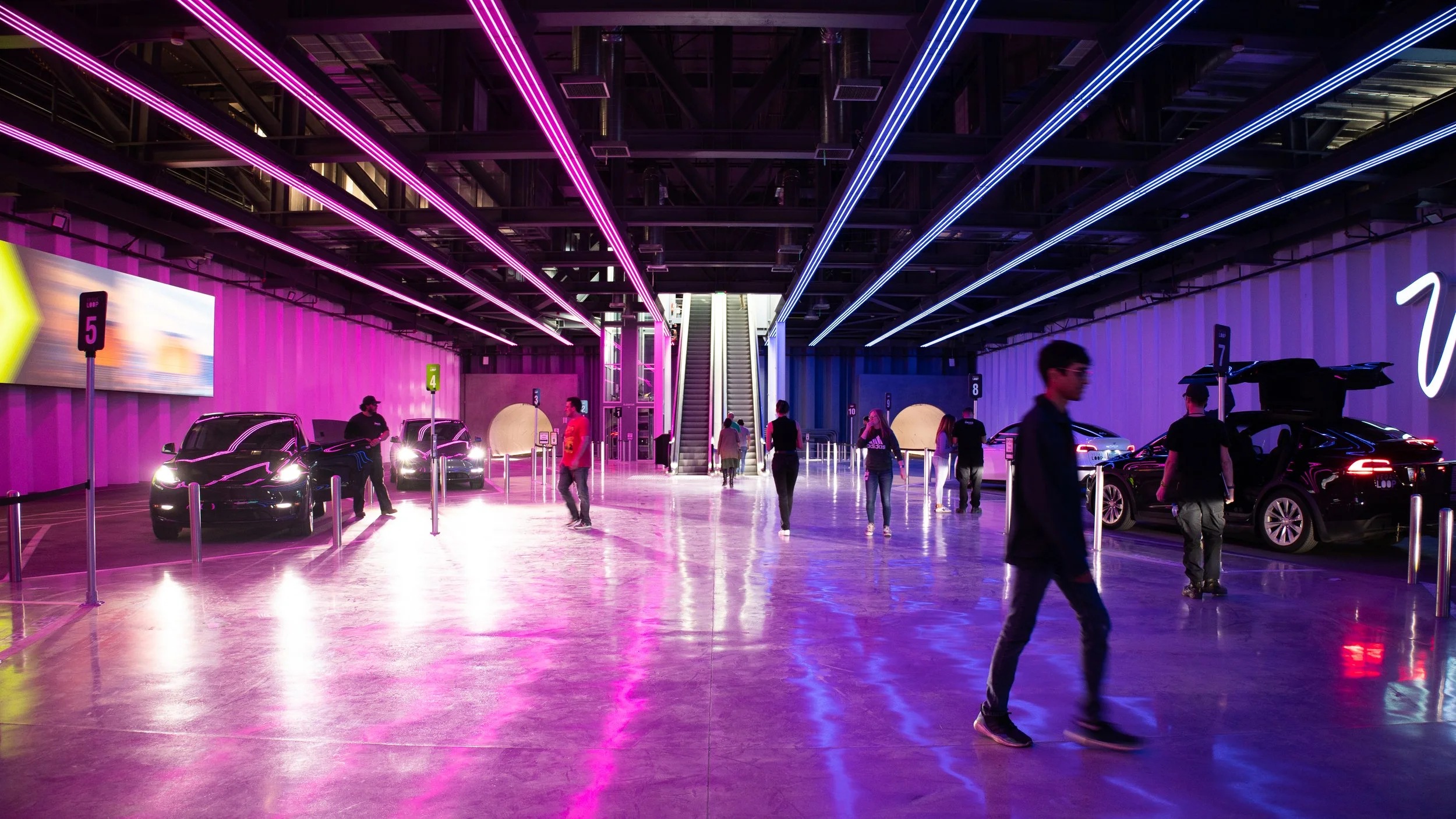
The customers sit on both sides of the transaction. Authorities and property owners need connections; visitors need rides. Convention venues, hotels and airports supply destinations where a saved minute has an audience. Industrial customers have another use: the company’s Cybertunnel takes completed Cybertrucks beneath a highway at Tesla’s Austin factory.
The machine that dislikes waiting
Prufrock, the company’s proprietary tunnel-boring platform, attacks the pauses around excavation. In soft soil, conventional machines stop to install concrete lining. TBC’s continuous-mining design installs the liner while advancing. Its “porpoising” approach starts at the surface and brings the machine back out, avoiding some of the elaborate launch and retrieval works.
The company designs and manufactures both machines and liners, then builds and operates Loop. That arrangement gives engineers access to the consequences of their decisions. A difficult part can be redesigned within the same organization that has to use it underground. It also concentrates responsibility: there is less room to blame the next contractor.
There is a literary joke in naming a machine after Prufrock, the hesitant figure in T. S. Eliot’s poem. The engineering intention is rather less hesitant. Remote operation and automated ring building aim to remove people from normal tunnel operations. The company reports a continuous-mining demonstration without tunnel personnel in May 2025, followed by autonomous ring assembly in August 2026.
The price of a shortcut
Cost needs its nouns attached. TBC puts the original three-station, 1.7-mile convention-center system at approximately $47 million on a fixed-price basis. Nevada legislative testimony describes a $52.5 million construction contract. Those are differently described figures; neither should become a universal price for a mile of tunnel.
Prufrock’s current target is a transport tunnel costing less than $5 million per mile. A target is a destination on a spreadsheet. A complete transport project must also pay for stations, power, safety equipment and the work needed to make the service usable. Comparing a tunnel target with a finished railway budget produces a seductive, unhelpful bargain.
Original LVCC system
Company’s reported fixed price
Per tunnel mile
Prufrock target, not total project cost
Dubai pilot project
Estimate, not completed expenditure
The business model changes with the customer. The convention-center system was publicly procured. Nashville is presented as privately funded construction and operation, with riders paying fares and private station funding. In September 2026, TBC announced a $3 billion Series D at a $23 billion valuation, led by the United Arab Emirates and affiliated investment entities.
Where the car meets the crowd
The operating record has substance. The company reports more than four million cumulative Vegas Loop passenger trips through 14 stations. That counts trips, rather than unique people. The original campus system demonstrated more than 4,500 passengers per hour; a larger future network remains a different undertaking.
A cheap hole still needs a good journey.
The trade-off is straightforward. Direct trips avoid intermediate stops, but small vehicles carry fewer people than trains. Boarding speed, vehicle occupancy and station circulation matter. A hotel connection and a crowded commuter corridor ask different things of the same tunnel. Buses, rail and automated people movers remain alternatives, depending on the job.
Nor does an electric fleet erase construction obligations. Nevada lawmakers examined allegations of workplace and environmental violations in February 2026. TBC defended its project in written responses. Passenger security systems and construction-site compliance deserve separate examination; approval in one does not settle the other.
Two new cities, two different tests
Nashville tests geology and replication. The October 1, 2026 company update reports two Main Beam machines tunneling in limestone, with another launch planned later that month. Dubai tests international delivery: its contracted pilot spans 6.4 kilometers and four stations. The estimated $154 million pilot budget comes before a proposed wider network.
Start with the journey you can prove
Early ambition ran ahead of delivery. In 2018, TBC dropped a West Los Angeles tunnel proposal after community litigation. The later Las Vegas service supplied a bounded demonstration. That sequence reveals a commercial adjustment without requiring guesses about anyone’s private change of heart.
The useful lesson is to own a recurring bottleneck and measure the customer’s result. Repeat the parts that truly repeat; investigate the ground, permissions and demand that do not. A convention visitor can use Loop today. A planner considering a network should begin with the journey, the queue and the whole bill. The hole comes afterward.