The first vehicle Jason Marks built from scratch made it as far as his high-school parking lot. He was 13. The machine met the pavement in what he later called a blaze of glory. A second contraption produced a similar lesson, apparently because adolescent engineering, like adolescence itself, sometimes needs to repeat the experiment. Marks eventually drew a practical conclusion: if he wanted to build vehicles, he ought to learn how to build safe ones.
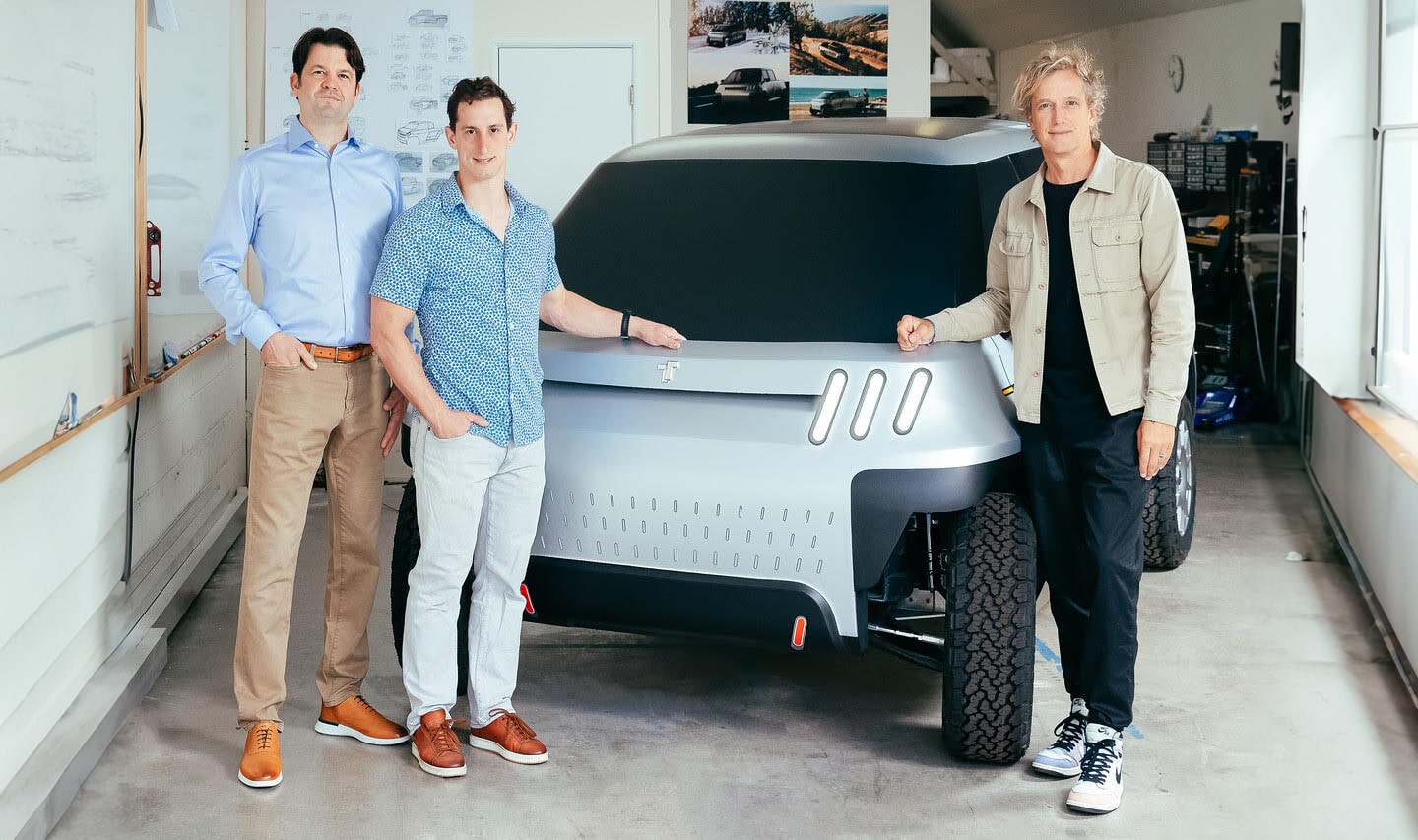
That decision carried him to Columbia University, where he studied mechanical engineering and competed as a Division I pole vaulter. It then took him through National Instruments, LiDAR and radar testing, autonomous-driving systems, and the delicate business of proving that a car can perceive danger before danger becomes a repair bill. Today he is co-founder and CEO of TELO Trucks, trying to package a five-seat electric pickup into 152 inches, the length of a two-door MINI Cooper.
The compactness attracts the eye. The continuity is more revealing. Marks has spent much of his life around machines that meet fixed boundaries: a homemade vehicle and the end of a parking lot, a vaulter and a crossbar, a safety system and a federal test, a truck and the hard geometry of a city street. TELO is his latest negotiation with a line that refuses to move.
Run fast, jump high.Marks's pole-vaulting motto
The useful kind of crazy
Pole vaulting is an odd preparation for a startup only until one considers the procedure. Sprint while carrying an inconvenient object. Plant it precisely. Trust the physics. Commit at the moment when hesitation becomes dangerous. Marks still keeps a pole-vaulting photograph behind him, and he has said the sport's compact motto remains part of how he lives.
The sport also supplied the coincidence at the center of TELO's founding. Marks met Forrest North through a mutual friend in 2019 while exploring an electric motorcycle. North had the sort of resume that makes an EV historian sit up: early work on the Tesla Roadster battery pack, a turn founding electric-motorcycle company Mission Motors, and the creation of charging-station app PlugShare. In conversation, the pair discovered that both had pole-vaulted at the same Washington high school, roughly a decade apart.
Marks describes pole vaulters as sharing a recognizable appetite for lunacy. The comment is funny because it is also a hiring thesis. Marks brought automotive testing and safety; North brought batteries and electrification. They had different technical domains and a similar willingness to run at an obstacle. Their electric-motorcycle idea gave them somewhere to start, but not where they would land.
Marks meets Forrest North and learns that both once pole-vaulted at the same Washington high school.
Work on an electric motorcycle opens a route toward a new kind of compact pickup.
TELO introduces a 152-inch electric truck concept and begins taking paid reservations.
A $20 million Series A is followed by a body-manufacturing partnership and plans for a measured first run.
A dog, a dinner reservation and a pickup problem
The product brief came from less athletic inconveniences. Marks lived in downtown San Francisco, owned a pickup and shared his life with a 150-pound dog. The truck could carry the dog to the beach, along with mountain bikes and paddleboards. It could not reliably fit near a restaurant he liked afterward. A vehicle designed to make weekends possible had a weekday habit of making the city difficult.
A trip to Japan more than a decade earlier had introduced Marks to kei trucks, tiny working vehicles common in dense places. In San Francisco, he and North tested the premise in public. They talked to friends and interviewed 100 people on the street. The team began with a motorcycle in mind. The conversations kept pointing toward a truck.
This is the pleasantly unromantic part of the founding story. They did not receive the final product in a flash of private genius. They brought a hypothesis outside, where strangers could bruise it. The pivot followed the bruise. The company began working on the truck in 2022 and relaunched as TELO Trucks in 2023.
Consumers were only half the discovery. After launch, commercial and fleet operators began contacting TELO. Contractors, utility crews and maintenance teams had their own urban arithmetic. A large pickup held the tools, but the nearest parking place could be a long walk from the work. Some operators were preserving older small trucks because new ones had grown beyond the job. Others combined low-speed neighborhood vehicles with conventional pickups, using two machines to cover the abilities one right-sized road vehicle might provide.
Specificity can widen a market. Solve for the dog, the plywood and the parking space, and a consumer complaint may reveal a fleet problem hiding beside it.
Spend every inch twice
The proposed MT1 is a packaging argument on wheels. TELO says it will seat five adults, provide a five-foot bed and extend that bed to eight feet through a folding mid-partition. The company lists up to 350 miles of range and 6,600 pounds of towing capacity. Every claim carries the customary asterisk of a vehicle approaching production, but the geometry is already the point: the truck is 152 inches long.
Electrification lets the team reconsider an old silhouette. Without a combustion engine demanding a long bay, the front can shrink. Battery cells can live in a pack shaped around space efficiency. Motors and power electronics can come from suppliers while TELO concentrates its engineering on the battery, safety structure, design and packaging. The company assigns complexity where it believes it has something distinct to contribute.
Safety is the fixed allocation. At National Instruments, Marks led test programs for autonomous vehicles and advanced driver-assistance systems. His work included strategies used by major U.S. automakers and LiDAR test technology that places him among the named inventors on National Instruments patents. He learned the vehicle from the sensor inward: what it sees, how engineers simulate what it might see, and how a system proves its response before the road performs its own exam.
TELO applies that validation instinct before sacrificing real prototypes. Marks has described running large numbers of virtual crashes, changing materials and interfaces, then running them again. Physical crash testing remains essential. Simulation is how the team hopes to arrive there with fewer expensive surprises and greater confidence in the structure.
The humility of 4,000 parts
The automotive business is gifted at punishing charisma. A convincing render cannot source a headlight, certify a seat belt or make six layers of body structure agree about where they belong. Marks likes a line from investor and Tesla co-founder Marc Tarpenning: it takes 4,000 parts to build a car, but only one missing part to prevent it.
That lesson altered TELO's attention. Marks has spoken candidly about body engineering as one of the team's surprises. Surface, structure, closures, interior panels and floor must stack into a manufacturable whole. The glamorous difficulty is inventing a new architecture. The daily difficulty is persuading every bracket, lamp and seat to arrive, fit, pass and repeat.
TELO's answer is a staged production plan. The company has raised about $27 million, including a $20 million Series A announced in September 2025. It plans to have Michigan-based Schwab Industries build the body-in-white, while TELO installs its battery pack and other systems in San Carlos. Marks has outlined an initial run of roughly 500 trucks, followed by a target rate of 5,000 per year after about twelve months.
That is slow by launch-video standards and brisk by the standards of federal compliance, supply chains and metal. Marks points to the first Tesla Roadster as a precedent for proving the machine before chasing great volume. TELO says its first customer vehicles are targeted for late 2026 or early 2027. The useful word is targeted. A factory schedule is a collection of promises made to physics.
Mini can be mighty.Jason Marks on TELO's first product
The purpose inside the footprint
TELO takes its name from telos, the Greek word associated with purpose or end. It is an earnest choice for a playful-looking truck, but Marks's argument is earnest too. The city still needs work vehicles even if more trips shift to trains, bikes or autonomous shuttles. Waste crews, beverage deliveries, builders and utilities do not disappear when streets become denser. They simply spend more time looking for somewhere to stop.
Marks is not trying to abolish the pickup. He is trying to recover the relationship between its exterior and its job. The vehicle should hold people and cargo, pass the safety tests, travel beyond the neighborhood and avoid occupying more city than its purpose requires. In his telling, the compact truck is both a consumer adventure vehicle and a tool for the people who keep a city running.
There is a personal neatness to the arc. A child builds a car and learns that motion without safety ends abruptly. A student learns to clear a bar by respecting its location. An engineer studies how vehicles perceive obstacles. A founder starts allocating a strict 152 inches among crumple zone, cabin, battery and bed. The scale changes. The question persists: where is the boundary, and what must fit before it?
The MT1 still has tests to pass, vehicles to ship and thousands of small parts to persuade. Marks appears to understand the indignity built into that work. His early machines crashed. His first startup idea changed shape. Commercial buyers arrived from outside the original plan. Body engineering proved harder than expected. None of those facts spoils the story. They give it suspension.
If TELO reaches the street, its revealing achievement may be that a founder treated size as a choice. American vehicles have accumulated inches as if length were weather. Marks looked at the forecast, remembered the dog waiting for the beach, and decided to design his own climate.
Follow the work