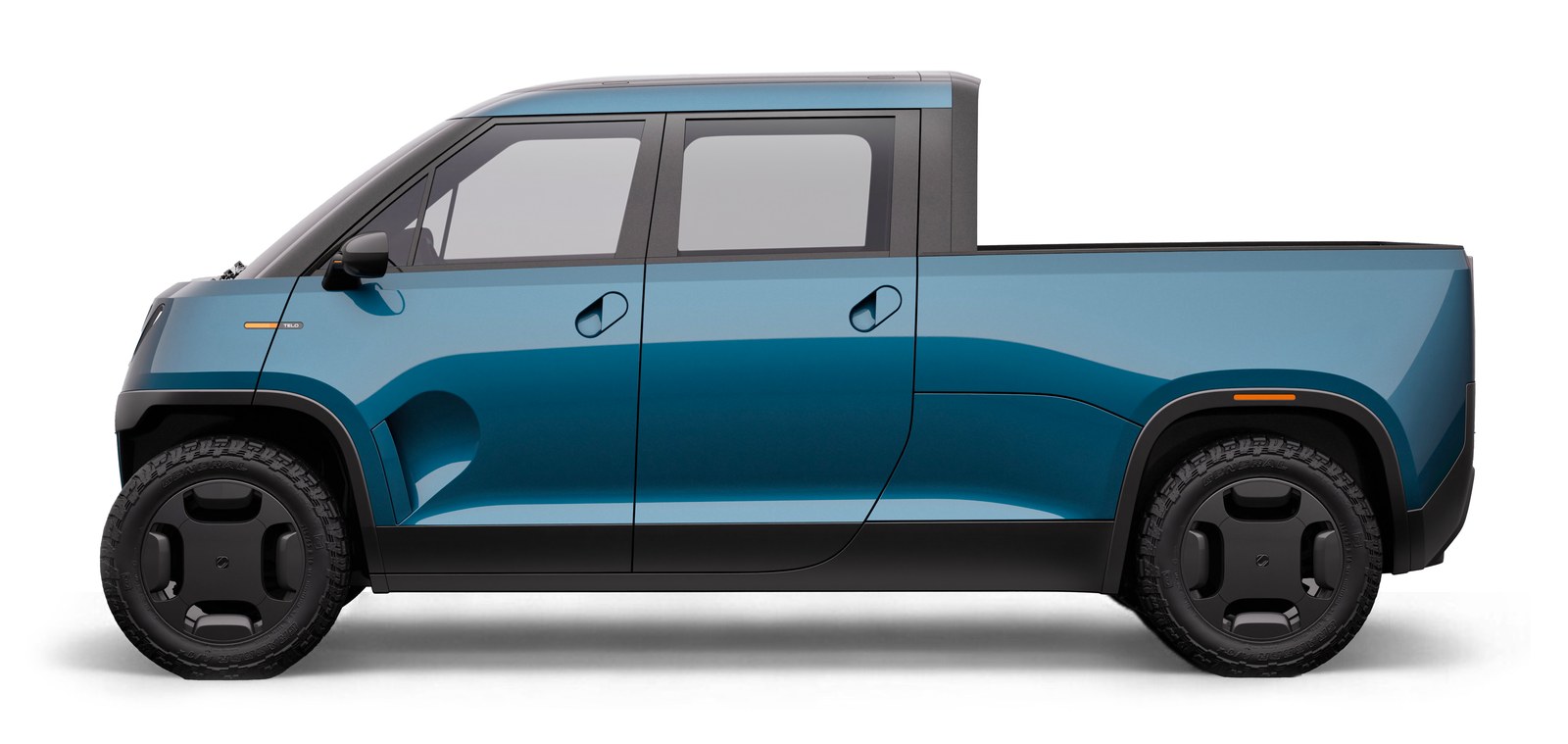
Here is a fact about American pickup trucks that is either a business opportunity or a minor tragedy, depending on your mood: over the past thirty years, they got enormous. The bed shrank, the hood grew, the whole thing ballooned until parking one in a city became a small act of civic aggression. Everybody noticed this. Almost nobody did anything about it, because bigger trucks with bigger margins are a lovely business and questioning them is bad for quarterly earnings.
TELO Trucks noticed it and then did the annoying thing, which is to take the observation seriously. The company, founded in 2022 in San Carlos, California, builds a single product so far: the MT1, a compact all-electric pickup that is 152 inches long. That is shorter than a two-door MINI Cooper. It also seats five adults, has a five-foot bed that extends to eight feet, tows 6,600 pounds, and hauls up to 2,000 pounds. If you are keeping score at home, that is roughly the capability of a mid-size truck in the footprint of a very small car, which sounds like it violates some conservation law but mostly just violates the industry's habits.
The trick, to the extent there is one, is that electric trucks do not need a big engine bay. Take away the internal combustion machinery, lay the battery flat like a skateboard, put the motors where the wheels are, and suddenly the space you used to spend on a giant hood is yours to redistribute. TELO redistributes it toward the cabin and the bed. A folding midgate - a partition between the cab and the bed that swings open - lets the five-foot bed become an eight-foot bed when you need to move something long, at the cost of a rear seat you probably were not using anyway.
The founders, briefly
The people building this are not tourists. Jason Marks, the CEO, spent his early career at National Instruments developing test systems for driver-assistance features on major U.S. automaker platforms; he is also, for the record, a former collegiate pole vaulter, which is the kind of biographical detail that does nothing to explain a truck but is fun to know. Forrest North, the CTO, worked on the original Tesla Roadster, founded the electric motorcycle company Mission Motors, and then built PlugShare, the EV-charging app that a large number of electric-car owners have quietly relied on for years.
The third co-founder is Yves Behar, the designer behind fuseproject, who serves as Chief Creative Officer. Behar's involvement is why the MT1 looks less like a science project and more like a considered object - a truck that is small on purpose rather than small by accident. Design, in a category defined by aggressive grilles and chrome, turns out to be a differentiator when you point it toward restraint.
"TELO has the vision, product, capital efficiency, and manufacturing strategy to make the next great transportation company."
- Marc Tarpenning, Tesla co-founder and TELO investorThe money, and the weird efficiency of it
In September 2025, TELO announced a $20 million Series A. The round was co-led by Behar and Marc Tarpenning, who co-founded Tesla and therefore has some standing to judge whether a small EV company is going to make it. Salesforce CEO Marc Benioff joined, along with TO VC, E12 Ventures, Neo, Uncorrelated Ventures, Nova Threshold, and MCJ. That brought total funding to roughly $28 million, following a $6 million seed led by Neo and a $2 million pre-seed from GoAhead Ventures.
The number that makes venture people sit up is not the $20 million. It is the $8 million - the amount TELO reportedly spent over three years to get to a functioning compact EV pickup. For context, competing EV startups routinely burn $50 million or more to reach a comparable stage, and several of them burned considerably more than that on the way to not existing anymore. TELO's pitch, made explicit by its investors, is that it uses a "liquid and well understood bill-of-materials" - meaning off-the-shelf, sourceable parts rather than bespoke everything - which is the unglamorous discipline that determines whether a car company survives contact with actual manufacturing.
"The MT1 proves that innovation can deliver smarter design. I have great confidence in the TELO team as we build a future-proof vision for mobility."
- Yves Behar, co-founder & Chief Creative OfficerThe demand
The reservations are the part that should make incumbents uncomfortable. TELO has collected more than 12,000 preorders, which the company values at over $600 million in potential sales. Preorders are refundable and therefore soft - a reservation is a wish, not a purchase - but 12,000 wishes for a small electric truck is a strong signal that the "trucks got too big" complaint was real and widespread rather than the private grievance of a few urban weirdos.
Who are these people? Two groups, mostly. The first is urban and suburban consumers who want a truck that can carry a dirt bike or a load of lumber on the weekend but still fit in a city parking space on Monday - the "urban living and weekend adventures" buyer TELO explicitly courts. The second is commercial and fleet operators: contractors on tight job sites, urban-delivery outfits, and anyone who has ever tried to maneuver a full-size work truck down a narrow alley and wished it were about two feet shorter in every direction.
The solar footnote
In 2025 TELO signed an agreement with Aptera Motors - the solar-electric three-wheeler company - to offer integrated solar options on the MT1: a solar cab top, a solar tonneau bed cover, and a solar camper top. It will not charge the truck by itself, and it would be dishonest to pretend otherwise. But it is a nice tell about the kind of company TELO is trying to be: one that optimizes the margins other manufacturers ignore, then lets you check a box for it.
The open question, as with every pre-production EV company in history, is whether TELO can actually build the thing at volume and hand keys to customers. First deliveries are targeted for the end of 2026. Manufacturing is where ambitious car startups go to discover the difference between a prototype and a product, and no amount of clever packaging or capital efficiency exempts you from that reckoning. But the thesis is sound, the demand is documented, and the people running it have shipped hard things before. For a company whose entire premise is "the industry made this needlessly complicated," that is a fittingly straightforward place to stand.