The first minute in a Waymo is mildly theatrical. The car arrives. The door unlocks. A screen asks you to buckle up. Then the wheel turns by itself, the empty driver’s seat stops looking haunted, and the extraordinary collapses into a ride across town. That quick slide from spectacle to routine is Waymo’s most important product achievement. Autonomous driving works commercially only when a passenger can become bored by it.
Waymo began in 2009 as Google’s self-driving car project, a small team chasing ten uninterrupted 100-mile routes in modified Toyota Priuses. It became a separate Alphabet company in 2016 and launched Waymo One in Phoenix two years later. By early 2026, the company said it had delivered more than 20 million fully autonomous rides. In February it raised $16 billion at a $126 billion post-money valuation and described plans for ride-hailing operations in more than 20 additional cities during the year.
That arc makes Waymo a rare thing in artificial intelligence: a research program that escaped the screen, entered public streets and began charging ordinary people. It also means the questions have changed. The old question was whether a car could drive itself. The current questions involve utilization, maintenance, insurance, regulation, rider support and what happens when temporary construction makes a familiar road unfamiliar overnight.
01 / The productThe car is only the visible part
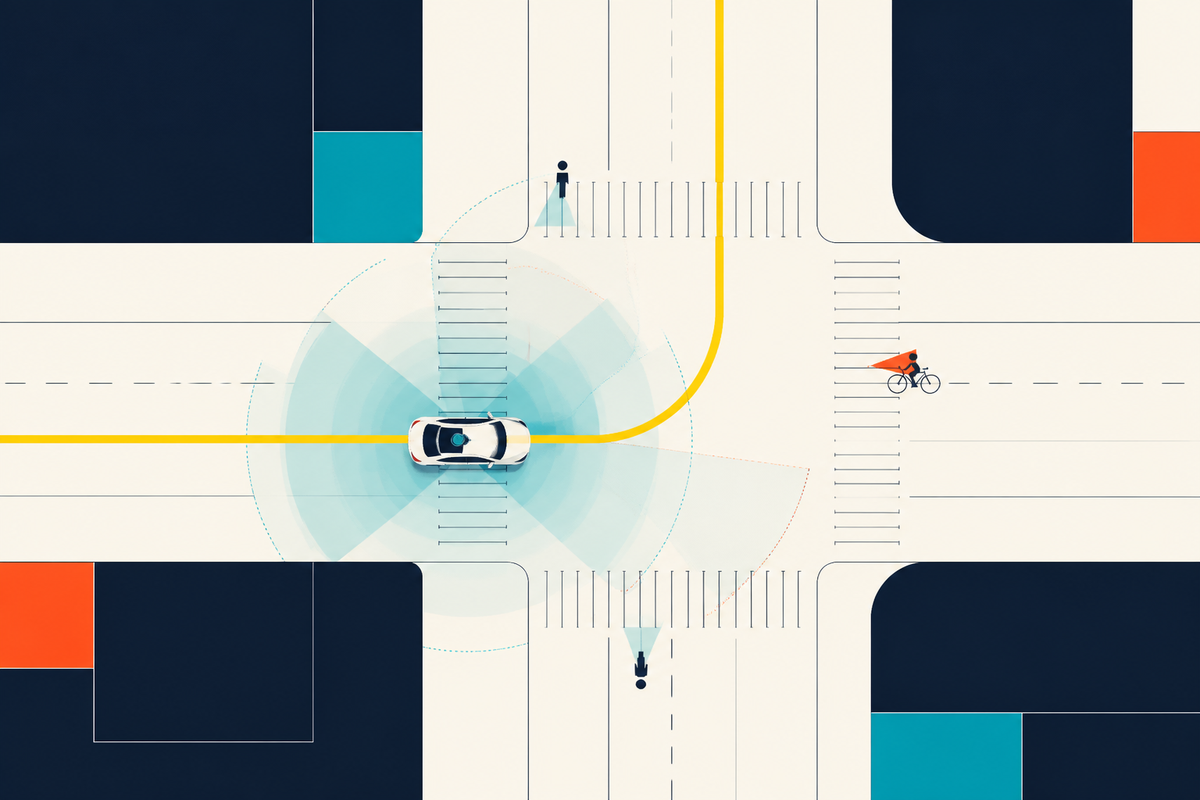
Waymo sells a ride. Underneath it sits the Waymo Driver, a Level 4 autonomous-driving system designed to perform the entire driving task inside defined operating areas. Unlike consumer driver-assistance features, it does not ask a passenger to supervise the road or take over. The Driver combines cameras, lidar and radar with onboard computing, high-detail maps and machine-learning models that perceive objects, predict movement and plan a path.
The distinction matters. A lidar pulse does not make a robotaxi, just as a camera does not make a photographer. The product is the coordinated loop: sensing, prediction, planning, action and evaluation. Real rides generate situations the system can study. Simulation lets engineers replay those situations, alter traffic speeds or visibility, and ask how new software would behave without staging every variation on a public road.
Waymo One wraps that engineering in a consumer service: an app, a price, a pickup point, an in-car interface and human support when a rider needs help. In most active markets, Waymo owns the customer relationship through its app. In Austin and Atlanta, riders request cars through Uber. That split is an early clue about the market’s shape. Autonomy, vehicle ownership, fleet operations and demand generation do not have to belong to the same company.
02 / The customerMobility for people who would rather not drive
Waymo’s customer is not a single demographic. It is the airport traveler with luggage, the late-shift worker, the visitor who does not know the street grid, the commuter who wants twenty quiet minutes and the person who cannot or prefers not to drive. Accessibility is more than a talking point here. A vehicle that requires no driver’s license can offer unusual independence, provided pickup instructions, entry, screens and support are usable.
The forthcoming Ojai vehicle makes that logic physical. Its low step and flat floor ease entry; braille, screen-reader compatibility and a seat-integrated handle address needs that are easy to ignore when a car is designed around a human driver. Three cabin screens turn navigation and climate controls toward the riders. Waymo says the vehicle will be the first to introduce its sixth-generation Driver and is building toward capacity of tens of thousands of Waymo-enabled units per year at its Mesa, Arizona factory.
The empty seat gets the photograph. The repeatable service gets the valuation.What changed when Waymo left the lab
Riders pay a fare shown before booking, much as they do with a conventional ride-hailing app. An outside analysis of tens of thousands of 2025 offers found that customers sometimes paid more for Waymo than comparable Uber or Lyft options. That willingness is informative but not proof of durable economics. Waymo does not publish stand-alone revenue, profitability or vehicle-level margins. A fare must eventually cover the expensive vehicle and sensor package, energy, cleaning, maintenance, depots, insurance, remote assistance and the miles a car travels without a paying passenger.
03 / The argumentSafety is both the advantage and the obligation
Waymo’s clearest differentiation is not that its cars can move without a driver. Several competitors can demonstrate autonomy. It is the volume of fully driverless commercial experience and the safety case built around it. Through March 2026, Waymo reported 220.6 million rider-only miles across Phoenix, the San Francisco Bay Area, Los Angeles, Austin and Atlanta. Compared with human benchmarks for the same areas, its analysis found 94 percent fewer crashes causing serious or fatal injuries, and 82 percent fewer injury-reported or airbag-deployment crashes.
The useful interpretation is neither worship nor dismissal. Waymo’s results are evidence that automated driving can reduce harm in the environments it serves. They are not a universal claim about every road, weather condition or future expansion. The company’s own 2026 software recalls make that boundary tangible. One addressed vehicles’ responses to flooded high-speed roadways. Another followed incidents in which cars entered active freeway construction areas. Waymo restricted operations, updated software and procedures, and later resumed freeway service.
A human driver might call a construction setup confusing and improvise. A deployed autonomous fleet needs the confusion defined, reproduced, tested and governed. That makes public failure unusually visible, but it can also make the remedy systematic: a software improvement can reach thousands of vehicles. Waymo’s challenge is to preserve that learning advantage without asking cities to tolerate mistakes that undermine trust.
04 / The marketFour different bets on the same street
The robotaxi market is not one race with a shared vehicle. Waymo favors geofenced Level 4 operation, custom maps and a multimodal sensor stack. Tesla brings manufacturing scale and a camera-led approach, but its consumer driver-assistance history is different from Waymo’s rider-only record. Amazon-owned Zoox designed a bidirectional robotaxi from scratch, trading the familiarity of a converted passenger car for a cabin built around riders. In China and selected international markets, Baidu Apollo Go, Pony.ai and WeRide have accumulated fleets, partnerships and regulatory experience of their own.
Mapped Level 4 service, lidar + radar + cameras, commercial rides at U.S. scale.
Camera-led autonomy, vertical vehicle manufacturing and a vast consumer fleet.
A purpose-built, bidirectional cab with no conventional driver controls.
Large domestic pilots, lower-cost supply chains and widening overseas partnerships.
Waymo’s moat, if it holds, is compounding experience. Millions of autonomous miles reveal rare combinations of behavior that a smaller deployment may not see. Its custom sensors are designed together with the software. Its partnerships widen the stack: Hyundai supplies future IONIQ 5 vehicles; Toyota and Woven are exploring both a new platform and personally owned applications; Uber supplies demand and operations in two cities. Alphabet supplies the patient capital required for a business whose infrastructure arrives before its margins.
That same stack is heavy. A new city is not a software toggle. It requires mapping, testing, permits, service territory design, charging, maintenance, local emergency-response work and a fleet large enough to keep wait times reasonable. Waymo’s all-electric vehicles avoid tailpipe emissions, and the company procures renewable electricity where possible. In 2025 it estimated that rides avoided more than 18 million kilograms of carbon dioxide. But sustainable transport is still an operational claim, not a paint color: vehicle production, grid mix and empty repositioning miles count.
05 / The next cityDenver is where generalization meets weather
Waymo said in July 2026 that fully autonomous employee rides were coming to Denver, Las Vegas, San Diego and Tampa before a public opening. Denver is the revealing one. Snow, glare, variable road markings and seasonal weather provide a sterner test than the warm-weather cities associated with the first robotaxi wave. The sixth-generation Driver was designed partly to expand the range of weather it can handle; Denver will help show whether lower hardware cost and broader capability can arrive together.
London and Tokyo raise another class of difficulty: left-side driving, different street geometry, denser transit systems, local regulation and public expectations formed far from Phoenix. Waymo’s ambition is a general Driver, but commercialization remains stubbornly local. Every successful opening makes the technology look portable. Every exception reminds the company that roads are culture rendered in asphalt.
The business eventually has to become less interesting. Cars need to show up on time, cabins need to be clean, fares need to make sense, and the vehicle needs to handle the detour that appeared after lunch. Waymo has already crossed the line from technical possibility to public utility. Its next era will be judged by how quietly it operates on the other side.