The man teaching robots to fix what other robots build
Somewhere between a DARPA race course in 2007 and a collision shop in Santa Ana in 2021, Nikhil Naikal figured out something most people in the auto industry still haven't fully registered: the vehicle that just got rear-ended isn't broken mechanically. It's broken digitally. And the trillion-dollar repair industry was not ready for that.
Naikal holds a PhD in Electrical Engineering and Computer Science from UC Berkeley and an MS in Robotics from Carnegie Mellon - the two schools that, between them, basically invented autonomous driving as a discipline. At CMU, he was part of the Tartan Racing team that won the 2007 DARPA Urban Challenge, the famous government-funded robotics race that proved machines could navigate city streets without a human hand on the wheel.
That win planted something in him. He spent the next decade-plus building and selling companies at the intersection of maps, sensors, and software. Flyby Media, where he worked as a computer vision engineer, was acquired by Apple. Mapper.ai, which he founded to build HD machine-readable maps for autonomous vehicles, was acquired by Velodyne Lidar, where he then served as VP of Software Engineering. His Medium bio - "Robotics and autonomy enthusiast. Ex-Velodyne, Ex-Mapper, Ex-Bosch." - is a hacker's CV in nine words.
In June 2021, he co-founded Kinetic with CTO Sander Marques and COO Chris Weber (whose previous stint at Uber gave the team operational muscle). The premise was counterintuitive: don't build a car company, build the infrastructure that fixes car companies' cars. Specifically, the digital systems - the ADAS sensors, the camera arrays, the radar modules - that modern vehicles depend on and that traditional collision shops had no idea how to recalibrate.
"Automotive aftermarket is a trillion dollar industry that has not seen any major innovations in decades," Naikal wrote when he launched the company. The sentence lands differently now that Kinetic has $31M in funding, six operational hubs, and Allstate and Liberty Mutual among its backers.
Kinetic's core product is disarmingly simple in concept, fiendishly complex in execution. After a car comes out of the body shop, every camera, radar, lidar, and ultrasonic sensor in its ADAS suite needs to be recalibrated to tight tolerances. Traditional shops send the car to a dealer. That takes hours. A Kinetic hub does it in under 15 minutes, with robots handling the geometric precision work while AI and computer vision validate the results. A single hub runs up to 80 calibrations a day.
The business model is deliberately capital-light for the collision shops. Kinetic doesn't ask partners to build in-house infrastructure. It operates as a third-party outsourcer - a network that shops route vehicles to, the way hospitals route lab work to a diagnostics center. "They're not promising X capacity; we ask to be their primary vendor, and we earn that right," Naikal has said.
His technician hiring strategy is equally unconventional. Kinetic recruits from Sprint retail stores. The reasoning is pure Naikal: you don't need someone who already knows cars; you need someone comfortable with technology and hungry to learn. He modeled the certification program on Apple's Genius Bar - fast certification, competitive pay, and a clear path for people coming from non-traditional backgrounds.
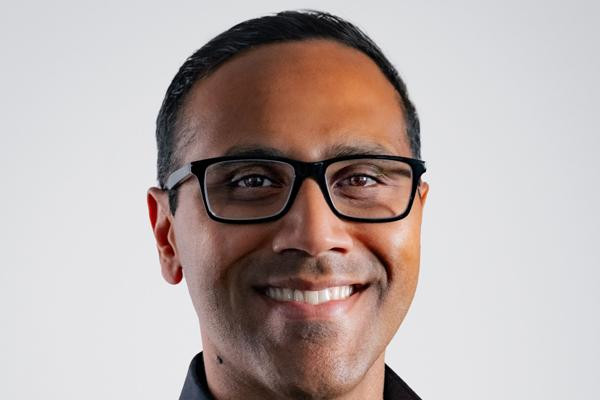
"We want to be the 'Intel Inside' for the automotive repair industry."Nikhil Naikal — CEO, Kinetic
The analogy Naikal keeps returning to is Intel. In the 1990s, Intel didn't sell computers. It sold the chip inside every computer - the component that everything else depended on, invisible to the end user but irreplaceable to every manufacturer. That's the position he wants Kinetic to occupy in the repair ecosystem.
"Collision repair is a geometry and physics problem, not an AI problem," he's said - a disarmingly un-buzzwordy statement from a robotics PhD running an AI company. It's the kind of precision that marks someone who actually built the systems rather than just marketed them. The AI, in Naikal's view, is the connector between the messiness of real-world repair (every car comes in different, no two accidents are the same) and the structured precision that automation requires.
His expansion logic is similarly data-driven. He dismisses shop count as a "false metric" because geography distorts it - a hub in Manhattan serves a completely different volume than a hub in Fresno. Instead he focuses on calibration capacity per market, density of collision shops within range, and the presence of anchor MSO partners willing to outsource to Kinetic as their primary ADAS vendor.
The partnership with Chilton Auto Body in San Carlos, announced in May 2025, marks what Naikal described as "the first time in our company history where we have perfect alignment with the MSO" - meaning Chilton's operators, its private equity backers, and the insurance companies covering its region all wanted the same thing. That alignment, he argues, is the template for every future market Kinetic enters.
Backed by two major insurance companies (Allstate and Liberty Mutual) as investors, Kinetic has structural advantages that purely technology-first startups don't: the entities that ultimately approve and pay for repair claims are inside the tent.
"You need AI to bridge the gaps between collision repair's unpredictable nature and structured automation processes."Nikhil Naikal — CollisionWeek Interview, 2025
Modern vehicles have become mechanically simple and digitally complex.
Automotive aftermarket is a trillion dollar industry that has not seen any major innovations in decades.
Larger MSOs want standardization. They maximize EBITDA when throughput is high.
We're not only training technicians on standard industry practices, but also on how to operate advanced machinery like robots.
Collision repair is a geometry and physics problem, not an AI problem.
They're not promising X capacity; we ask to be their primary vendor, and we earn that right.
Home of the DARPA Urban Challenge-winning Tartan Racing team. Where Naikal first worked on autonomous vehicles navigating real city streets.
Dissertation work in computer vision, object recognition, and indoor localization. 9+ publications, 603+ citations, h-index 9.
Kinetic operates a network of highly automated service centers built for the digital repair of modern vehicles. The core service is ADAS sensor calibration - the precise realignment of cameras, radar, lidar, and ultrasonic sensors that post-collision repair requires. This isn't optional for modern cars: a misaligned forward camera means a malfunctioning lane-keeping system, a broken emergency braking trigger, or a blind-spot monitor that lies to you.
Each Kinetic hub uses proprietary robotics, computer vision, and machine learning to run calibrations at tolerances that manual methods can't consistently hit - and at a speed that makes the economics work for high-volume collision shops. The platform also includes AI-powered diagnostic software that identifies which modules need calibration before the technician touches the car.
Backed by Menlo Ventures, Lux Capital, Construct Capital, and the strategic arms of Allstate and Liberty Mutual, Kinetic sits at the center of a structural shift: as vehicles become software platforms on wheels, the repair infrastructure has to catch up. Naikal is building that infrastructure.