Palo Alto · Physics AI · Est. 2023
Vinci.
The startup teaching artificial intelligence the laws of physics - so a chip can be tested before it is ever built.
The startup teaching artificial intelligence the laws of physics - so a chip can be tested before it is ever built.
Somewhere in a semiconductor lab, an engineer is waiting. The design is done. The question that matters - will this package warp under heat, will this device throttle itself into uselessness - sits inside a simulation queue that will not finish for days. By the time the answer arrives, the next deadline has already moved. This is the quiet tax on modern hardware: not a lack of ideas, but the long pause between an idea and the proof it works.
Vinci's entire reason for existing is to delete that pause.
The company, legally Vinci4D, Inc., builds a foundation model for physics. Instead of grinding through the slow numerical machinery of traditional finite-element analysis, it predicts how a physical system behaves - thermal, thermo-mechanical, the warpage that ruins advanced chip packages - up to a thousand times faster. It does this without meshing, the painstaking step that engineers have dreaded for decades, and without ever training on a customer's proprietary geometry. Speed and secrecy, usually a trade, arrive together.
"Vinci has demonstrated lightning-fast, high-accuracy simulations without requiring customer data for some of the world's most complex physical devices."
There is a pleasing irony at the center of this company. Hardik Kabaria spent his Stanford doctorate cracking one of simulation's most stubborn problems: automating high-fidelity meshing, the carving-up of a complex shape into millions of solvable pieces. He got good at it. Then he spent fifteen years in physics simulation, including a stretch at Carbon working with the likes of Ford and Specialized Bicycles, watching the same bottleneck strangle every ambitious hardware project he touched.
So he built a product that throws the mesh away entirely. Vinci's model does not chop geometry into a grid and crawl through it. It understands the governing physics directly, then pairs that understanding with solver-grade accuracy. Kabaria's verdict on the old way is blunt: as hardware complexity climbed, "the traditional simulation stack becomes a major bottleneck."
Computational-geometry expert. Stanford PhD on automating high-fidelity meshing; ~15 years in physics simulation before founding Vinci in 2023.
A pioneer in large-scale machine learning and autonomous systems - the production-ML half of a team built to fuse physics with shippable software.
That last detail is the point. Plenty of teams can do physics. Plenty can do machine learning. Vinci was assembled precisely to unite two domains that rarely talk to each other - physics-based simulation and production-grade AI. As Eclipse's Charly Mwangi put it, "few teams combine deep physics expertise with the ability to ship real, production-ready software."
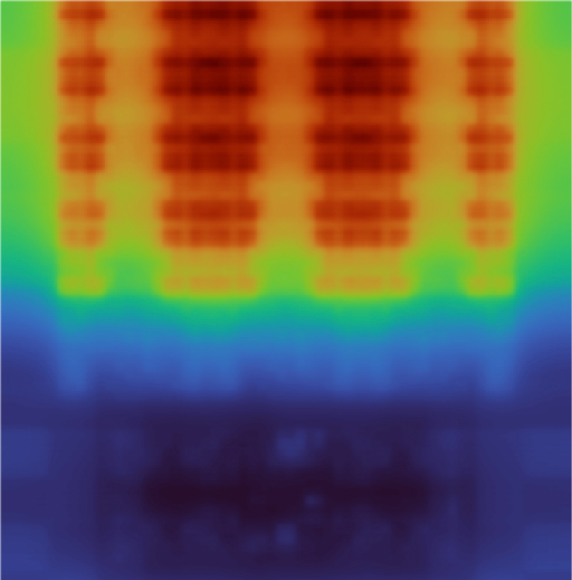
Illustrative, based on Vinci's published semiconductor packaging case study. Accuracy benchmarked against commercial FEA solvers.
Vinci's pitch to a hardware team is disarmingly practical. Two questions, the kind that keep packaging engineers awake: Will this device get hot enough to shut down? Will this package warp under thermal stress? The product answers both - on real designs, at manufacturing resolution, in minutes rather than days.
Native understanding of physical law, fused with FEA solver accuracy. Full manufacturing-resolution results, no meshing, no per-case retraining.
Production-grade prediction of warpage and thermal stress in advanced packaging and 2.5D/3D ICs, at manufacturing scale.
Nanometer-resolution thermal conduction on complex real geometries, run in minutes and validated for accuracy.
Runs without exposing proprietary geometry. Your IP stays yours - the model learns physics, not your designs.
"Few teams combine deep physics expertise with the ability to ship real, production-ready software."
For most of its history, simulation has been an event. You design, you finish, you submit the job, you wait, you pray. Vinci's ambition is to turn that event into a continuous condition - physics that runs alongside the design, answering questions as fast as an engineer can ask them. The company frames the long arc plainly: simulation should be continuous, not episodic. The near-term beachhead is semiconductor thermal and thermo-mechanical work; the longer horizon is a foundation model for each class of part the world makes.
So return to that lab, and the engineer who was waiting. The design is done; the question that matters is the same. Only now the answer does not arrive in days. It arrives before the coffee gets cold - accurate enough that more than half of the industry's biggest names checked the math themselves. The pause is gone. What fills the space it left is the thing hardware has always been short on: another try.
Watch & listen: video podcast - "How AI and Physics Reinvents Hardware Design" with CEO Hardik Kabaria. Product demos and simulation walk-throughs are featured on the Vinci homepage.