Somewhere between a prototype and a product, an engineer has to make the thing fail. A battery is charged and drained until it complains. A radio is assaulted with signals. An aircraft actuator is pushed through years of motion in a fraction of the time. The work sounds destructive, but its purpose is reassurance: find the lie before the customer does. NI, the Austin company long known as National Instruments, sells the hardware and software that stage these interrogations.
The company does not fit neatly in the instrument cabinet. It makes oscilloscopes, data-acquisition modules, radio-frequency gear and rugged controllers, but the physical boxes are only half the proposition. LabVIEW, TestStand, SystemLink, VeriStand, FlexLogger and the rest of its software portfolio coordinate instruments, run sequences, analyze measurements and keep track of fleets of test stations. The pitch is less “buy this meter” than “build a test system you can alter without starting over.”
A computer invaded the instrument rack
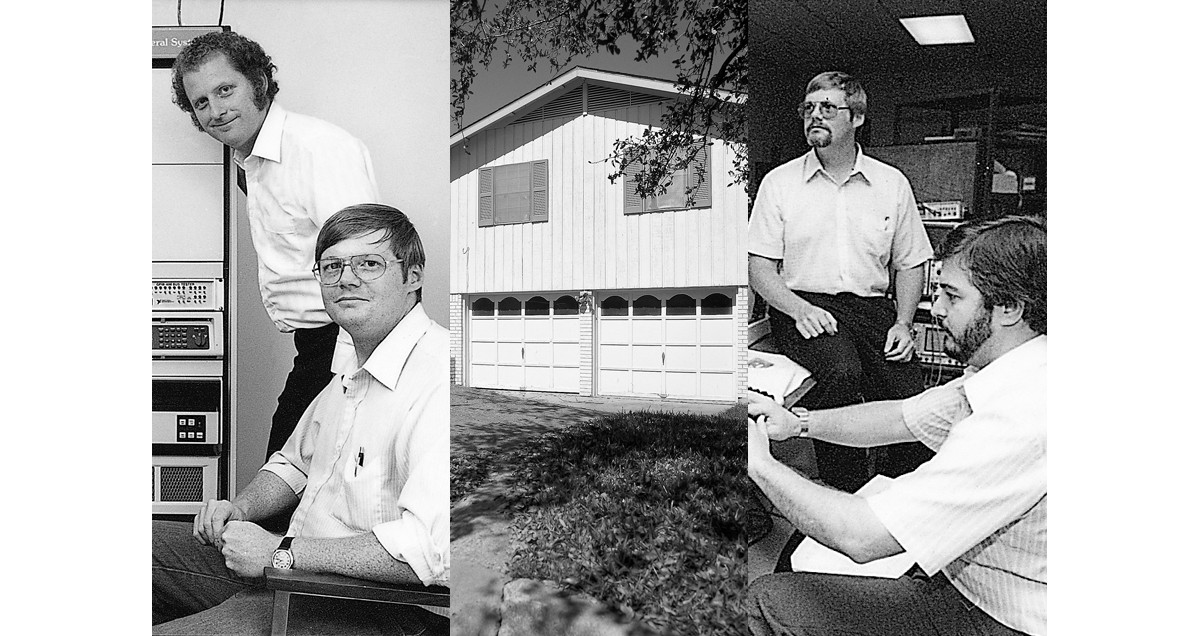
The founding insight was wonderfully plain. In 1976, University of Texas colleagues James Truchard, Jeff Kodosky and Bill Nowlin began working out of Truchard's garage on a way to connect laboratory instruments to computers. NI's first interface product followed in 1977. The company was not inventing measurement; it was making measurements easier to command, collect and reuse.
Then came the product that made NI peculiar. LabVIEW launched on the Macintosh in 1986 with a graphical, dataflow language. Instead of writing only lines of text, engineers could wire functional blocks together on screen and watch data move through an application. Programs became “virtual instruments,” or VIs. The interface matched the way many experimental systems were already sketched: signal enters here, gets filtered there, triggers this action, then lands on that display.
“The instrument is the software.”NI's defining product philosophy
That philosophy changed what NI could charge for. A customer might begin with a data-acquisition device, then add LabVIEW, signal-conditioning modules, support, training and another test station. Engineering time already invested in code and workflows made the next NI purchase easier to justify. The model blended hardware sales with software licenses and subscriptions, services and certification - supported by direct sales, distributors and specialists who could finish the last mile.
PXI put shelves on the idea
Software needed a physical architecture. In 1997, NI developed PXI, a rugged modular standard built around PC technology, precise synchronization and card-sized instruments installed in a chassis. The practical image is a stereo rack for serious measurements: choose a controller, slide in the instruments a job requires, and coordinate them in software. NI made the specification open; today an industry alliance of more than 70 companies governs it.
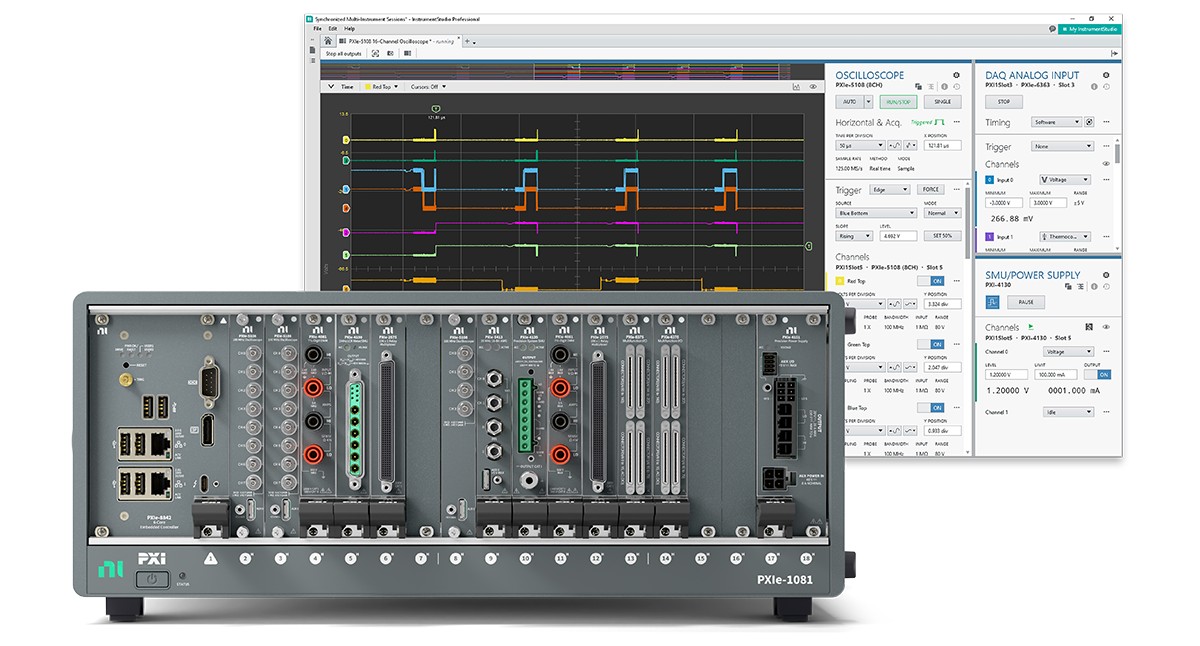
Around that center, the portfolio divides by job. CompactDAQ acquires temperature, strain, vibration, voltage and other sensor data in the lab or field. CompactRIO adds real-time processing and a programmable FPGA for control work that cannot wait politely for a desktop operating system. TestStand runs validation and production sequences. SystemLink deploys software, monitors assets and pools data across distributed laboratories. PXI handles demanding, high-channel-count automated tests. LabVIEW remains the connective tissue, while Python, C++, C# and third-party instruments can join through drivers and APIs.
Who buys this? In 2022, the last full year before the takeover, NI reported more than 35,000 customer accounts and $1.66 billion in revenue. No customer contributed more than 4 percent. The list crosses semiconductors, electronics, vehicles, aerospace, defense, energy, industrial machinery, life sciences and universities. Collins Aerospace standardized electromechanical testing on PXI, CompactRIO and LabVIEW. NXP has used NI collaboration to push common automation into semiconductor validation. A recent Lunar Energy case describes one architecture spanning controller and power-electronics testing from development into production.
The recurring problem is fragmentation. Separate teams buy separate instruments, write overlapping code and save results in incompatible places. When a new product arrives, the organization pays again in fixture design, sequence development, correlation and maintenance. NI's answer is standardization without complete uniformity: common chassis, reusable modules, shared execution software and enough openness to retain existing code or third-party hardware.
The first thing that failed was the clean rewrite
A platform's advantage becomes its constraint. Long-lived aerospace and factory programs do not appreciate fashionable incompatibility. NI learned that with LabVIEW NXG, a next-generation reworking released in 2017. Customers liked parts of it, but they also warned about migrating to an entirely new LabVIEW product. In 2020, NI said it would end NXG development after version 5.1, issued in 2021, and direct investment back to the established LabVIEW line while reusing NXG work elsewhere.
This was the right kind of retreat. NI did not pretend the migration cost belonged to the customer. It recognized that a cleaner new architecture loses if it strands decades of test code, drivers and trained people. The episode reveals what customers truly buy from NI: continuity under change. A test station may outlive the laptop used to program it, the engineer who commissioned it and several product revisions. Backward compatibility is not housekeeping. It is part of the product.
The courtship got expensive in public
Emerson began approaching NI privately in May 2022, first at $48 a share and later at $53. NI resisted exclusive negotiations, started a strategic review and adopted a shareholder-rights plan. Emerson took the bid public in January 2023. That move replaced a quiet industrial courtship with a brightly lit auction. By April, the companies had an agreement at $60 a share in cash. The acquisition closed that October at an equity value of $8.2 billion.
What changed NI's mind was not romance. It was price, process and alternatives. The board opened a broader review rather than accept Emerson's earlier terms, and the final agreement delivered a higher figure. Emerson, meanwhile, saw a route into discrete industries adjacent to its process-automation base. It estimated a $35 billion priority addressable market and $165 million in cost synergies. NI brought instruments, software and relationships in semiconductor, transportation and aerospace testing; Emerson brought global scale and a larger automation portfolio.
| Choice | Best when | The catch |
|---|---|---|
| NI platform | Tests must scale, synchronize and be reused across teams or products. | Licensing, training and integration can be substantial. |
| Box instruments | A bench needs a few excellent standalone measurements. | Automation and fleet reuse can become a cable-and-script project. |
| Custom / open source | The team has deep software talent and unusual requirements. | It owns drivers, timing, support and maintenance forever. |
Competitors attack from several directions. Keysight, Rohde & Schwarz and Tektronix sell deep instrument portfolios. Advantest is formidable in semiconductor production test - and also partners with Emerson on real-time analytics. MathWorks and Python-centric stacks compete for the engineer's desktop. Dewesoft and HBK cover important acquisition and measurement territory. A competent internal team can build a custom rig from all of them. NI's distinction is the integrated middle: modular hardware, precise timing, domain software and an ecosystem of integrators that can turn components into a supported system.
Nigel enters a room where mistakes have voltage
The post-acquisition product story now has an improbably friendly name. Nigel is NI's test-focused AI assistant. It began by answering questions and guiding users through hundreds of software functions. In 2026 releases, NI expanded it across LabVIEW, TestStand, VeriStand, InstrumentStudio and FlexLogger. LabVIEW can generate measurement VIs from a prompt; TestStand can turn a specifications document into a sequence using existing or placeholder code modules. SystemLink integration remains on the roadmap.
This is not the same risk profile as asking a chatbot to draft an email. Test code can energize hardware, accept a defective component or stop a line. NI explicitly warns that Nigel can make mistakes and tells users to review its responses. The sensible value is narrower than autonomous engineering: reduce the blank-page problem, expose the correct function, scaffold a sequence, then let an accountable engineer inspect the result. In a domain built on proof, an answer without traceability is merely another thing to test.
Standardize the layer customers repeatedly rebuild. NI chose instrument control, timing and test execution, then made reuse the economic argument.
Own the workflow without demanding a sealed world. PXI standards, multivendor drivers and Python APIs widen the system's useful life.
A mature platform contains customer capital. Treat migration cost as a product constraint, not an inconvenient footnote.
There are conditions where the platform logic weakens. A one-off temperature reading does not need an enterprise test architecture. A software-only simulation may need no NI hardware. Small teams can find commercial licenses and specialist skills harder to justify than a script and a commodity device. Ultra-specialized measurements may favor a rival's instrument, and regulated work still requires validation that no general platform supplies by magic. NI works best when complexity repeats: many channels, tight synchronization, several product generations, distributed stations or expensive failures.
That boundary is also the reason the company matters. Modern products contain more radios, sensors, embedded software and silicon, which means more ways to be almost correct. NI occupies the unglamorous checkpoint where “almost” gets measured. The founders connected one instrument to one computer. Nearly 50 years later, Emerson is betting that the same abstraction can connect whole test organizations - their hardware, code, people and evidence - without asking them to rebuild the bench every time the world changes.