A tote sounds like an easy assignment for a robot. It has edges. It stays put. It does not complain. But at a Texas warehouse, three conveyors sat close together, and two delivered totes in stacks of varying heights. A machine would have to find the right edge before it could lift anything. The interesting problem began where the product brochure ended.
- The job: connect industrial components into usable automation.
- The method: test the application before committing to the build.
- The buyer’s choice: a part, an assembly or an engineered system.
The tote is the test
Motion Automation Intelligence paired a Photoneo scanner with an OnRobot gripper and custom, 3D-printed fingers. Its published account says the totes weighed up to 40 pounds. Robotics specialist Parth Sagpariya produced a proof of concept within two weeks; the order closed within two months. Motion AI credits the demonstration, simulated throughput and custom components with winning the work.
The detail to notice is the finger. A general-purpose machine became useful through something shaped for one particular object. For an automation buyer, that is a reason to bring the engineering team a real sample early. The awkward lip of the container deserves attention before the purchase order.
of concept
to order
One published application. These are project milestones, not standard delivery promises.
A gathering of specialists
Motion AI’s history helps explain that attention to the application. Motion announced the business brand in February 2022, bringing together specialist operations including AMMC, Axis, BRAAS, F&L, Integro, Kaman Automation and Numatic Engineering. Established technical businesses now had a shared name and a wider set of capabilities to draw upon.
“We approach each opportunity as consultants,” said Aurelio Banda, then Motion’s group vice president of automation, at the launch. The sentence describes a commercial opportunity: customers can know what they want a machine to accomplish while still needing help deciding what belongs inside it.
The customer might be an equipment manufacturer, an integrator or a factory’s own engineering team. Motion AI serves semiconductor, pharmaceutical, medical, logistics, automotive and aerospace applications, among others. Across those settings, the requirements change. A supplier needs enough technical range to follow the problem from mechanical movement through sensing and controls.
Choose how much of the machine to buy
Motion AI offers three levels of involvement. Customers can buy components and install them themselves. They can order assemblies that connect to existing equipment. Or they can commission more complete engineered solutions. The catalog includes drives, motors, controllers, robots, pneumatics, framing, safety equipment and industrial networking.
That gives the business several ways to earn its place in a factory’s purchasing process. A straightforward replacement can remain a product transaction. A difficult application can become a design, assembly and integration engagement. Its Solutions Engineering Division also lists commissioning, customer training, technical support and maintenance contracts.
- 01 / COMPONENTSource the part.Your team applies it.
- 02 / ASSEMBLYConnect the pieces.A configured subsystem.
- 03 / SYSTEMEngineer the job.Build and commission.
The competition includes Applied Industrial Technologies’ automation businesses, which also sell engineering expertise alongside robotics, vision and motion products. Regional integrators and a customer’s internal team are other options. Motion AI’s proposition is the combination of distribution and engineering across disciplines. Buyers still have to assess the proposed team, scope and support.
A useful cost comparison therefore includes the work surrounding the hardware: design, integration, commissioning, training and continuing service. Those are activities Motion AI explicitly offers. Comparing only the robot price leaves a purchasing team with an incomplete picture of what it is asking someone to deliver.
The sensor that cried jam
A September 2026 technical article makes the sensing problem easy to understand. A conventional photoelectric sensor detects an interrupted beam. On a crowded conveyor, a temporary cluster of moving packages can resemble a blockage. The resulting alarm can interrupt a line that was still doing its job.
Motion AI describes Zebra’s Iris GTX cameras and Aurora Vision software observing a broader area and assessing movement and congestion. The failure mode is specific: the signal can be accurate about one point while misleading about the process. A wider view gives the control system more information before it stops the conveyor.
“We approach each opportunity as consultants.”
Aurelio Banda · Motion automation brand launch, 2022
This is where machine vision becomes practical. The question is whether better information improves a particular decision. An inspection system has to distinguish acceptable products from defects; a handling system has to locate something it can grip. Cameras, lighting, software and material handling must agree on the task.
Intelligence needs floor space
Some of that work requires a substantial building. Motion AI’s Eden Prairie facility opened in June 2022 with 105,000 square feet, up 55,000 from its previous location. It combines engineering labs, a proof-of-concept area, classrooms, fabrication, assembly and fulfillment. Customers can encounter the experiment and the means of building it in the same operation.
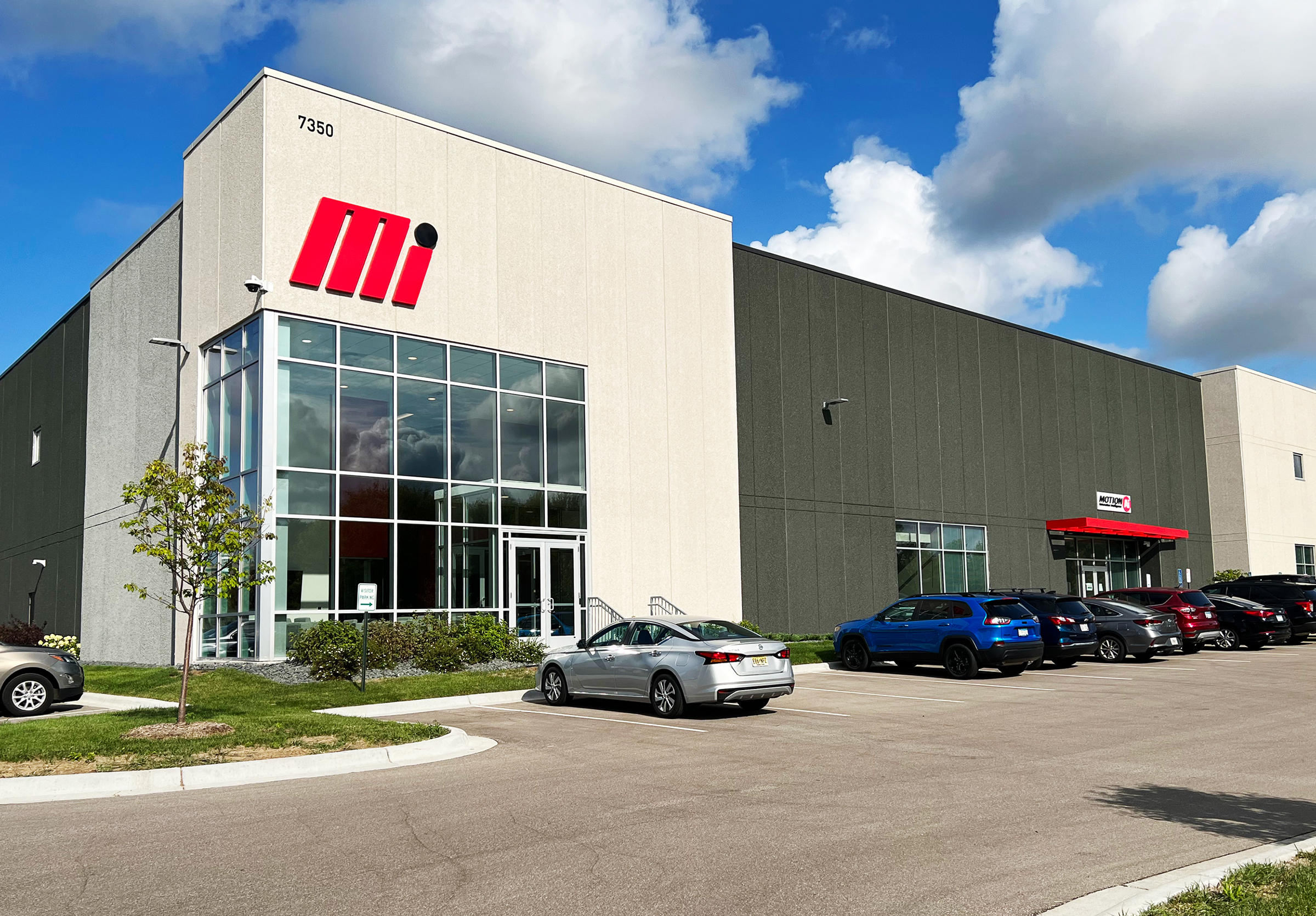
Massachusetts added another piece: a 33,000-square-foot Beverly facility opened in December 2022. The company’s April 2023 announcement linked the space to manufacturing, inventory and larger orders. Its hiring needs included automation engineers, electromechanical assemblers and quality technicians. The business depends on people who can build and check the proposed solution.
There is also a larger ownership story in progress. Motion AI operates within Motion, part of Genuine Parts Company. GPC announced plans in February 2026 to separate its automotive and industrial businesses, targeting the first quarter of 2027. That timetable concerns the broader group. The engineering task facing a customer remains wonderfully concrete: make this process work.
Bring the awkward part
For a prospective customer, the useful first step is a precise brief. Bring the actual product, its variations, the required production rate and the constraints of the existing line. Ask what the demonstration will establish and how the finished system will be accepted. Motion AI’s vision group describes sample testing, design reviews and dedicated project teams.
It is worth agreeing on who will handle changes after installation, too. Motion AI’s vision offering includes training, troubleshooting and continuing support; its engineering division lists on-site assistance. Those services belong in the scope discussion. A factory needs to know who can diagnose a problem when the original project team has moved on to the next build.
A simple replacement may need only a component order. A changing product mix may demand further tests before a fixed design makes sense. Supplier availability also varies by location. The scope should follow the application. The warehouse tote supplies the useful reminder: start with what the machine must touch, see and do.