The blower was getting hot. In a bakery case study published by Regal Rexnord, a monitoring system noticed temperatures above its alarm settings. An inspection found vibration. During planned downtime, technicians replaced bearings and belts, corrected alignment and investigated further. Thermal imaging revealed holes in the recirculation blower. They welded in new sheet metal. The interesting number came afterward: the company calculated that avoiding 48 hours of downtime had protected $168,000.
- Make the components that power, transmit and control motion.
- Combine them into systems that save customers engineering work.
- Watch for trouble early enough that maintenance can stay on the calendar.
At $3,500 an hour, an unremarkable blower becomes a consequential piece of equipment. That is a useful way into Regal Rexnord, a company whose products tend to disappear inside somebody else’s machine. Bearings, couplings, motors and controls rarely get the photograph. They do get the responsibility.
The machine inside the machine
Regal Rexnord supplies the physical infrastructure of movement. A motor creates it. A gearbox changes its speed and torque. A coupling connects rotating shafts. Bearings support them. Controls tell the assembly what to do. Put these things together properly and a production line can move the right load at the right speed.
Its customers include equipment builders, distributors, system integrators and the people operating factories. The applications stretch from food processing and HVAC to aerospace, surgical equipment and data centers. These buyers have different specifications, but they share a practical concern: equipment must perform reliably under the conditions in which it actually works.
The company organizes that work into three businesses: Industrial Powertrain Solutions, Power Efficiency Solutions, and Automation & Motion Control. The names sound like an industrial directory. The distinction matters because Regal Rexnord can supply individual components or assemble several technologies into a larger working subsystem.
A robot with somewhere else to go
Consider a collaborative robot fixed beside a workstation. Its arm can reach only so far. Put the robot on a powered linear rail and it can travel between workstations. Now somebody has to make the rail, gearing, motor, coupling and software behave as one assembly.
In August 2026, Regal Rexnord announced a FANUC collaboration that does exactly that for supported CRX cobots. Thomson supplies linear motion technology, Boston Gear the gearheads, Huco the couplings, and Kollmorgen the motors and software. Configuration tools are accessible through the FANUC teach pendant. A similar collaboration with ABB Robotics was announced in 2025 for GoFa cobots.
The competitive argument is concrete: fewer interfaces for the buyer to sort out. An integrator can spend less effort reconciling components and more on the production task. Specialist suppliers remain alternatives when a customer needs a particular part. Regal Rexnord’s broader pitch becomes more persuasive when the difficult work lies between the parts.
The selling model follows those different needs. Equipment makers buy components for new designs; distributors help supply replacements; operators can add reliability services and monitoring. A replacement order and a newly engineered subsystem are different purchases, even when they share a supplier. For a buyer uncertain about a conveying application, Regal Rexnord also offers customer testing at its Innovation Center without a testing charge. Running actual packages across candidate equipment is a useful antidote to choosing from a catalog alone.
The portfolio had a price tag
This breadth was assembled over time. The Regal lineage began in 1955 as Beloit Tool, operating from a converted roller rink in Wisconsin. In October 2021, Regal Beloit combined with Rexnord’s Process & Motion Control business and adopted the Regal Rexnord name. The transaction brought motors and mechanical transmission closer together.
Then came Altra Industrial Motion. The March 2023 acquisition carried an announced enterprise value of $4.95 billion. Management targeted $160 million in annualized cost synergies by the fourth year. Those were expectations at the time of the deal, rather than a receipt proving the savings had arrived.
Buying the capabilities was the opening move. Integrating them was the work that followed.
The financing created obligations alongside the opportunity. At the end of the second quarter of 2026, Regal Rexnord reported net debt to adjusted EBITDA, including synergies, of 3.06 times. Portfolio editing also ran in the other direction: the industrial motors and generators sale to WEG closed in April 2024 after a $400 million agreement.
A sensor still needs a mechanic
The bakery story shows what the digital layer can accomplish. Perceptiv gathers condition information and helps teams identify developing problems. In that case, the alarm led to inspection, replacement, alignment and welding. The saved production time depended on people doing physical work. An alert alone would have left the blower exactly as it was.
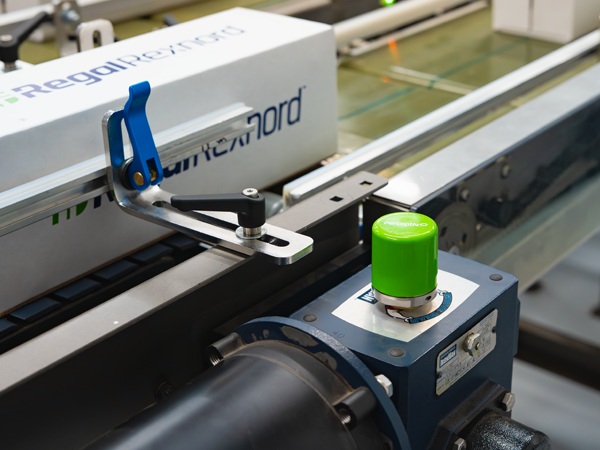
Arrowhead Intelligent Conveyors make the same idea part of the initial purchase. The offering includes factory-installed vibration and temperature sensors. Its gateway and professional installation offer requires a one-year subscription purchase. Hardware, monitoring and service can therefore belong to the same customer relationship, although the commercial terms still need reading.
Estimated downtime cost avoided. This is the case’s calculation, not a universal savings forecast.
A plant manager can copy the sequence without copying every purchase: identify a costly stoppage, understand its physical causes, then decide what sensing and maintenance response would change the outcome. Where downtime is inexpensive, the calculation may favor a simpler approach. Where nobody can investigate an alarm, more measurements will leave the central problem unresolved.
The sensible comparison starts with the existing machine. How often does it stop? What does each interruption cost? Which failures give detectable warnings? Those questions turn a technology proposal into an operating decision. They also help separate an appealing demonstration from an upgrade that earns its place.
The next job is making it repeatable
Aamir Paul was serving as CEO by the August 2026 results announcement. His stated objective included building growth while delivering predictable results. It is an apt assignment for a company that has accumulated capabilities through major combinations. Customers experience those capabilities one delivery, installation and service visit at a time.
“Ultimately, the goal is to create a sustainable platform for growth, while also delivering predictable results along the way.”Aamir Paul / August 2026
For buyers, the useful question is whether a proposed assembly lowers the combined burden of engineering, energy, maintenance and interruption. Regal Rexnord’s strongest examples answer that question at machine level: a robot reaches another workstation; a conveyor reports its condition; a blower gets repaired before production stops. The ordinary parts earn their attention.