Consider the motor nobody notices. It sits behind a pump, or beneath a fan, turning electricity into something useful. The room gets cooler. Water reaches another floor. Nothing about this looks like a technology story until the motor needs replacing. Then a small metal cylinder becomes a question about wiring, controls, downtime, and who will pay for all three.
- The business: motors and controls for equipment makers and the replacement market.
- The useful twist: efficiency upgrades designed around installation and maintenance.
- The test: whether the whole system saves money, and keeps its promises.
This is the territory of Nidec Motor Corporation. Its U.S. MOTORS brand serves pumping, ventilation, refrigeration, water treatment, and other applications where movement is useful and interruption is expensive. The interesting product is often the one that lets a customer improve a machine without redesigning everything around it.
A motor with two birthdays
The company has an unusually revealing origin. Its predecessor began in Los Angeles in 1908 as U.S. Electrical Manufacturing Company. It joined Emerson in 1962. The present Nidec Motor Corporation emerged when Japan’s Nidec acquired Emerson’s motors and controls business in 2010. One business, two birthdays: an established manufacturing lineage inside a newer corporate structure.
The acquisition was a deliberate expansion. Nidec, already known for small precision motors, wanted a stronger position in industrial and appliance motors and a North American presence to complement Asia and Europe. Its later financial reporting recorded ¥57.442 billion in cash consideration. The buyer acquired an operating business, bringing established products and customer relationships into its wider motor strategy.
That distinction matters today. Nidec Motor Corporation is the Missouri-based subsidiary; Nidec Corporation is the Kyoto-based parent. Their histories overlap, but their financial figures are not interchangeable. The subsidiary’s story is clearest when told through the equipment it supplies.
The replacement is the product
Take SynRA. Introduced in 2022, its name spells out an engineering proposition: Synchronous Reluctance Motor with Aluminum Cage Rotor. The rotor has no magnets. The design combines an induction motor’s starting characteristics with synchronous operation, reducing a source of motor losses. Nidec also designed it to work with simpler volts-per-hertz control.
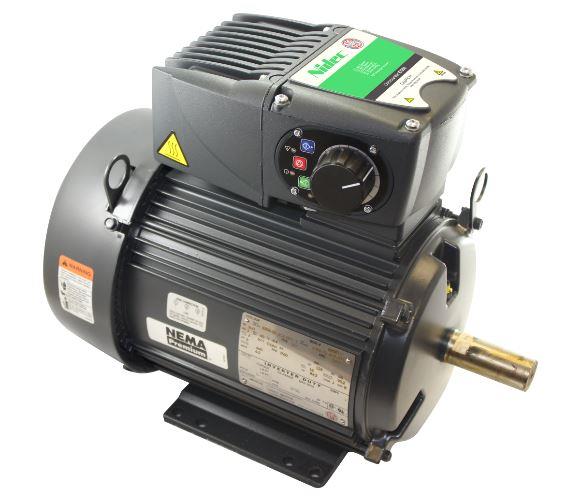
The sales argument becomes more interesting at replacement time. Nidec says components can be replaced individually, rather than requiring an entire new system. Its launch material points to compatibility with existing variable-frequency drives. For a maintenance team, that can mean less disruption, fewer replacement decisions, and a smaller job to organize.
There is consequential small print. The current SynRA catalog says drive-operated only, unsuitable for direct-on-line use. It lists IE4 and IE5 variants at different ratings. An efficiency class is not a promise that every configuration suits every pump. Voltage, speed, enclosure, load, and controls still need checking.
A good upgrade has to fit the machine, the maintenance crew, and the bill.
THE BUYER’S EQUATION
This puts Nidec in a competitive neighborhood with motor suppliers such as WEG and ABB’s Baldor-Reliance. Efficiency alone cannot settle that contest. Selection, availability, support, and compatibility belong in the comparison. Nidec’s practical pitch gives the customer a reason to consider changing the motor while preserving more of the surrounding installation.
The bill keeps spinning
The business model follows the machinery. Nidec sells stock and application-specific motors and controls to equipment manufacturers and through distribution and replacement channels. Application engineering helps match the product to the job. Technical literature, selection tools, and service resources help buyers live with the decision afterward.
For the buyer, the purchase price begins a longer calculation. Electricity use depends on mechanical output, efficiency, and operating hours. The illustration below holds output constant and changes only motor efficiency. It is arithmetic, not a Nidec performance claim. Move the hours: the same hypothetical upgrade earns a very different annual saving.
The hours do the talking.
Energy = output kW ÷ efficiency × hours. Excludes drive losses, installation, maintenance, and changes in load. Dollar values are illustrative, not a quote.
Low running hours, inexpensive electricity, or costly installation can weaken the case. A heavily used motor may offer a different calculation. The transferable lesson is straightforward: make the comparison at the application level. Selling a better component gets easier when the customer can see what adopting it will actually require.
Room for the people who build it
The factory provides another view of the strategy. In 2025, Nidec announced more than $19 million for its Mena, Arkansas, operation, which makes large vertical and horizontal motors, including equipment for moving liquids. The plan adds 61,000 square feet, production capacity, more testing space, and a customer demonstration room.

“We’ve essentially outgrown our facility,” operations executive Claudemir dos Santos said in the expansion announcement. Construction was scheduled for completion in the second quarter of 2027. The demonstration room is a telling detail: a large motor is easier to assess when a customer can watch equipment run and ask the people who build it awkward questions.
A promise that needs checking
Newer applications stretch that expertise. Nidec Motor Corporation and Embraer established Nidec Aerospace, with the transaction closing in October 2023. The venture develops electric aircraft propulsion. In 2024, Nidec announced a $20 million investment in Eve Air Mobility through NMC, linking capital to the venture’s launch partner.
Growth has also brought a harder lesson. In September 2026, the parent disclosed a group investigation identifying 844 quality-related cases. It acknowledged that management systems had lagged growth, with target pressure and insufficient quality resources among the problems. Those are group findings, not an NMC-only tally. Announced reforms include stronger shipment-stopping authority for quality managers and continuing audits.
The engineering and the governance meet at the same place: a buyer trusting something they cannot watch all day. Nidec’s useful idea is to reduce the work of adopting a better motor. Keeping that idea valuable requires compatible hardware, credible testing, and people who can stop a shipment when the paperwork and the product disagree.