In 2005, a Texas A&M engineering student went online with a senior-design problem. His team was building a laser microphone. Proper data-acquisition hardware would do the job, but optics had already pushed the project beyond its ordinary budget. Could the sound card inside a computer stand in for a dedicated measuring device? Brett Burger, then an applications engineer at National Instruments, answered in the company forum. A microphone, he wrote, was another kind of sensor. He discussed signal levels, suggested a LabVIEW example, created a service request and offered a phone number. When another engineer warned about noise and poor low-frequency performance, Burger acknowledged the tradeoff. The specification, not enthusiasm, would settle it.
It is a modest scene: one student, one support thread, one engineer trying to be useful. It also reads like a miniature of Burger's career. The hardware matters. The software matters. But the person with a question matters first.
Burger has now spent more than two decades at NI, the Austin test-and-measurement company acquired by Emerson in 2023. His public biography identifies him as the head of data-acquisition marketing and a chief solution marketer for validation. Over the years, the nouns around him have grown more imposing: smart grids, industrial IoT, power quality, machine condition monitoring, distributed control. His method has remained pleasingly concrete. Find the signal. Connect it to a consequence. Let the measurement do the boasting.
The useful beginningFirst, answer the person at the bench
Burger studied aerospace engineering at Texas A&M University from 1998 to 2003, with a summer internship at Compaq Computers along the way. He joined National Instruments after graduation through its Engineering Leadership Program. His first assignment put him in the platinum support queue for LabVIEW customers. He later became a team lead for new support engineers.
Support work is an unforgiving education in clarity. A user does not need a sweeping vision of digital transformation when a cursor will not behave or a report refuses to save. Burger's surviving forum replies from that period are concise and diagnostic. He asks what hardware the customer has. He points to the relevant tool. He says when he reproduced a bug and will report it to research and development. He occasionally signs off with “cheers.” The answers have none of the lacquer that technical marketing can acquire when it drifts too far from a workbench.
“A microphone is just another type of sensor.”Brett Burger, answering a LabVIEW user in 2005
By 2005 he had moved into product marketing. It was less a departure from engineering than a change in the size of the question. Instead of helping one user decide how to acquire a signal, he would help whole markets understand why a new approach to measurement was worth adopting. An early article on smart sensors explained how storing calibration and identification data with a sensor could reduce setup errors. The idea was technical; the advantage was human. Fewer transcribed values. Fewer misplaced decimal points. Less ritual before useful work could begin.
The widening circuitFrom sensors to systems
During the next decade, Burger's work expanded from individual acquisition products to embedded systems and the electrical grid. In 2011 he became senior product marketing manager for smart-grid systems. By 2013 he was involved in an end-to-end synchrophasor data-management project with Intel, Dell, NI and OSIsoft. Synchrophasors produce time-synchronized measurements of electrical waves across a power system. The collaboration set out to make that flood of information manageable with standards-based computing and a system tested before deployment.
The grid is a gift to anyone fond of grand metaphors and a danger to anyone who forgets that electricity must still arrive on time. Burger tended toward the practical. In 2015 he joined colleagues from RTI and the Industrial Internet Consortium to explain a microgrid testbed built with NI and Cisco. Renewable generation, storage and two-way power flows were making the edge of the grid more complicated. A single, sealed architecture would not suit every installation. The testbed instead explored interoperable components, scalable control and real-time security.
How Burger translates a measurement
This was systems thinking with an operator's sense of stakes. Burger had already supplied a terse summary while discussing wind-turbine monitoring: “If it's not spinning, it's not making any money.” A turbine is an immense piece of machinery, but the sentence strips the problem to its economic bearing. Monitoring lets engineers choose when to stop it for service rather than waiting for a fault to choose for them.
Listen before the breakdownThe important many
That logic led naturally to pumps, motors and the industrial Internet of Things. As principal marketing manager for monitoring solutions, Burger argued that plants could move beyond periodic inspection routes. The familiar practice sent a technician around a facility to collect vibration readings from one machine after another. Burger found the contrast faintly absurd: a homeowner could look inside a connected refrigerator from a phone while a factory still sent experts walking to the data.
Online monitoring reversed the trip. Sensors could bring measurements to maintenance specialists, reserving scarce attention for machines that showed signs of trouble. In demonstrations developed with Flowserve, HPE and PTC, sensors captured vibration, temperature, pressure, voltage and current from a process pump. Analytics turned those readings into a warning about a deliberately misaligned shaft. An augmented-reality display then guided the imagined repair. Burger compared the arrangement to a tire-pressure monitor: once drivers can see a problem developing, they no longer have to wait for the blowout.
The pitch was not automation for its own sake. It was time returned to people who knew how to use it. Maintenance specialists could diagnose remotely, plan parts and labor, and schedule a shutdown rather than improvise in the wake of one. “Even adding a few minutes of uptime could save companies millions,” Burger said during the 2016 pump demonstration. The machine's faint vibration had become a line in an operating budget.
A colleague's public recommendation gives another view of the same period. Brian Phillippi described Burger as strategic, technically fluent in C Series input and output, and unwilling to settle for a quick fix when a durable solution was possible. He also remembered a manager invested in both product outcomes and his employees' growth. Technical authority can make a room colder. In Phillippi's account, Burger used it to give direction.
Bring the instrument homeLaundry, generators and curiosity
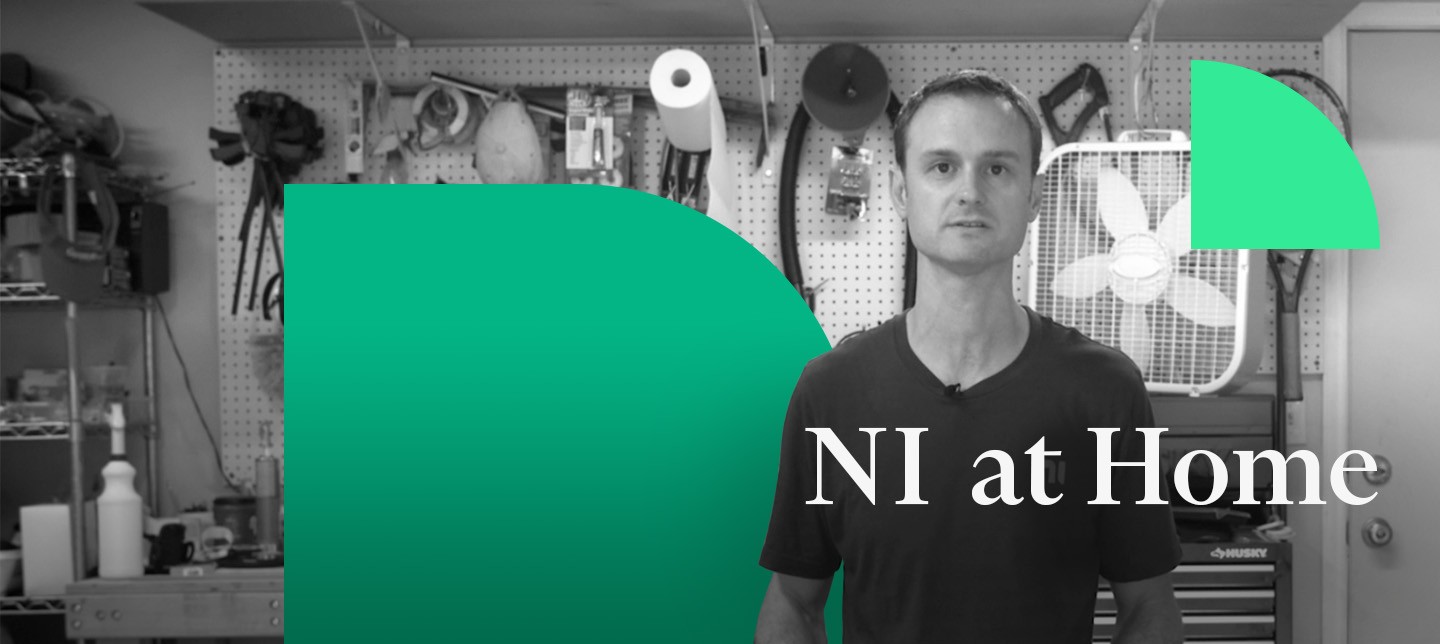
In 2021, Burger appeared in a garage for NI at Home, a YouTube series with an unusually generous premise: everyday questions deserve real instruments. How well will an inverter generator perform during an outage? How much energy does a load of laundry consume? The setting traded the factory floor for pegboard, tools and a box fan. Measurement became less like an industrial priesthood and more like something a curious neighbor might attempt on a Saturday.
The series suits Burger because it collapses the distance between his earliest and latest work. The aerospace graduate who helped a student measure a laser microphone was now inviting a wider audience to investigate appliances. The sophistication of the equipment had not extinguished the beginner's question: what is actually happening here?
His humor travels through the same channel. For April Fools' Day in 2025, Burger wrote about a fictional system for monitoring giraffe hydration. The device was called Drinky McMonitorface. It required camouflage, naturally, because ordinary data-acquisition equipment might trouble the animals. The mock engineering brief wandered onward to beaver dams, mountain-lion caves and cryptozoology. The joke works because its author knows exactly how a sober application note sounds.
The recurring trick is simple: preserve the engineering, remove the fog.
Away from the acronyms, a current professional biography supplies a few Austin coordinates. Burger is a father of two. He likes local beer, barbecue and breakfast tacos. Those details are small, but they fit the public work: a career devoted to high-specification systems, explained in the language of ordinary appetite.
Back to DAQThe signal comes around again
Burger's recent work has returned him squarely to data acquisition. In videos about mioDAQ, FieldDAQ and CompactDAQ, he handles connectors, demonstrates wiring and talks through the choices that determine whether a physical signal becomes trustworthy data. A 2024 clip on ferrules even produced a characteristically specific tip about temporarily seating a short ferrule during debugging. It is the kind of detail that could only come from someone who has fought with small wires.
At NI Connect 2026, he walked Electronic Design through new CompactDAQ modules, snap-in connectors, high-precision acquisition and hardware tough enough for field deployment. Artificial intelligence drew much of the conference attention. Burger kept showing the equipment that gives any intelligence something reliable to think about. Before a model finds a pattern, a transducer must sense a physical event; a wire must stay put; an analog signal must cross into the digital world without losing its meaning.
That chain explains the durability of his career. Product categories shift. Corporate ownership changes. Industrial IoT moves from novelty to infrastructure. Yet every ambitious system still begins with contact: heat, pressure, motion, voltage, sound. Burger has made a profession of standing near that contact point and asking the next useful question.
There is no theatrical mystery to it. The invisible becomes a signal. The signal becomes data. The data becomes a decision. And somewhere nearby, ideally, an engineer explains why anyone should care.