Twenty-six years is a long time to learn a company’s habits. Long enough to understand its planning rituals, its products, its geography and the reasons people give for doing things as they have always been done. Lal Karsanbhai joined Emerson in 1995. When he became chief executive in February 2021, he had spent much of his working life inside the business he was now responsible for changing.
The interesting question was how much familiarity would help. A long apprenticeship supplies knowledge, but it also supplies attachments. Karsanbhai’s subsequent decisions would alter the collection of businesses beneath Emerson’s name. Climate technologies would leave its majority ownership. Test and measurement would arrive. Industrial software would occupy more of the picture. The company he knew would acquire a different outline.
There is a pleasing complication here. The executive directing this change began with the decidedly untheatrical title of international planner. Planning rarely gets a standing ovation. Yet his route through Emerson suggests how much preparation can sit behind a decision that later appears sudden.
An international planner finds his place
Karsanbhai was born in Lisbon, Portugal. His father is Indian and his mother Portuguese. He has written that he did not learn English until he was 10, and that his childhood took him through cities in Europe, Africa and the United States. In his own account, that experience helped make international planning an appealing place to begin.
He studied economics at the University of Michigan, then earned an MBA at Washington University in St. Louis in 1995. That same year he joined Emerson. The chronology contains no miraculous shortcut: a business degree, an entry into planning, then a succession of assignments with larger responsibilities.
His education also offers a useful way into the story. The chief executive of an industrial technology business came through economics and business administration. His subsequent experience supplied the regulators, factories and control systems. The résumé gradually acquired its machinery.
The apprenticeship in valves and factories
By 1999, he was director of corporate planning. Operating responsibilities followed in regulator technologies, then a move to Gallardon, France, in 2005 as vice president and general manager of natural gas. The assignment included combining two European businesses, restructuring operations and establishing a plant in Cluj-Napoca, Romania.
These are unusually tangible details in a senior executive’s biography. A new organization chart can be drawn in an afternoon. A factory requires a location, people, equipment and a working business around it. His preparation included responsibility for that sort of practical integration.
In 2008, he became president of Fisher regulator technologies, a business spanning four units, nine manufacturing plants and 2,200 employees. He later returned to corporate planning, led Network Power across Europe, the Middle East and Africa, and took charge of Rosemount Measurement & Analytical. In October 2018, he became executive president of Automation Solutions.
The sequence matters more than the ladder. Planning offered a view across the company; operating roles carried responsibility for particular businesses. Moving between them gave him repeated encounters with the distance between a proposed strategy and its implementation. By the time he reached the CEO’s office, automation was familiar territory.
Buying a different future
The portfolio changes became visible in transactions with substantial price tags. In May 2023, Emerson completed the sale of a majority stake in its Climate Technologies business to funds managed by Blackstone in a transaction valued at $14 billion. The standalone business became Copeland. Emerson initially retained a 40 percent common equity interest.
That distinction is useful: selling a majority stake did not mean every connection disappeared on closing day. Corporate transformation comes with intermediate stages, retained interests and financial arrangements. Even a decisive strategic move can have a lengthy administrative tail.
In October 2023, Emerson completed its acquisition of NI at an equity value of $8.2 billion. NI brought software-connected automated test and measurement systems and became a new Test & Measurement segment. The acquisition extended Emerson’s activities further into the technologies used to test products and bring them to market.
The next major marker came in March 2025, when Emerson acquired the outstanding AspenTech shares it did not already own. AspenTech became a wholly owned subsidiary. Antonio Pietri retired as its CEO, and Vincent Servello was appointed president of the business unit. Ownership changed; people still had to run the business the following morning.
- May 2023Climate TechnologiesMajority stake sold; standalone business becomes Copeland.
- October 2023NIAcquired at an equity value of $8.2 billion.
- March 2025AspenTechRemaining outstanding shares acquired; full ownership.
The people inside the transaction
A deal gives a transformation a date. Workplace culture resists that convenience. Karsanbhai made the latter part of his agenda early, writing about the importance of trusting teams, giving them responsibility and making Emerson a place where different people could contribute.
“Diversity makes us better.”
That brief sentence appeared among the lessons he published after his first year as CEO. He connected the subject to his own family and upbringing. He also described an early pilot allowing employees greater flexibility in choosing where they worked. The changes reached into the ordinary arrangements through which a company becomes someone’s daily life.
By 2023, Emerson had introduced Your Voice Counts, an employee listening strategy, alongside a new employee proposition called Let’s Go. Corporate initiatives inevitably arrive wearing names. Their significance depends on what happens after the launch: whether employees can express themselves, whether managers listen, and whether those conversations affect decisions.
In his five-year reflection in 2026, Karsanbhai again joined culture to strategy. He described encouraging innovation and calculated risk-taking while concentrating the portfolio on automation. The recurrence is revealing. Across those years, his public explanation of Emerson’s changes kept returning to the people expected to carry them out.
A deal gives a transformation a date. Workplace culture resists that convenience.
The human timetable
What the data should be allowed to do
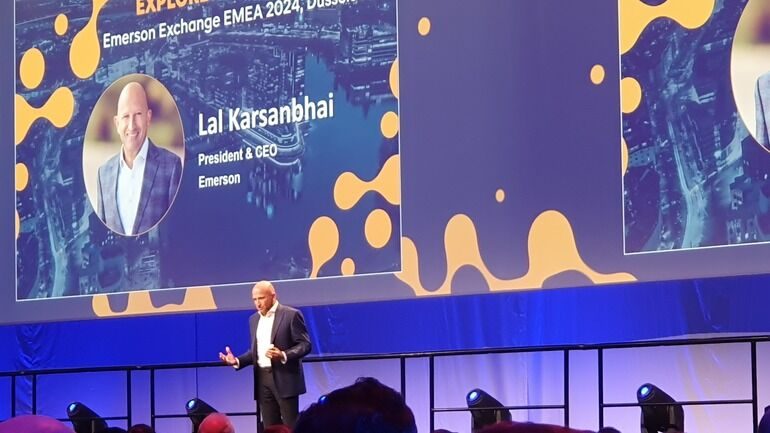
At Emerson Exchange in Düsseldorf in 2024, Karsanbhai presented the company’s Boundless Automation vision. Its architecture connects intelligent field devices, edge computing and cloud environments, with software helping data move across the boundaries that have traditionally separated industrial systems.
Translated from conference language, the ambition concerns the usefulness of information. A measurement has more potential when it can reach the people and applications that need it. A collection of capable devices still needs a way to work together. The industrial world has plenty of equipment; connecting its information is another undertaking.
His investment in this direction also extends to education. In 2025, Emerson announced an $8.5 million agreement with the University of Texas at Austin supporting work across semiconductors, artificial intelligence, energy and automation. The university would become a core research partner. The arrangement linked the company’s industrial ambitions to laboratories and the next generation of engineers.
In August 2026, Emerson appointed Rudy Sengupta chief technology and AI officer, effective that month. Sengupta had joined through NI and worked in test and analytics software. His remit spans the company’s technology and AI strategy. One consequence of acquiring a business, then, is acquiring people who can help direct the buyer.
A global career with a St. Louis address
Karsanbhai speaks Portuguese, French and English, and has lived and worked on three continents. St. Louis has nevertheless become a recurring point on his map. His MBA, his employer and several of his civic responsibilities connect there.
In 2023, Olin Business School honored him with its Distinguished Alumni Award. In July 2025, he joined Washington University’s Board of Trustees for a four-year term. Thirty years after completing his MBA, the relationship had acquired a different responsibility. Alumni mail had become board papers.
The Federal Reserve Bank of St. Louis designated him its board chair for 2026. The bank’s directors contribute information about economic trends and business conditions. For an executive whose work crosses industrial markets, the position creates another setting in which to consider what businesses are experiencing beyond his own company.
His local life also has less official coordinates. He enjoys running in Forest Park. In a 2026 questionnaire, he said he had retired from marathons; both his children run cross country. Running survives in the family even after the marathon calendar has been cleared. A chief executive can reorganize a portfolio more easily than persuade a family pastime to disappear.
Five years in, another assignment
The financial picture supplies one dated checkpoint. For its fiscal third quarter ended June 30, 2026, Emerson reported net sales of $4.873 billion, up 7 percent from the corresponding quarter a year earlier. Pretax earnings rose from $734 million to $916 million. Those are company results for a specific period, rather than a verdict on every decision made along the way.
Karsanbhai’s stated ambition reaches further: helping customers address digital transformation, electrification, AI and energy security while moving toward autonomous operations. Those aims require the businesses Emerson has assembled to become useful together. The next assignment follows naturally from the acquisitions.
He once entered Emerson to help plan its international development. He now has to make a changed collection of technologies, teams and operating businesses function as a company with a common direction. After three decades, the planner still has work to do. He simply has rather more authority over the plan.