A barcode is a modest thing to build a career around. It takes up very little space, offers no conversation and usually attracts attention only when a checkout scanner refuses to cooperate. Robert DeJean spent much of his working life taking such objects seriously. In the machinery of packaging, he found questions large enough to occupy a company for decades: What is this particular item? Where has it been? What else can its data tell us?
He founded Systech International in 1985. The business began with machine vision and packaging line management, then extended into serialization, traceability and authentication. His career followed the information outward, from the inspection station to the factory, and from the factory into the supply chain. The package remained quite ordinary. The questions asked of it became considerably more demanding.
A Pittsburgh education, before the engineering degree
DeJean grew up in Pittsburgh. His father, an engineer and executive at Westinghouse, supplied an early business education at the dinner table: serve customers well, bring value and resist the quick exit. The son graduated from Fairleigh Dickinson University in 1981. His later résumé included sales and management roles at Ribble Engineering, Texas Instruments and General Electric.
Engineering and sales make an interesting combination. One asks whether a system works; the other asks whether anyone has a compelling reason to buy it. DeJean’s eventual business required both. A packaging customer needed dependable inspection, but also a reason to connect that inspection to a larger investment. The working line, rather than an elegant demonstration, would deliver the verdict.
An early Systech assignment illustrates the habit. The company inspected glass vials for cracks and retained the inspection data. The customer subsequently used those records to compare suppliers and consolidate purchases. DeJean said the resulting savings ran into millions of dollars. A job commissioned to spot defects had also become a purchasing tool. The useful discovery lay in keeping the evidence.
Once a machine has seen something, what else can the business learn from it?
The label leaves the factory
By March 2006, Systech had agreed to combine its TIPS serialized tracking software with Domino Printing Sciences’ marking and coding systems. The arrangement supported barcodes, Data Matrix codes and RFID. DeJean described the partnership as a “natural fit”. Each company brought a different part of the job: putting an identity onto a product and maintaining control of that identity as the product moved.
There is a practical distinction here. Printing a code is an event. Keeping the code attached to the correct item, checking it and making its history useful is a continuing obligation. An identity system has to survive the unglamorous handoffs. A perfectly printed label is of limited assistance if the information associated with it goes astray.
The partnership also shows why DeJean’s story cannot be told as a lone inventor’s tale. Printers, software, line equipment and implementation teams all had to cooperate. His contribution as an executive included finding the combinations that could reach a customer’s production floor. The handshake could matter almost as much as the technology, provided somebody followed through after lunch.
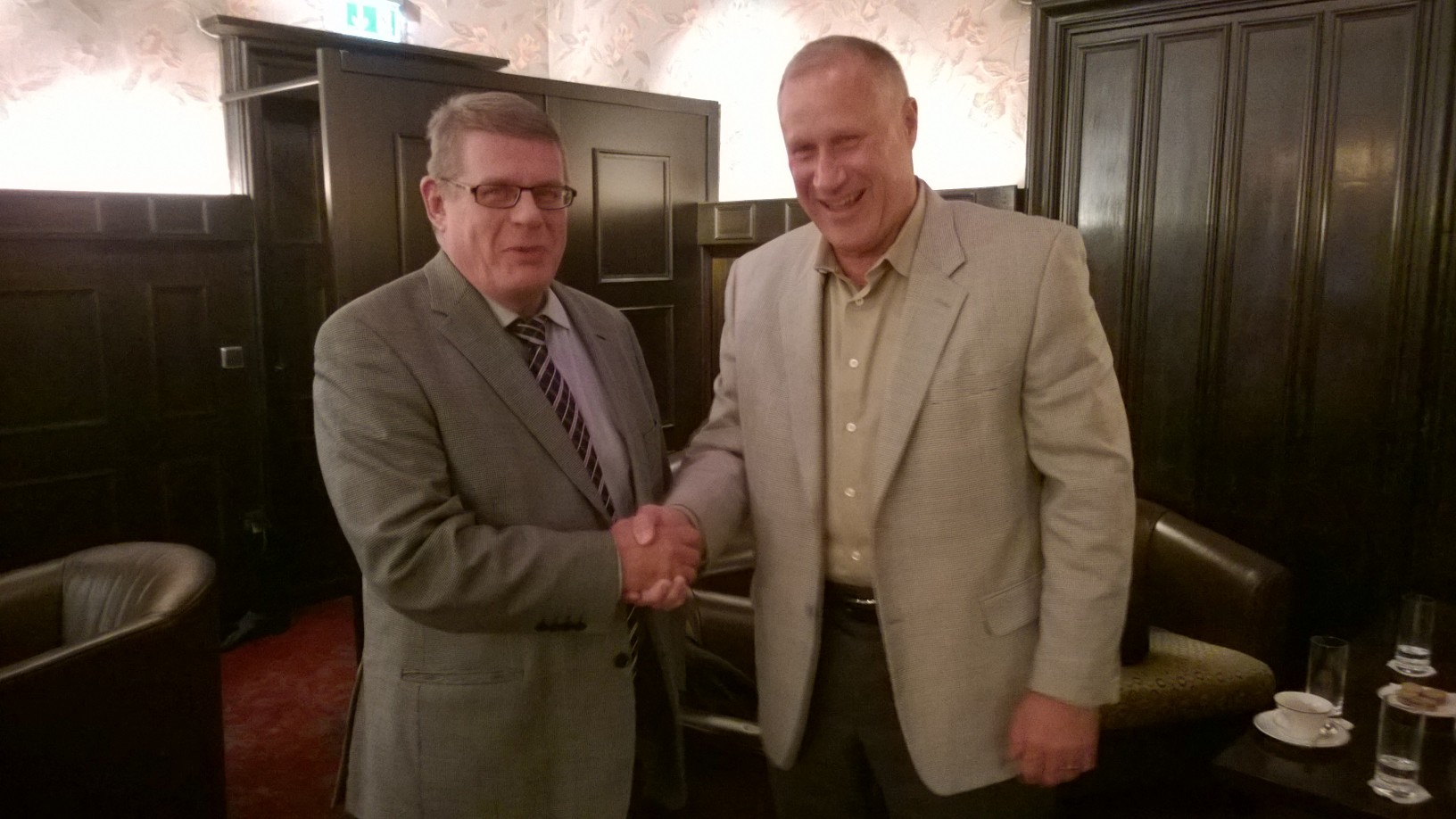
The December 2015 Servicepoint agreement extended that approach. Servicepoint became a representative and integration partner in Finland, Estonia, Sweden and Russia. The two businesses had already worked together on a customer implementation before formalizing the relationship. Their agreement gave commercial form to a collaboration tested on an actual assignment.
That sequence is revealing without requiring any mythology about entrepreneurship. First came a shared job. Then came the wider arrangement. For industrial software, expansion depends on people who can install, test and maintain what the sales discussion has promised. A map of markets is easy to draw. A functioning network of delivery partners takes rather more work.
The cloud still had to reach the line
During 2012, Systech acquired Philadelphia-based Apostrophe Systems, a business specializing in cloud and software as a service technology. DeJean explained the immediate purpose in concrete terms: customers could deploy packaging execution software as a service rather than purchase the hardware and site licenses themselves. The intended audience included midsize manufacturers and contract manufacturers seeking a smaller initial capital commitment.
It was a specific answer to a specific obstacle. A prospective customer might need serialization but lack the infrastructure of a multinational manufacturer. Changing how the software was delivered could change who was able to adopt it. The factory problem remained on the floor; the purchasing and computing arrangements around it could become more flexible.
In October that year, Systech launched Citadel, its cloud enterprise network solution. It connected serialization deployments across sites and included number management, data exchange and a repository for product event information. The scope had widened from seeing a package to coordinating the information that made its identity useful across an organization.
Growth created its own requirements. In August 2012, Systech reported that its workforce had increased by almost one third since January, with additions in the United States and Europe. The hiring covered cloud expertise, IT architecture, project engineering, professional services and leadership. Those are the people a growing software business needs when its promises become deployments.
In November, Horizon Technology Finance announced a $7.5 million venture loan to Systech. DeJean said the company needed capital to support continued expansion. The detail belongs in his story because product development, hiring and working capital must eventually agree with one another. Even a business devoted to tracking things has to keep track of its own capacity.
The useful imperfection
At INTERPHEX in New York in 2015, DeJean discussed a different way to identify a printed label. Systech was already photographing labels for verification. Its e-fingerprinting approach analyzed small variations in printing to derive an identifying signature. Characteristics that might ordinarily be dismissed as noise became information about the individual package.
That reversal gives the technology its appeal. Printing aims for consistency, yet physical output contains variation. The system used those differences as evidence. For a reader accustomed to thinking of manufacturing as the removal of imperfections, the idea has a pleasing wrinkle: some imperfections can earn their keep.
Systech launched UniSecure in September 2015. The product generated a signature from an existing printed mark, stored it in the cloud and supported subsequent authentication through a mobile application. The company presented it as a way to work with existing packaging infrastructure. The printed object could carry more information without acquiring another conspicuous label.
DeJean also saw a commercial use beyond the authentication check. A customer scanning a package could open a conversation with its manufacturer. His interest extended to product information and engagement. It was another extension of the same business logic: once a useful connection exists, consider what additional service can travel across it.
“I have been fortunate to work with a very talented and passionate team”
Robert DeJean, on the 2018 leadership transition
Learning to hand over the controls
In September 2016, Systech appointed Lou Arace president and chief operating officer. DeJean remained founder and CEO, with more scope to concentrate on strategy and opportunities for growth. Bruce Bleiman joined to lead sales, while Erin Dunkel joined to lead marketing. The organization was distributing responsibilities that a founder can otherwise accumulate almost by accident.
The distinction between founding a business and running every part of it becomes more consequential as the company grows. Here the change was explicit: operating leadership had its own position, and DeJean’s remit moved toward strategic work. It was an intermediate step, with the founder still chief executive and a broader leadership structure around him.
In March 2018, Ara Ohanian succeeded him as CEO. The announcement described DeJean as retiring from day-to-day leadership after 32 years and identified him as founder and director. He publicly supported the appointment and credited the team that had built the business. The change was a handoff with a stated continuing connection.
- 1985
- Founds Systech International
- 2018
- Hands the CEO role to Ara Ohanian
- 2020
- Dover acquires Systech
- 2024
- Joins IotaComm’s board
In January 2020, Dover agreed to acquire Systech for integration into Markem-Imaje. Systech then had approximately 170 employees worldwide. Dover’s subsequent financial reporting records completion on January 24. DeJean had already handed over the CEO position; the acquisition belongs to the continuing life of the business he founded.
That chronology matters. A founder’s career and a company’s history overlap without remaining identical. Systech’s move into a larger industrial group added another chapter to the organization. DeJean’s next documented chapter would place him beside an executive team, helping with decisions rather than holding the daily operating controls.
Another table, a familiar problem
In July 2024, IotaComm appointed DeJean to its board. The wireless communications and Internet of Things company brought him into a business concerned with connecting physical environments to information. Its chairman and CEO, Terrence DeFranco, pointed to DeJean’s experience building an international company. DeJean said he wanted to help guide the next phase of growth.
A 2025 company filing also identifies him as an independent director. The connection to his earlier work is straightforward: devices produce information, organizations need to use it, and somebody has to make the commercial and technical arrangements hold together. The setting changes. The need for disciplined execution remains familiar.
DeJean’s career offers a business story at the scale of the object in your hand. A vial can reveal something about a supplier. A printed mark can support an identity. A label can become the starting point for another interaction. His work repeatedly returned to small physical details and asked whether they had finished being useful. Quite often, there was another job for them.