The Grand Rapids Company Putting a Radio Inside Your Pill Bottle Cap
How a vertically integrated RFID factory in Michigan built a business on a simple bet: that the smartest part of a medicine bottle should be the cap.
Most companies that call themselves "IoT" or "smart" turn out to be dashboards. CCL eAgile is a factory. In a 40,000-square-foot building in Grand Rapids, Michigan, a team of roughly 32 people designs radio-frequency identification chips, tunes their antennas, tests them, prints them onto labels, and encodes each one with a serial number - all under one roof. The output is small enough to hide inside a bottle cap, and that is exactly where the company likes to put it.
The idea underneath the business is stubbornly simple. Every package - a pill bottle, a syringe, a nutraceutical jar - should be able to say what it is, prove it is real, and report if someone has tampered with it. RFID has promised that for two decades. eAgile's contribution has been to make it reliable enough, and cheap enough per item, that regulated industries will actually deploy it.
01 / What it makesThe whole stack, not just the sticker
Plenty of vendors sell RFID tags. eAgile's pitch is that it sells the system around them. It designs the inlay (the chip plus antenna), runs performance and durability testing in its own labs, prints and converts the labels, and writes the software that reads and validates the data. That vertical integration is the point: when a pharmaceutical customer needs a serial number, a barcode, and an RFID tag to all agree on the same product, having one company own the whole chain removes the seams where errors creep in.
That approach also shapes how the company makes money. eAgile is a business-to-business manufacturer, not a subscription app. Revenue comes from producing the tags and inlays, from encoding and serializing each unit as it is printed, and from the integration and validation work that surrounds a deployment. Customers pay for physical parts and for the assurance that the data written to them is correct - a mix of per-item volume and engineering services rather than seats sold monthly.
The catalog spans four radio frequencies, each suited to a different job. eAgile builds all of them, which is unusual for a shop its size.
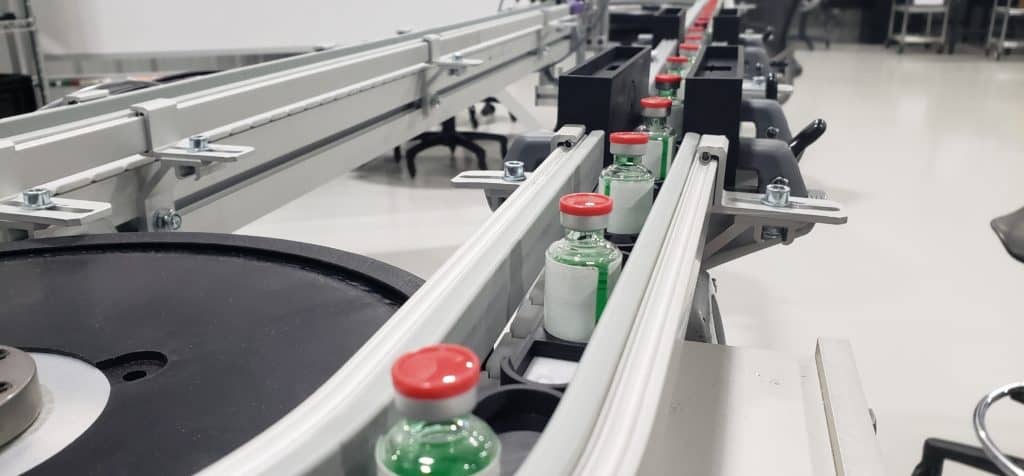
02 / The signature productA cap that knows its own name
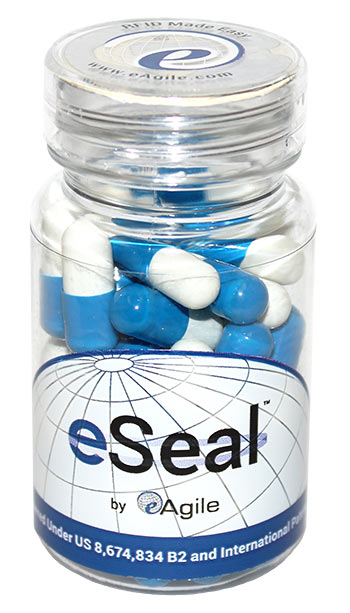
The product that best explains eAgile is eSeal. Instead of slapping a tag onto the outside of a package, where anyone can peel it off, eAgile embeds an RFID chip directly into a sealed cap or closure. The chip carries a unique identifier that can be linked to the product name, strength, serial number, batch number, and where and when it was made. Break the seal, and the story of that package changes.
The radio is inside the cap - not on a sticker you can peel off. That single design choice is the anti-counterfeiting argument. On the logic behind eSeal
It targets exactly the industries where a fake is dangerous: pharmaceutical, nutraceutical, healthcare, medical, cosmetic and chemical manufacturing. For those customers, "intelligent packaging" is not a marketing flourish - it is diversion control, tamper evidence, and item-level traceability that survives the trip from the factory to a patient's hand.
The customer list explains why the design matters. eAgile counts Fortune 500 manufacturers among its buyers, and the healthcare references are concrete - Fresenius Kabi, for instance, has used GS1 RFID standards on eAgile-enabled products. In practice the tags end up on syringes, vials, surgical kits and medication packaging, where a miscount or a counterfeit is not a lost sale but a patient-safety event. That is a different bar than tagging sneakers or pallets, and it is the bar eAgile chose to clear.
Its companion, eLink, flips the same chip toward the consumer. Tap an NFC-enabled phone - Apple or Android - against the package and it verifies the product is genuine, then opens a channel back to the brand for reordering or engagement. One antenna, two audiences: regulators who want authentication, and marketers who want a direct line to the person holding the product.
03 / The long gameTwenty years, three logos, one lane
eAgile did not appear in 2009 from nowhere. Founders Gary Burns and Peter Phaneuf started RF IDentics in 2004, built a vertically integrated inlay facility, and in 2006 saw their UHF tags win top honors in independent Gen 2 testing - after which Avery Dennison bought the business. Rather than retire the idea, the same founders relaunched it as an independent company in 2009, this time focused on the unglamorous problem of data-serialization accuracy: making serial numbers, barcodes and RFID agree, every time.
Along the way the company kept adding pieces it could not buy off the shelf. In 2011 it acquired a healthcare labeling company, which turned a tag maker into a supplier of turnkey RFID systems for healthcare and pharmaceutical markets. In 2014 it was awarded a patent for the intelligent-packaging breakthrough that became eSeal, and by 2017 it was expanding its Grand Rapids operations and opening a sales office in Switzerland to reach European pharma customers. Each step pushed the same idea a little further from "we sell tags" toward "we solve the identity problem end to end."
Burns' resume reads like a map of the field he stayed inside: executive stints at Siemens and Avery Dennison, and international patents spanning RFID, robotics and automation. It is a founder pattern worth noticing - build in a narrow niche, sell, and build again in the same niche with deeper conviction each time.
04 / The exitWhy CCL paid $54 million for 32 people
On April 3, 2023, CCL Industries - the world's largest label maker - acquired eAgile through its CCL Healthcare division for approximately $54 million, including about $1 million of net cash assumed and $7 million deferred over five years. The bet was not the headcount; it was distribution. CCL already prints labels for much of the global healthcare industry. Drop eAgile's RFID into that pipeline and every one of those labels can become an intelligent one.
"By 2027, we expect eAgile products to generate at least an incremental $15 million EBITDA." Geoffrey T. Martin, President & CEO, CCL Industries
05 / Where it fitsBoring credentials, real moat
The RFID market is crowded with tag vendors - Avery Dennison Smartrac, SATO, Zebra, Alien Technology and others. eAgile's edge is not being the cheapest sticker; it is being the shop that owns design, testing, encoding, software and validation together, backed by the credentials regulated buyers actually audit: ISO 9001:2015 certification, NFC Forum licensing, RAIN RFID membership, and ARC-certified designs built on Impinj silicon.
The market context is favorable but unforgiving. RAIN UHF RFID has moved from novelty to standard equipment in retail and logistics, and regulators worldwide keep tightening serialization rules for medicine. Both trends push demand toward exactly the item-level, verifiable identity eAgile builds. But they also invite scale players, and a 32-person shop cannot win a price war on plain tags. eAgile's answer was to compete on the parts that are hard to copy: the validation methodology, the certifications, and a factory that can turn a customer's odd requirement into a working part without outsourcing the tricky steps.
What a reader can steal
Own the unglamorous middle. eAgile's durable advantage came not from inventing a flashier chip but from guaranteeing that the data on it is accurate and reliable - the thing pharma buyers lose sleep over. In a commodity market, verifiable reliability is a moat.
There are conditions where the model strains. RFID at item level only pays off when the product is valuable enough, or regulated enough, to justify a chip per unit - which is why healthcare and pharma, not low-margin consumer goods, anchor the business. And as a division inside CCL, eAgile trades some independence for reach; the roadmap now serves a global labeling parent rather than a scrappy startup's own priorities. For its customers, that trade mostly reads as an upgrade: more scale, same factory.
What eAgile ultimately sells is trust, rendered in silicon and adhesive. A bottle that can prove it is genuine. A cap that reports if it has been opened. A syringe that can be counted without being touched. It is not a flashy story. It is a durable one - which, in hardware, is the harder thing to build.