FILA had lawyers. What it needed was time. The sportswear company was trying to deal with counterfeits internally, supported by law firms around the world. Yet the fakes kept arriving. New listings appeared, impersonation spread onto social media, and customers who had been deceived brought their complaints to the brand whose name appeared on the merchandise. The name was authentic. The transaction was somebody else’s.
In Red Points’ account of the relationship, FILA Italy’s general manager Marta Benedetto described the old arrangement plainly: “it was impossible and very expensive for us to continue in that way.” The failure came at the point where a reasonable process met an unreasonable volume. Every additional counterfeit demanded attention. Attention remained stubbornly expensive.
- The job: find and remove counterfeits, piracy, and online impersonation.
- The customer: brands whose enforcement queues have outgrown manual work.
- The offer: tailored flat-fee plans with unlimited takedowns within their coverage.
- The useful distinction: a deleted listing, an estimated infringement value, and recovered cash are different results.
Red Points occupies this gap between the ease of copying something and the effort required to stop it. Its managed software searches for abuse, helps validate what it finds, requests enforcement, and records the outcome. The company says more than 1,300 brands use it. Its customers include sportswear businesses, industrial equipment makers, consumer brands, and content owners. A fake handbag and a pirated video have different legal details, but both can create a formidable administrative queue.
A copy costs less than a complaint
Consider the asymmetry. A seller can borrow a photograph, a product name, or the appearance of an official store. The brand must determine what has happened, establish the relevant rights, identify the platform’s reporting route, and follow the case. Even when the individual task is straightforward, repetition changes its economics. A thousand small jobs can become one large department.
Red Points’ proposition is to make that repetition manageable. Computer vision and text analysis help locate suspicious images and listings. Seller information helps connect incidents and prioritize attention. Automation handles eligible enforcement actions, while specialists oversee the process. The product combines software with the expertise needed to navigate intellectual property claims and platform procedures.
FILA’s published case study reports 638,653 listings removed. The period is unspecified, so the figure belongs to that case study rather than a yearly performance chart. It does, however, explain why one-at-a-time work becomes an unattractive arrangement. The number also invites a sensible follow-up: did the sellers stop, or did they return under different names?
Company-published result; reporting period unspecified.
The musician, the lawyer, and the recurring invoice
Josep Coll founded Red Points in Barcelona in 2011. He was an intellectual property lawyer and, as he explained in a 2018 interview, a musician who cared about culture. David Casellas joined as co-founder in 2012. There is something pleasing about a business against copying beginning with somebody who understood both a song’s value and the paperwork needed to defend it.
Coll offered a small irony in that interview: the cultural sector ultimately became the company’s smallest business segment. The original concern had opened onto a wider market. Manufacturers and retailers had their own versions of the same problem, with product images and trademarks taking the place of recordings.
Laura Urquizu joined as partner and CEO in 2014. The company credits her with shifting the business to its SaaS model. That change matters because a subscription can support a continuing operation: monitoring, learning a customer’s assets, handling cases, and improving rules. A fresh quotation for every new infringement would make a busy customer’s problem the supplier’s billing opportunity. Red Points instead sells a defined scope of recurring protection.

The scale required capital. A 2019 funding announcement described a $38 million round, bringing capital raised to $64 million at that time. The European Investment Bank subsequently agreed to provide up to €15 million in venture debt over five years for research, development, and growth. In November 2022, Red Points announced another €20 million round led by IRIS, with Summit Partners and Eight Roads participating. Those are financing events, not evidence that every customer earns a particular return.
Four steps between spotting and stopping
The operational sequence is more revealing than the phrase “AI-powered.” First, the system detects possible infringements across covered channels. Then it validates them using models, rules, and expert input. Enforcement follows through the available platform or legal process. Finally, reporting shows what happened and helps the brand decide what deserves attention next.
- 01DetectFind suspicious listings and content.
- 02ValidateCheck the asset, context, and claim.
- 03EnforceSubmit requests and pursue escalation.
- 04MeasureTrack outcomes and recurring actors.
The counterfeiting product sits beside anti-piracy, impersonation removal, domain management, gray-market protection, and social video protection and monetization. Expert services include investigations, test purchases, IP registration, seller notices, and domain disputes. For a legal team, the practical benefit is a consolidated process. For an ecommerce team, it is visibility into activity occurring outside the official storefront.
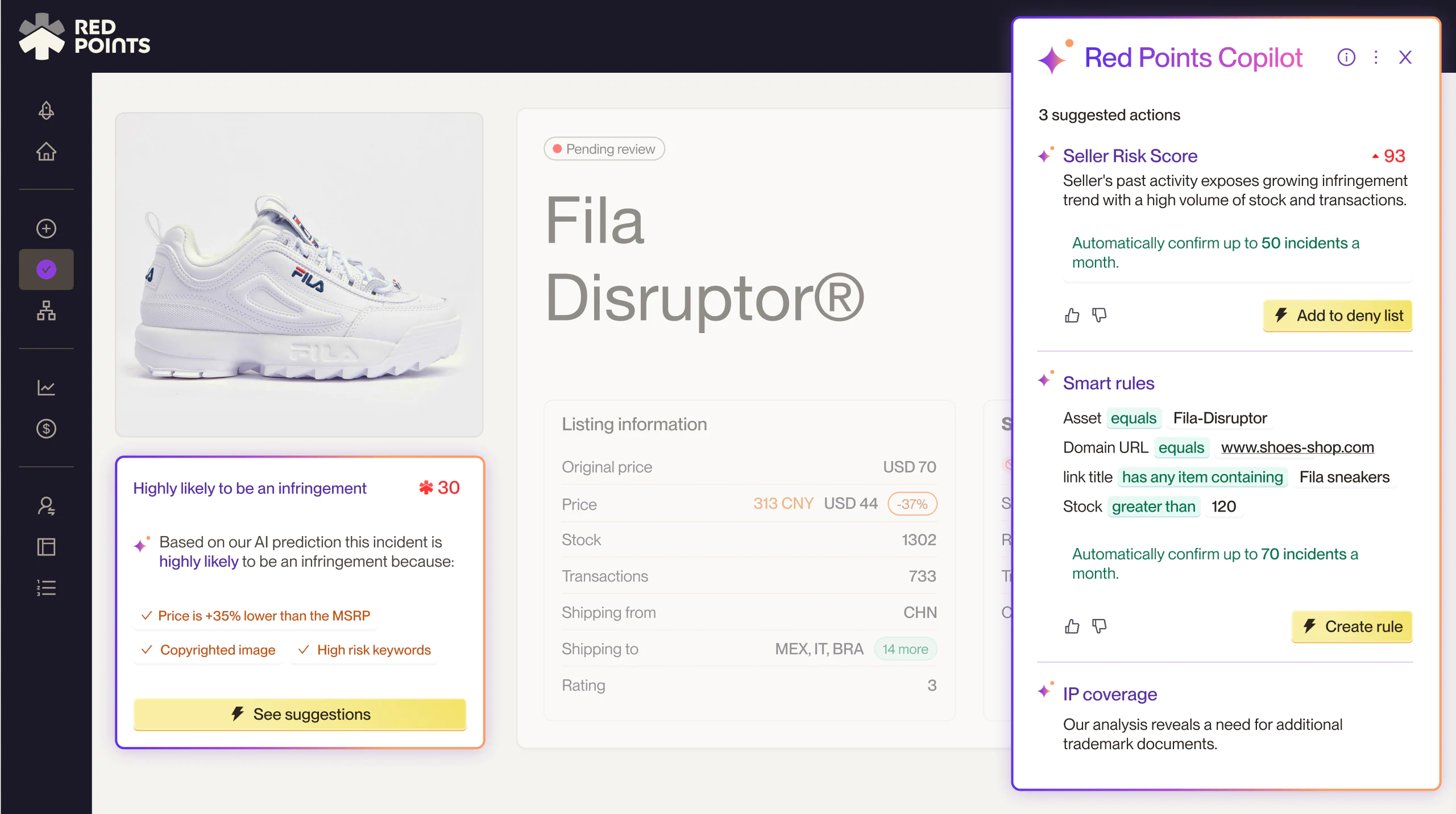
Red Points’ Copilot, launched in 2024, adds predictive models, automation suggestions, seller risk scores, and image assistance. These features address a familiar limitation of monitoring: finding more suspicious material can simply create more review work. Prioritization becomes valuable when the queue is already full. A suggested relationship between sellers can guide an investigation; it still needs to be assessed.
Unlimited has a boundary
Red Points’ published pricing describes Starter, Professional, and Enterprise counterfeit plans. Each offers unlimited detections and takedowns, but the protected assets, channels, and services differ. Starter lists up to ten trademarks; broader tiers add coverage and capabilities. Some protection remains an add-on. The useful purchasing question is therefore which threats and channels the contract includes.
The company asks buyers to request a tailored quote. Its value argument is predictable expenditure as case volume rises, rather than paying for each deletion. That will appeal to a team facing repeated abuse across several channels. A brand dealing with one isolated incident has a different calculation. Red Points’ own partner guidance identifies recurring, multichannel infringement as a particularly useful fit.
Competitors include Corsearch, MarqVision, BrandShield, and OpSec. Brands can also retain internal teams and specialist law firms. Red Points emphasizes unlimited enforcement, managed expertise, and connections to reporting systems. Those are procurement criteria worth comparing in an actual proposal. They do not establish that another provider cannot perform well on a particular brand’s problem.
A listing removed is an action completed. Whether the business problem shrinks is the next question.
The measurement problem
When a takedown becomes a court case
Revenue recovery requires special care in the telling. Removing a listing may reduce exposure to counterfeit goods. An estimated value assigned to those goods does not become money in the brand’s account. The separate Revenue Recovery Program combines detection and evidence gathering with a U.S. litigation partner, targeting qualifying counterfeit sellers serving the U.S. market.
The program describes a sequence involving transaction records, samples or test purchases, lawsuits, court orders, and the recovery of funds. It operates on a contingency basis with no upfront costs. That describes how participation is financed; it does not promise a particular recovery. Red Points identifies businesses with U.S.-registered IP as a fit. Evidence, eligibility, court decisions, and available funds all matter.
Ordinary enforcement also has dependencies. The platform, host, registrar, or other intermediary must act through its procedures. A genuine product sold through an unwelcome channel raises different questions from a counterfeit. The brand’s wish to remove something and the grounds for removal must be reconciled. Software can organize that work, but the claim still needs to stand up.
The borrowed face joins the borrowed logo
Red Points’ recent launches show the scope widening. Actor Networks, announced in October 2025, helps reveal potential connections between sellers and accounts. Enforcement Log followed in March 2026, documenting actions chronologically. One helps teams understand who may be connected; the other makes the work on a case more visible.
In July 2026, the company announced Deepfake Protection for videos impersonating executives and public figures. Its described methods include facial and voice recognition, behavioral analysis, and language analysis. Context matters: a parody and a fraudulent endorsement may feature the same face, yet demand different responses. The product’s stated approach checks identity, intent, and potential harm.

The transferable lesson is practical. Collect the assets and rights you can defend. Make detection, validation, and escalation repeatable. Give recurring sellers attention, rather than celebrating the same removal twice. Keep deleted listings, infringement estimates, and cash recoveries in separate columns. FILA’s experience gives that advice a sharp edge: when the copies keep arriving, the costliest habit may be treating every copy as a brand-new problem.
Follow the case
Explore the Red Points website, plans, blog, and company news. Follow its updates on LinkedIn, X, Facebook, and YouTube.
↗ Watch: Brand protection 101↗ Watch: Customers on managing IP↗ Request a product demo