A factory machine can be working perfectly while the people around it are working from an imperfect picture. A number on one display. An alarm on another. A handwritten note that has acquired the authority of scripture. Wonderware made its name by making that picture easier to read. Its consequential move was to bring the graphical world of Microsoft Windows into industrial operations, where the cost of misunderstanding a screen could be rather more substantial than a misplaced spreadsheet.
- The job: turn industrial data into displays people can use to monitor processes and act.
- The bet: build the operator interface on Windows and ordinary PCs.
- The expansion: add historical records, reusable plant models and manufacturing execution.
- The present: the products carry AVEVA’s name; Wonderware remains part of industrial vocabulary.
Think of Wonderware as a company concerned with the distance between a machine doing something and a person understanding it. That distance might be measured in steps across a control room, minutes spent reconstructing an incident, or hours building another screen for another pump. The products approached different versions of the same problem. The commercial opportunity was hiding in the everyday work of paying attention.
The bet was on a familiar window
Dennis Morin and Phil Huber founded Wonderware in Irvine in 1987. Morin had worked at Triconex, where a proposed interface project, TriView, did not receive board funding. He was subsequently laid off during a reorganization. Consulting work exposed him to the limitations of existing industrial applications. His idea was to connect graphical objects to changing process values, so a display could show what equipment was doing.
InTouch arrived in 1989. In May 1990, InTouch 2.0 launched on the same day as Windows 3.0. The choice of operating system mattered: an industrial software business was tying its prospects to a platform whose success would bring familiar tools and an expanding PC ecosystem into the plant.
The lesson is more interesting than “choose the winning platform.” A graphical interface becomes valuable when it reduces the effort required to represent a real process. A tank can have a level; a valve can have a state; the picture can change as those values change. Engineers can build a view that operators recognize. Familiarity becomes a practical asset rather than a decorative flourish.
Wonderware’s public offering raised $32 million in 1993. Morin left in 1995. Siebe acquired the company for $375 million in 1998. Those milestones establish a business with substantial commercial value. They also make clear that today’s Wonderware story is about a long-lived product family, rather than an independent startup awaiting its next financing round.
The railway needed one picture
An archived AVEVA case study supplies a useful scene. At Norfolk Southern’s Buckeye hump yard in Columbus, workers classified freight cars for onward journeys. Pin pullers had used paper lists. Trainyard Tech implemented InTouch on Windows 3.0 in the early 1990s, giving workers graphical access to car locations, destinations and handling information.
“Prior to having a graphical display, the pin pullers had a paper list”
Dan Niemiec, Trainyard Tech
Historical Norfolk Southern case study
The yardmaster could see the same information. That is the revealing change: separate jobs gained a shared view of the work. The case describes reduced maintenance labor and more efficient yard operations. It illustrates a concrete reason to adopt an interface: make coordination easier where misunderstandings have physical consequences.
Factories, breweries and utilities pose related problems. Their equipment and procedures differ, but an operator still needs to distinguish an ordinary condition from one requiring intervention. Software earns its place when it helps that person make the distinction in time.
First a screen. Then a memory. Then a method.
InTouch HMI is the visible part of the family. HMI means human-machine interface: engineers create graphical applications tied to industrial equipment and process information. Operators monitor conditions, inspect alarms and interact with the process. Current AVEVA editions add browser access and tools for reusing application designs. The customer is buying a way to build an operating interface, with the plant-specific work still to be done.
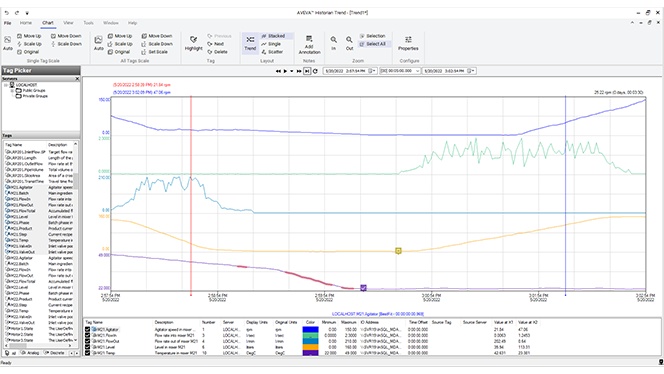
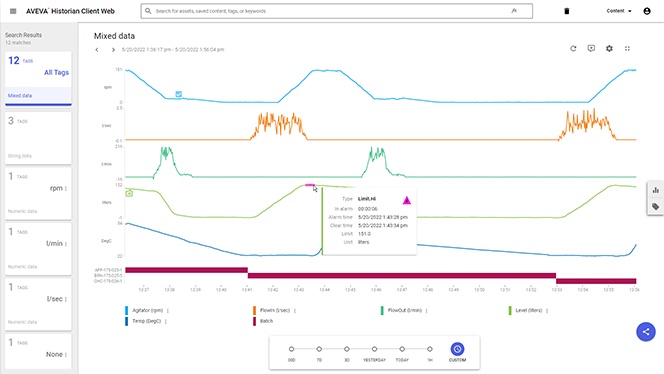
Historian answers the question that follows an incident: what happened before this? It stores process values over time alongside alarm and event records. Its clients let users examine trends and compare conditions. A screen shows the present; a record allows investigation after the present has inconveniently moved on. For maintenance and process teams, that changes the quality of the conversation about a recurring problem.
System Platform addresses repetition. Its object-based architecture models equipment with reusable templates. An engineering team can define a standard asset and apply that model across applications and sites. AVEVA identifies Thames Water’s standardization across more than 50 sites as an example. For a customer operating many similar assets, engineering consistency becomes part of the purchase case.
Manufacturing Execution System, or MES, organizes production activities, quality information and traceability. In a historical Baltika Breweries deployment, operators had entered process data manually into spreadsheets and a production database. The resulting reports were slow to prepare and not always accurate. That gave the brewery a specific problem to solve: capture and manage production information more reliably. A brewery may sell conviviality, but making it requires decidedly sober records.
The license is the first line of the bill
AVEVA publishes useful starting points. Its US pricing page lists InTouch Workstation at $1,850, Unlimited Standard at $12,360 and Unlimited Professional at $20,600. These are manufacturer suggested retail prices, excluding applicable taxes. Packages have different capabilities and entitlements. The prices establish the cost of named software offers, rather than a promise about the total cost of a commissioned plant system.
Published prices checked October 1, 2026. Taxes and implementation additional; confirm package scope with a distributor.
A buyer must also account for application engineering, equipment connections, testing, training and ongoing support. Those are project-specific costs. Comparing license prices alone would leave much of the decision outside the calculation. A small machine interface and a distributed plant application demand different amounts of work, even when both can be called an HMI.
The business sells through an ecosystem of distributors, integrators and equipment makers. These partners provide local knowledge and implementation work. Current buying options include perpetual licensing and AVEVA Flex subscriptions. Operations Control bundles visualization, history, communications and other operational tools into a subscription portfolio.
Its competitors have credible approaches of their own. Inductive Automation sells Ignition by the server with unlimited clients and tags. Rockwell’s FactoryTalk View SE offers a scalable HMI/SCADA environment within its broader automation ecosystem. Unlimited licensing therefore cannot, by itself, explain a Wonderware purchase. The persuasive case depends on existing applications, engineering expertise, required integrations and the support a customer can actually obtain.
A new name has to inherit the old knowledge
After Siebe and Invensys, the portfolio passed into Schneider Electric in 2014 and joined AVEVA in 2018. Wonderware’s former products now bear the AVEVA name. Some distributors retain the older name. AVEVA itself belongs to the Schneider Electric group. The ownership chain explains the branding; years of installed applications explain the vocabulary.
A plant application contains decisions made over many years: how equipment is represented, which conditions deserve attention, how a process is understood. Modernization has to carry that knowledge forward. AVEVA’s July 2026 release discussion describes reusable server-side Python and C# methods, a more consistent web architecture, and conversion of legacy Smart Symbols to Industrial Graphics. These are practical responses to the work of maintaining and extending mature systems.
The buying conditions matter. A larger platform is easier to justify when an organization needs repeatable engineering across assets or sites. A small installation with a simple display requirement may need a narrower tool. Existing applications require a compatibility review; operator workflows require testing. “Unlimited” describes license permissions. It cannot make engineering time, computing capacity or migration work unlimited.
There is a useful habit to copy here. Begin with a decision someone makes repeatedly. Find the information they collect to make it. Put that information together, preserve the history that helps explain it, and standardize the design once it works. Wonderware’s enduring contribution is that these ordinary acts of clarification can become valuable industrial software. The machine does its work. Someone still has to understand what it is telling them.
Open the next window
Explore the products, see a demonstration, or meet the community.