The easiest way to understand Morson Praxis is to picture a consultant walking past the meeting room and into the workshop. The company will map a problem, certainly. It will also model a bridge, write safety-critical software, design an aircraft jig, commission a control panel or place engineers inside a nuclear construction team for years. Its central promise is less glamorous than transformation-speak and more useful: the people specifying the answer should remain close enough to see whether it survives contact with the job.
The name is new. The machinery beneath it is not. Morson Group announced its largest structural reorganisation in November 2025, gathering Morson Projects, Waldeck, Ematics, Astraeus and related technical businesses under Morson Praxis. The parent divided the rest into Edge for specialist talent, Vital for deployed teams and Nexus for training. Praxis became the consultancy arm - a single shop for engineering, buildings and technology.
The useful contradictionA young brand with old fingerprints
Corporate birthdays get untidy after a merger. The active legal vehicle, Morson Projects Limited, was incorporated in 1979. Waldeck began in Lincolnshire in 1995, the founding year attached to the present profile, and Morson acquired it in 2018. Ematics brought industrial control and SCADA capability. Astraeus added specialist aerospace depth. The 2026 operating brand therefore has less of a founder story than a family-tree story.
That matters because the breadth can otherwise look implausible. Praxis advertises structural analysis, architecture, BIM, digital capture, quantity surveying, manufacturing engineering, embedded software, electrical infrastructure and enterprise change. Most buyers would not sensibly hire one undifferentiated generalist for all of that. The wager is that specialist teams can keep their craft while sharing commercial access, data, governance and a parent capable of recruiting and training the next shift.
Its customers explain the design. Network Rail, EDF, Sizewell C, Sellafield partners, Airbus, BAE Systems, Thales, Vertical Aerospace, IKEA, Prologis, Jaguar Land Rover and LSEG do not buy generic inspiration. They run assets where a missed interface becomes a delayed train, an unsafe isolation, a fabrication error or a regulator's question. Praxis belongs between the giant engineering houses - AtkinsRéalis, Arup, WSP, Jacobs, Assystem - and narrow specialist shops. It offers enough disciplines to own an interface, but sells the practical proximity of a smaller team.
The proof pointFifty bridges and a folder full of bad habits
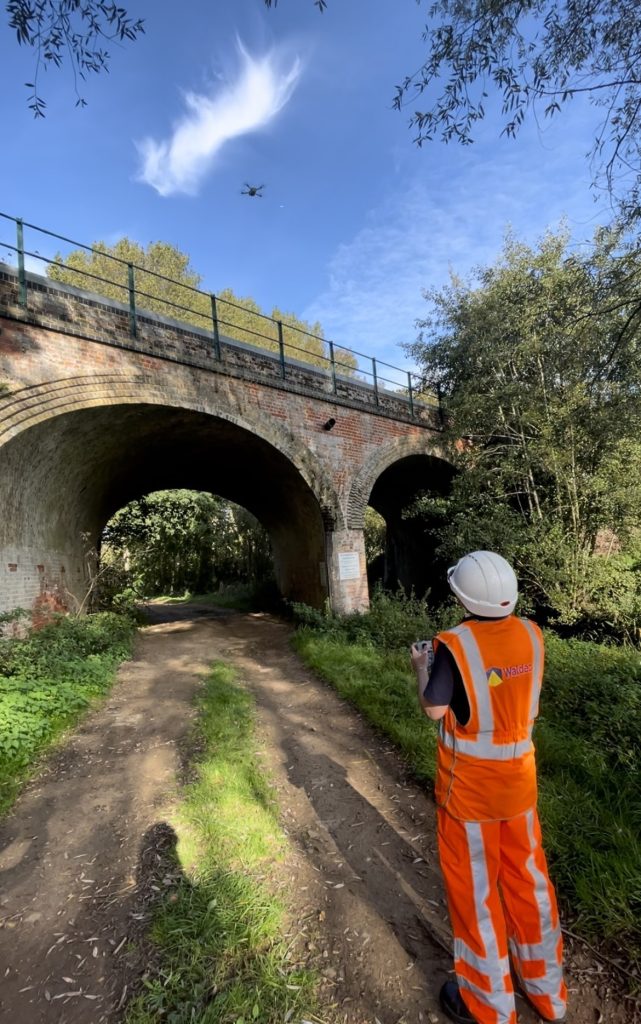
Network Rail's masonry bridges provide the neatest demonstration. Traditional condition reports relied on individual defect photographs with an engineer's annotation. Useful, but disconnected: a crack is visible while its exact position, scale and change over time are harder to compare. Network Rail wanted objective evidence for a portfolio of more than 29,000 bridge assets.
Working with Nottingham Trent University, the consultancy trialled drones and terrestrial laser scanning across 50 masonry bridges in 2020. The teams combined geolocated 360-degree imagery with measurable point clouds, then explored machine learning for defect recognition and automated BIM creation. Engineers could review a structure remotely, compare one survey with the next and retain what the project calls a digital “golden thread.”
“The trials ... were not only to demonstrate the capability of the technologies but also to enable Network Rail engineers to holistically evaluate the condition of the structures off-site.”Nataliya Aleksieva, senior engineer, Network Rail
What failed first was not a bridge. It was the old information format: isolated snapshots could not provide the whole-asset view the team needed. What changed minds was a trial on real structures, not a software demonstration. The work moved into a third phase focused on beta development, scale and deployment. That distinction is crucial. Fifty bridges prove a method; 29,000 demand repeatable capture, interoperable data, trained users and economics that hold outside an R&D budget.
From screen to shop floorAn aircraft needs more than a beautiful model
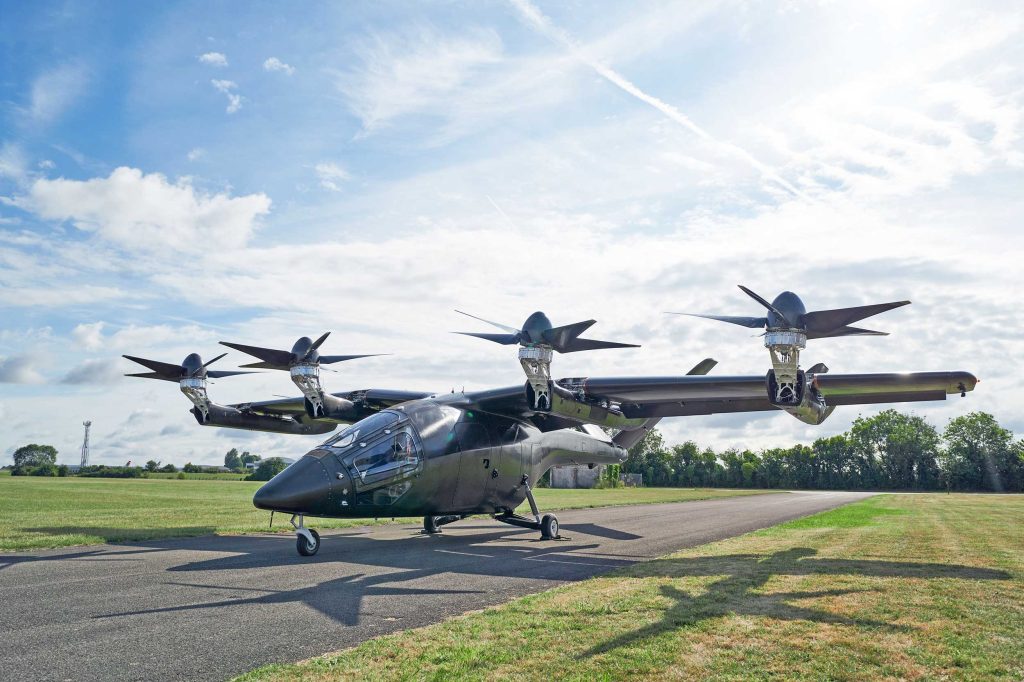
Vertical Aerospace needed equipment for the VX4, its piloted electric vertical-take-off aircraft. Praxis engineers designed and supplied tooling for assembly and transport: the physical fixtures that locate major components, allow an aircraft to be put together accurately, and let it be disassembled, moved and reassembled during flight testing. The glamour belongs to the aircraft; the jig has to be boringly correct.
Vertical's programme lead said the engagement was quick and the equipment arrived on budget and on time. The fee was not disclosed. That is typical of Praxis's public record: project totals sometimes appear, consultancy prices generally do not. London Bridge Station sat inside the £6 billion Thameslink programme, but that does not make the Praxis contract worth £6 billion. Its documented contribution was detailed design for more than 4,000 precast platform elements, with 3D models generating manufacturing drawings.
The same pattern appears in rail controls. Appointed through Telent in 2021, the former Ematics team built Version 5 of Network Rail's Traction Power Centralised Management System. Its network model calculates energisation states within milliseconds and warns operators about anomalies. A switching-schedule function automates isolation work, reducing the time needed to de-energise and restore lines. The eventual ambition is one platform spanning England and Scotland, used from 13 control rooms.
This is where “technology consulting” becomes a more precise label than it first appears. The software group says it has more than 70 engineers, averaging over 16 years in the field, working on real-time embedded systems and industrial automation. In aerospace, its methods reach DO-178B Level A, the most demanding failure classification in that standard. In tunnels, the company has delivered PLC and SCADA architecture designed around redundancy and continuous availability. The output may be code, but the product being purchased is confidence that the physical system will behave.
How the money worksProjects, work packages and long frameworks
Praxis is a private B2B services business. It charges for defined consultancy assignments, embedded specialists, integrated task forces, engineering work packages and longer framework call-offs. An industrial client might buy a feasibility study and design. A nuclear programme might keep a multidisciplinary team inside the organisation. A manufacturer might offload an entire tooling package. The Morson connection can add recruitment, deployed labour and training around the consultancy scope.
The framework model makes the revenue less theatrical and potentially stickier. In August 2026, Thales UK signed Praxis to a three-year niche-supplier agreement for sonar and naval-architecture work, with an option for two more years. In May, the consultancy retained EDF positions covering Hinkley Point C and the operating nuclear fleet and announced a parallel Sizewell C contract. Its Waldeck lineage had supported Hinkley since 2014, including BIM, temporary works, site engineering and management of construction issues.
The model has conditions. It works best when the problem crosses disciplines, the environment is regulated, implementation knowledge matters and the buyer wants one accountable route through the work. It is less persuasive for a narrow commodity study, a buyer determined to keep every discipline under separate contracts, or a programme without enough authority, data access and operator time to carry a design into practice. Integration only creates value if the teams actually integrate.
For a buyer, the practical question is not whether Praxis can list the required disciplines. It is who owns the interfaces between them. Ask for named responsibility from baseline to commissioning, evidence that the proposed team has delivered in the relevant regulatory regime, and a plan for handing knowledge back to operators. The approach earns its premium when those measures prevent rework, delay or unsafe ambiguity. Without them, “integrated” is only an adjective on a bid.
The next testCan a collection behave like one company?
The 2026 news flow suggests Praxis is filling gaps around the perimeter. It earned NERS accreditation for electrical infrastructure, achieved Schneider Electric's EcoStruxure Automation Expert competency, and signed an agreement with ICOMAT to explore Rapid Tow Shearing for lighter, more manufacturable composite structures. These are specific permissions and partnerships, not proof that every inherited team already shares one operating rhythm.
That is the honest challenge of the rebrand. Customers knew Waldeck for buildings and BIM, Ematics for controls, and Morson Projects for outsourced engineering. A common name makes cross-selling easier and vendor management simpler. It also raises the standard: a business promising seamless delivery will be judged most harshly at its own internal seams.
Still, the underlying idea is sound. On difficult engineering work, the expensive moment is often the gap between a recommendation and the person expected to make it real. Morson Praxis has named itself after practice. Now every bridge scan, switching schedule, nuclear work package and aircraft jig gets to test whether that name is a description or merely a hope.