Sebastian Fischer started with rockets in his parents’ backyard. His younger brother was there too. Years later, the brothers would put their names on a missile defense company, but the first arrangement was smaller: two children, something that could fly, and an outdoor space in which to find out whether it would. It is a pleasingly direct beginning for a career spent getting complicated machines to behave.
Today Fischer is the CEO and co-founder of Wardstone. Tobias Fischer, his brother, is its CTO. The company joined Y Combinator’s Fall 2025 batch with a space-based missile defense ambition. Its current commercial focus is a modular interceptor platform, with a stated emphasis on surface-based deployment. The change of altitude gives this story its most interesting turn. An aerospace founder’s flight plan can be revised while the company is already moving.
A backyard with a launch schedule
The childhood rockets offer a modest opening to a subject that can otherwise disappear into acronyms. Before there were organizations, credentials and product descriptions, there was the appeal of making a physical object move. A rocket supplies unusually prompt feedback. It either leaves the ground or provides its builders with a new afternoon’s work. Gravity has never been much impressed by a persuasive presentation.
The brothers eventually acquired different professional experience. Sebastian’s route took him through spacecraft work, drone delivery and autonomous vehicles. Tobias studied mechanical engineering at Cornell and worked at Astranis, building, launching and operating geostationary communications satellites. Their partnership brings those backgrounds into the same company. Family explains the connection; the work each had done before Wardstone explains the technical breadth.
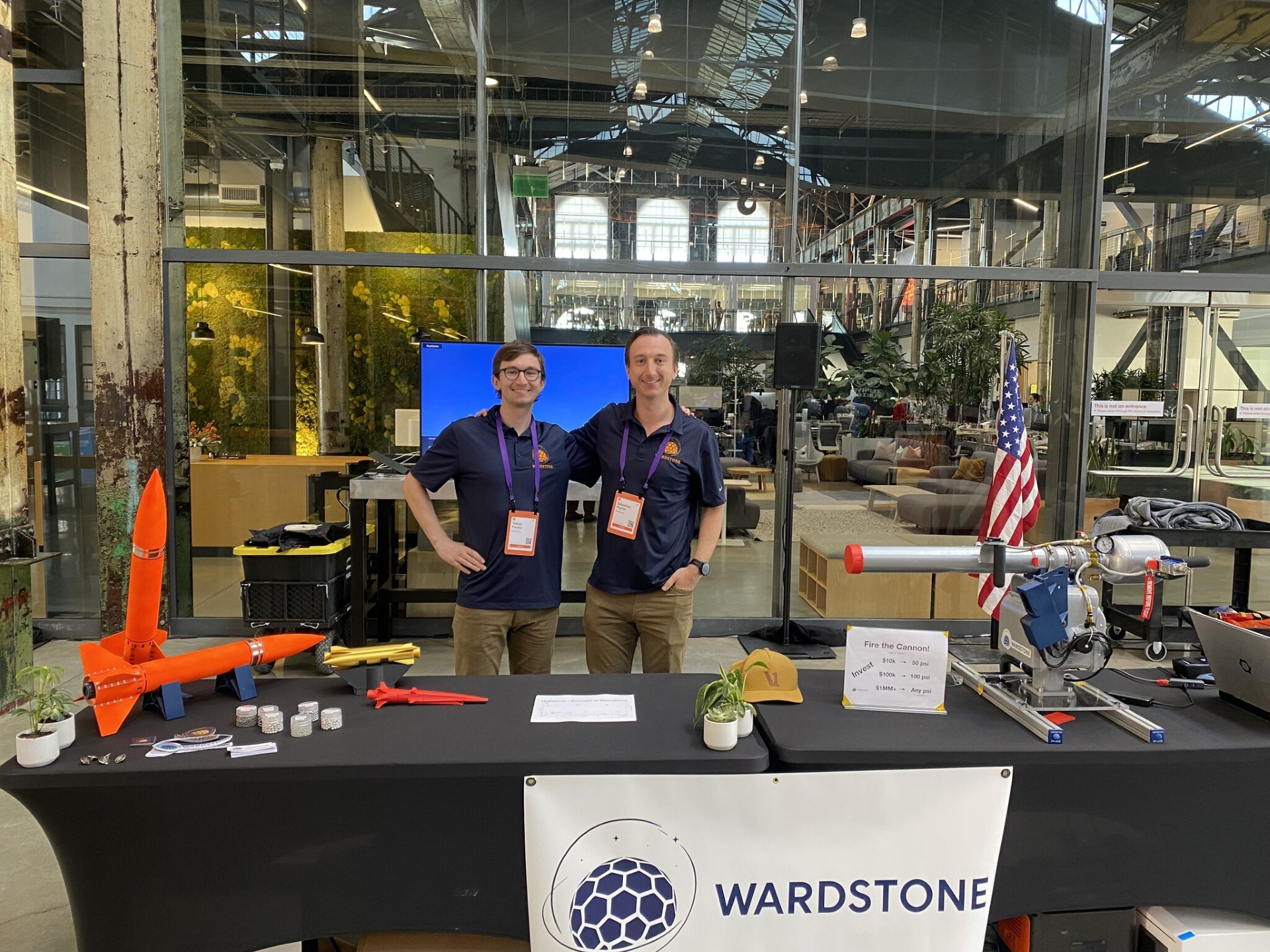
On the display table, orange flight hardware sits at one end and the cannon at the other. The brothers stand between them in matching Wardstone shirts. The picture has the ordinary clutter of a demonstration: equipment, small components and a sign inviting visitors to fire the cannon. The company introduction has acquired a collection of objects, with the founders standing beside their work.
The engineer between the engineers
Fischer grew up in the Bay Area and went to MIT. His undergraduate field was aerospace engineering, and internships at NASA and Lockheed Martin brought him into planetary spacecraft work. He later completed a dual MS/MBA at Harvard. Between those academic chapters and afterward came industry experience, including Amazon Prime Air and Cruise’s self-driving program.
The continuity is systems engineering. Fischer’s job at Prime Air involved coordinating technical disciplines. Such work lives in the connections: what one component asks of another, what an operator needs from the machine, and what happens when an apparently sensible decision has consequences elsewhere. The individual parts can be excellent and still make an awkward whole. A systems engineer has to notice the awkwardness before it becomes everyone’s problem.
A delivery drone offers a useful way to think about that responsibility. Its purpose sounds simple enough: carry something somewhere. Making the purpose repeatable requires the aircraft, electronics, software and operations to cooperate. The package has no interest in which department won an argument. It needs to arrive. This is the kind of practical coordination that sits behind an unglamorous job title.
His professional record includes recognition for that work. In June 2023, Fischer received Prime Air’s Delivery Champion Award for leading the Drone Airport engineering and product team through a preliminary design review. Earlier, in May 2015, he received MIT Aero/Astro’s Admiral Luis de Florez Award for Original Thinking and Ingenuity. The two awards sit eight years apart, across university work and an industrial program.
- SpacecraftNASA · Lockheed Martin
- Delivery dronesAmazon Prime Air
- Autonomous carsCruise
- Missile defenseWardstone · founded 2025
A brother joins the company
After Harvard, Fischer briefly returned to Amazon, then followed a mentor to Cruise in San Francisco. The subsequent disruption at Cruise became a turning point in his account of founding Wardstone. He had grown up around the idea of startups. Now he began working on one, looking for an aerospace problem that fit his experience.
For a few months, the project was his alone. Then he asked Tobias to join. His invitation was uncomplicated: “I’m going to go do this. Do you want in?” Tobias came aboard before the brothers applied to YC. There is something refreshing about a founding conversation that could fit on a kitchen note. The consequences, of course, required rather more space.
In his public announcement, Sebastian thanked friends and colleagues for their advice, feedback and encouragement. He identified the venture as space defense technology and named his brother as his co-founder. The message ended with a small instruction to himself and everyone watching: “Back to building!” It was an announcement with its own exit sign. The work was waiting.
The demonstration has to leave the table
Wardstone’s early YC launch described satellites equipped with interceptors. During the batch, the brothers also built an automated ground demonstration using infrared tracking and an air cannon. The company reported that the system destroyed three targets moving at more than 150 miles per hour. The test gave viewers a concrete piece of hardware to inspect alongside the proposed space architecture.
Target interceptions reported by Wardstone.
Development demonstration · not an operational deploymentThe distinction between the demonstration and the eventual product matters. An early test can show a principle working within its setup. A military system has to earn its place through further testing, integration and production. Keeping those stages separate makes the engineering story more legible. A small team can produce a useful result without that result answering every question about the machine it eventually intends to deliver.
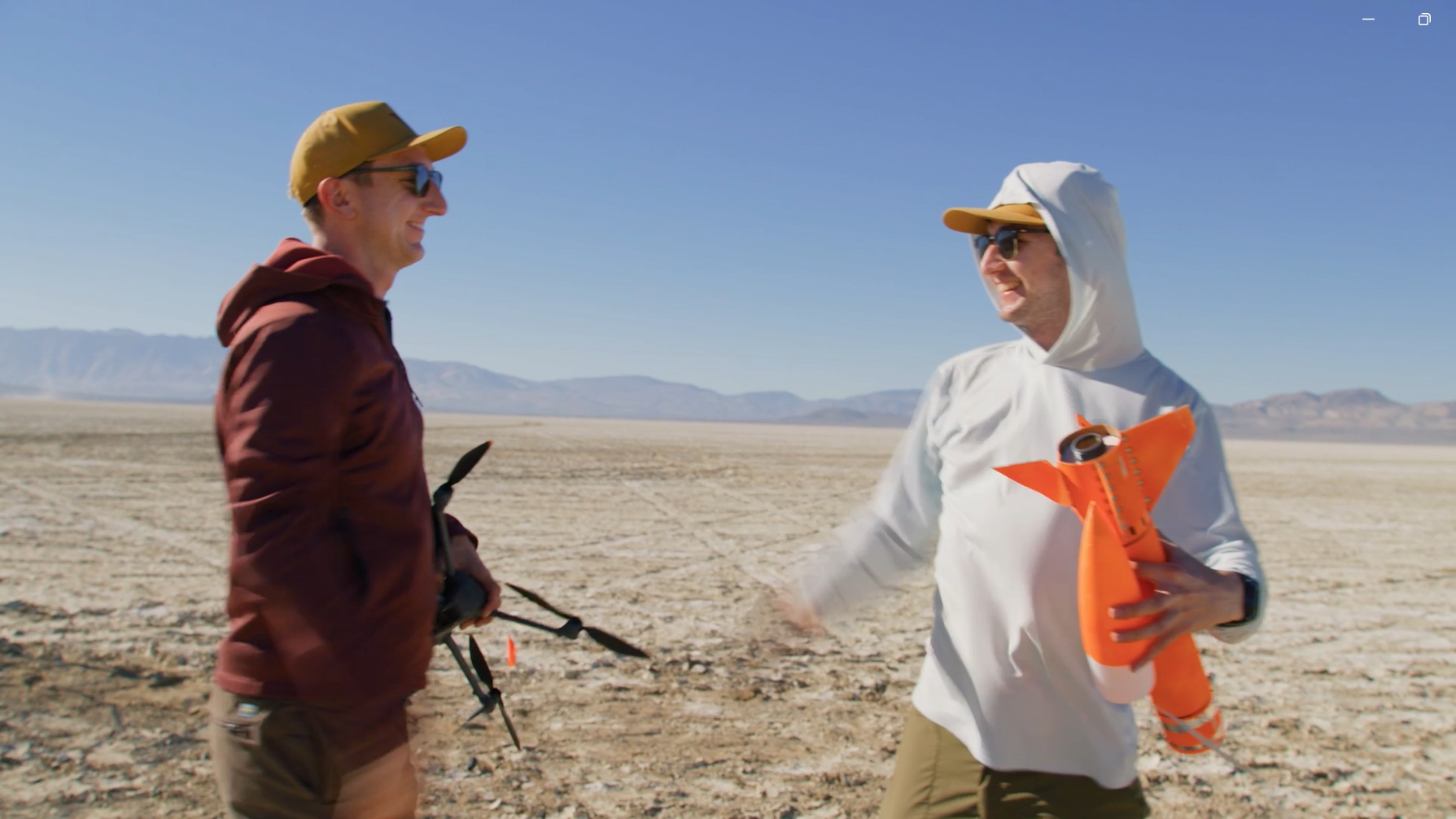
There is an appealing change of scenery in the photographs: founders beside equipment outdoors, then standing behind a display table. The objects are present in both. They make the project easier to understand than an abstract promise could. You can see the scale of an early effort and the people responsible for it, without imagining a finished constellation into existence.
Eighty conversations and a change of altitude
Wardstone later announced that it had held more than 80 one-to-one conversations with defense customers. The message it reported was a need for more interceptors at lower cost. The company said it was pivoting toward rapid commercialization of its surface-based interceptor. Its public description now leads with modularity: the ability to configure a platform for different threats and requirements.
For Fischer’s profile, this is a consequential piece of the record. The early premise concerned space-based defense. The newer emphasis concerns something customers said they needed nearer at hand. Both involve interceptors, but they organize the company’s immediate work differently. The public account lets us follow the revision without inventing a private moment of revelation.
“One airframe, many modules, to deliver the right performance at the right price.”
Wardstone’s description of its platform
That sentence brings economics into the design brief. A defense product has to perform, but the price and the ability to make enough of it also belong in the conversation. The word “modular” carries the proposed answer: retain a common platform while allowing the configuration to match the mission. The company presents this as a route toward manufacturing flexibility and future upgrades.
It is also a useful return to the systems engineer’s territory. An interchangeable part still has to fit the rest of the machine. A change in capability can affect cost, production and integration. The promise of an adaptable platform puts those relationships near the center of the product. Calling something modular starts the discussion; making the connections work is the longer job.
A company made of specialists
The team has expanded beyond the brothers. Wardstone’s public roster includes Mason Gawler in avionics and simulation, Robert Alviani in aerodynamics, and Ezekiel Bugay in propulsion. Aidan Gilkerson leads strategy and growth, while Patrick Barrett works in business operations. The range of disciplines gives a concrete picture of the organization around Fischer: flight hardware needs several kinds of expertise at once.
The company also lists Gur Kimchi and retired Major General Charles Corcoran as advisors, and Garry Tan as a partner and investor. Those are named relationships, alongside the working team. They place Wardstone within a wider network while leaving the daily engineering assignment where it belongs, with the people building and testing the product.
A founder’s work in this setting includes keeping the technical and organizational pieces aligned. A team can divide a problem into specialties; the resulting machine must bring them back together. Fischer’s career has repeatedly occupied that seam. At Wardstone, his title is CEO, but the company’s public work still revolves around the old question of how the parts will cooperate.
The next flight plan
Wardstone is headquartered in El Segundo, and Fischer lists the Los Angeles metropolitan area as his base. The company has announced finalist selection in the US Army’s xTech Apex Intercept competition. It has also reported Fischer presenting its modular interceptor at the Army Demand Signal Forum in Washington, D.C., discussing cost, technology insertion and production flexibility.
His stated mission remains defending the United States and its allies. The product emphasis has changed as Wardstone has developed. That gives his story a shape more interesting than a straight ascent: an engineer acquires experience across several kinds of machines, starts a company with his brother, builds an early demonstration, and adjusts the next step around what customers describe.
The backyard rockets make a fitting opening, but the present company supplies the real ending for now. There are more people at the table, more constraints to reconcile and a larger purpose for the hardware. Fischer and his brother are still building things that have to leave the ground. The next flight plan will have to survive contact with the equipment.