A perfectly good airplane can be a difficult thing to argue with. It flies. People buy tickets. Engineers know how to improve it. An entire industry has learned to work around its shape. For a young researcher, the interesting question begins a little further along: how long can that familiar arrangement keep getting better? Demetrios Kellari made that question the subject of his MIT thesis. Years later, as Dimi Kellari, co-founder and CEO of Neion Bio, he is still working on physical systems that ask for more than a clever component.
His career passes through aircraft engineering, community solar, infrastructure investing and roads designed for autonomous vehicles. Read as a list of industries, it looks restless. Read as a sequence of engineering problems, it has a recognizable rhythm. There is a machine, there are the systems around it, and there is the practical business of making the two cooperate. The résumé changes nouns. The work continues to involve things that must function outside a presentation.
There is a pleasing irony in the route. Engineering teaches you to improve what exists. Company-building sometimes requires asking whether the existing arrangement deserves another round of improvements. Neither choice comes with a guarantee. The aircraft that works today has evidence on its side. The proposed replacement has a model, a plan and quite possibly an enthusiastic person standing beside it. Kellari’s story begins with an attempt to make that argument more precise.
“I’m a recovering aerospace engineer.”
Dimi Kellari / Free Radicals, September 2026
A familiar airliner, an unfamiliar question
At Imperial College London, Kellari studied aerospace engineering. His early professional work included Airbus and CERN, before graduate research at MIT. These are institutions with different purposes, but his route through them was grounded in engineering. The work came before the founder title. In his later career, that background would sit alongside product management, strategy and investment, giving him several different vantage points on the same broad problem of getting a technical system built.
His 2016 thesis carried a direct opening question: What’s next for the airliner? It examined historical changes in aircraft architecture and performance, then considered future possibilities. An airliner’s architecture is the arrangement of its major parts. That arrangement can remain recognizable while the technologies inside it improve. For a passenger, the airplane may look much the same. For an engineer, the changes within that familiar outline can be substantial.
Kellari examined when the established arrangement might reach its limits. His research considered engine technology and policy alongside aircraft design. The Technology and Policy Program awarded the work its 2016 Best Thesis Award. It was a subject that required looking beyond a single part: technical progress, efficiency targets and the shape of the overall aircraft all belonged in the discussion. A better engine and a different airplane are related decisions, but they are decisions at different levels.
A 2017 Journal of Aircraft paper extended that research into a study of technology trends and future aircraft architecture. The work made room for several scenarios rather than a single confident sketch of tomorrow. That is an appealing quality in a forecast. The future rarely arrives with the courtesy to match the drawing. Exploring more than one route gives a design discussion somewhere to go when the first set of assumptions begins to wobble.
The electricity has to be shared
During his MIT years, Kellari also worked on Potluck Energy. The venture coordinated construction and allocated electricity from shared solar installations. It is a compact description of a fairly expansive task. The solar installation must be built, and its output must be organized for the people sharing it. Construction and allocation belong in the same sentence because a community solar venture needs both. Sunlight is generous about arriving without paperwork; the business around it has other requirements.
This early work gives his story a second scale. Aircraft research considered the architecture of a complex machine. Shared solar brought in the arrangement among users and an installation. A panel can produce electricity while the surrounding project still needs coordination. The engineering object alone cannot supply the whole description of the enterprise. There are connections to make, responsibilities to assign and a service to deliver.
In 2016, Kellari published writing on community solar, including an article about how it could change a neighbourhood and another about the implications of COP21. The titles place the work in its contemporary setting: a technical venture connected to questions about how energy is organized and used. His graduate period thus contained both a study of established aircraft designs and an effort to coordinate a shared energy system. Research and entrepreneurship were already sharing the calendar.
A road joins the conversation
After MIT, his professional history includes McKinsey, product and strategy roles at X, the moonshot factory, and investment work at Sidewalk Infrastructure Partners. A public infrastructure event described his work at X and SIP as incubating and investing in energy, mobility, waste and water platforms. The objects changed, but the physical demands persisted. An infrastructure idea has to fit into a world that already contains equipment, institutions and people who depend on them.
Kellari then helped build Cavnue, a company developing roads purpose-built for autonomous vehicles. He had been involved in its incubation at Sidewalk Infrastructure Partners. His operating work covered product, systems and technology; an event biography described him as leading systems and integrations. Integration is a modest word for a demanding job. It requires the parts to agree about what they are doing, rather than merely performing well in isolation.
The road is an interesting place to put engineering attention. Conversations about autonomous travel readily settle on the vehicle. Cavnue’s work brings the infrastructure into view as well. Once that boundary expands, the design problem changes. The thing moving and the thing it moves through both matter. For Kellari, the shift from investing to operating also changed his place in the work: from helping evaluate and develop a venture to helping build its technical organization.
His advisory roles retain that connection to technical businesses. New System Ventures lists him as a technical advisor. Radiant Intel lists him as a strategic advisor on technology products and bringing them to market, citing his Cavnue, X and SIP experience. The distinction between those roles is useful. Technical knowledge can inform a product decision; operating experience can inform how that decision becomes a business. His career has put him on both sides of that conversation.
Two Rockefellers, one new company
Neion Bio was founded in 2024. Kellari became its co-founder and CEO, working with Sam Levin, an evolutionary biologist with an Oxford background. The partnership brought together different technical histories. Kellari arrived with engineering, product and infrastructure experience. Levin had built a company around bioreactors. Their new enterprise required company-building and scientific expertise in the same organization. The team would have to combine them in its daily work, rather than simply place them beside each other on a website.
The setting was Rockefeller University’s Ford Center Incubator on Manhattan’s Upper East Side. The founders needed space suited to their team, equipment and specialized operations. The incubator offered a practical home. Locating the work is one of the less cinematic stages of starting a company, though it can determine how easily the more cinematic stages happen. Even an ambitious technical idea eventually needs a place for the next person to sit.
The address supplied an early joke. When Ming Li went to meet the founders at “Rockefeller,” he arrived at Rockefeller Center. They meant Rockefeller University. Both destinations were in New York; only one contained the meeting. It is a useful reminder that a company can assemble considerable technical expertise and still benefit from sending a precise location pin. Li later joined Neion’s commercial leadership.
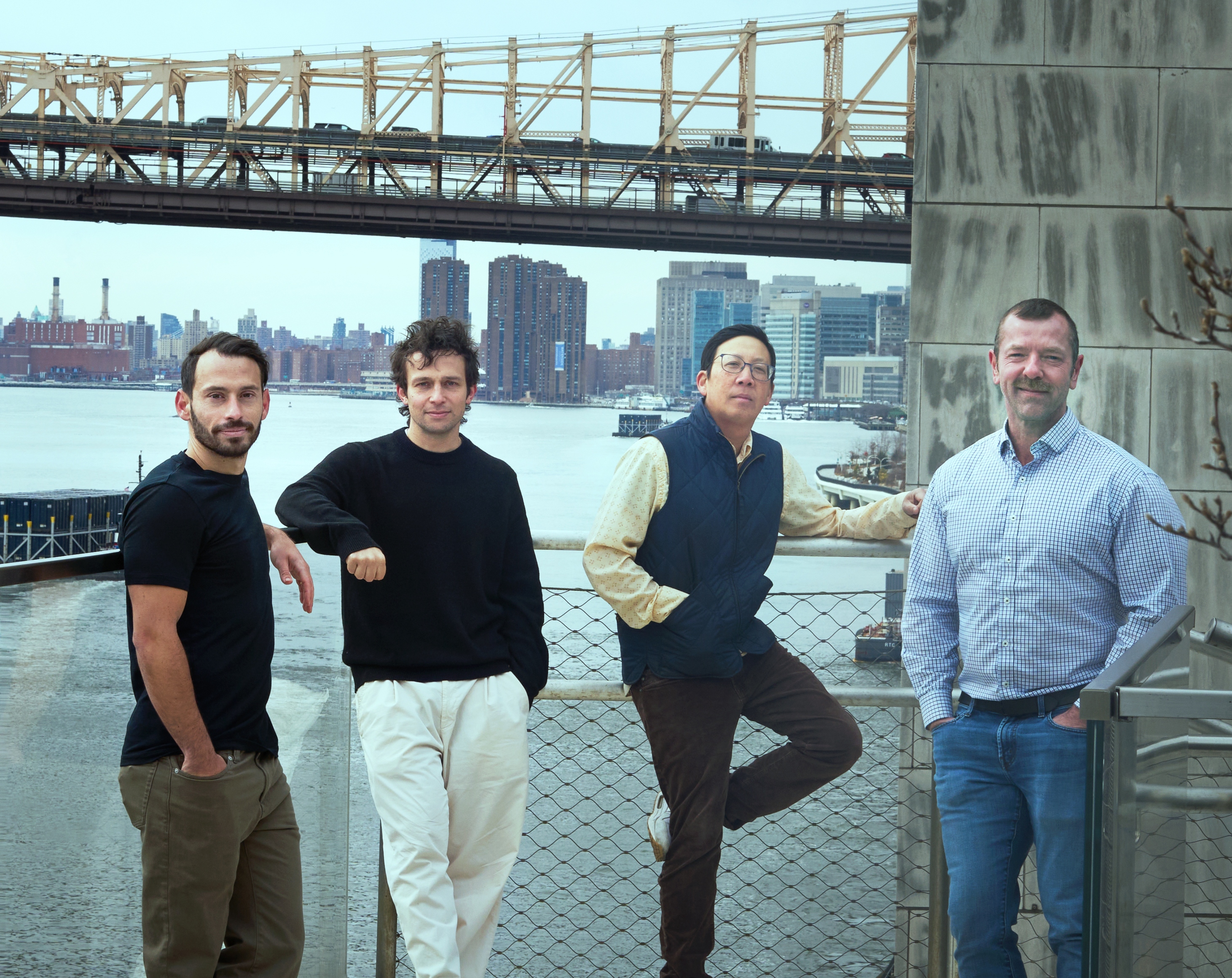
In the leadership photograph, Kellari stands with Levin, Li and chief scientific officer Sven Bocklandt beside the East River. The group reflects the organization’s different responsibilities: a chief executive, a technical co-founder, a commercial leader and a scientific leader. A company begins to become easier to understand when the work has names attached to it. There are people responsible for the idea, people responsible for testing it and people responsible for finding its place in a business.
The design is still being tested
Neion emerged publicly in March 2026. In June, it announced a $23 million Series A led by Caffeinated Capital. Those milestones mark a change in the company’s resources and public presence. They also bring the familiar obligations of a growing venture: building the team, organizing the work and deciding how to use the capital. Funding gives a project more room to proceed. The task of making the organization function remains with the people inside it.
Kellari’s public remarks on recruiting show one very concrete preference. He has objected to AI-generated cover letters that repeat the same structures and phrasing. He also clarified that cover letters were optional and that the screening he described involved people reading applications. It is a small operational detail, with a clear implication for applicants: a document intended to introduce a person should give the reader something specific about that person.
The career now contains research, a solar venture, investment work, product leadership, advisory roles and a CEO position. Its coherence lies in the actual projects rather than a claim that each step was inevitable. Aircraft, electricity and roads ask different things of an engineer. Building a company adds another set of requirements. Kellari has repeatedly moved between the technical object and the arrangements needed to make it useful.
That leaves the opening question alive. A perfectly good design deserves respect for the work it already does. It also deserves examination. Kellari’s MIT research put that examination into aircraft architecture; his later roles brought it into infrastructure and operating companies. Today the next design has a team and an address in Manhattan. This time, visitors should make certain they have the correct Rockefeller.