Bill Magnuson was waiting to cross a Manhattan avenue when he started talking to a stranger. His friend Jon Hyman was on the phone, so Magnuson had a conversational vacancy. The two engineers were heading to TechCrunch Disrupt to present a project they had built at its hackathon. A few days earlier, they had been colleagues with an entrepreneurial itch. Now they had won a programming contest.
The stranger was Bipul Sinha, then an investor at Lightspeed Venture Partners. The conversation led to an introduction to Mark Ghermezian, an entrepreneur working in Houston who wanted to revisit a mobile software project called Appboy. Dinner followed. So did a company. Magnuson, Hyman and Ghermezian would build the business that became Braze, which began trading on Nasdaq on November 17, 2021. A crosswalk had supplied the introduction. The intervening ten years supplied the less photogenic work.
There is an appealing temptation to leave the story at the traffic light. Chance encounter, clever engineers, ringing bell: the entrepreneurial fairy tale has its preferred punctuation. Magnuson's version is more interesting because the important decisions came on either side of that meeting. He had already left one familiar path. He would spend years working toward customers whose businesses were still taking shape. Luck offered him a conversation. It did rather less of the coding.
A college application with very little backup
Magnuson grew up in rural Minnesota, close to the land his ancestors had homesteaded after emigrating to the United States. He was a first-generation college student. His childhood included canoeing, camping and hunting in summer, skiing and snowmobiling in winter, and a sustained interest in computers. The outdoors and the internet occupied the same life. One offered nearby woods; the other made the world beyond them accessible without requiring a driving licence.
His route to MIT began with movies. He had seen the school on screen, liked the idea of it, and applied. In his telling, it was the only school he applied to, although he already had a route into the University of Minnesota through programmes he had taken in high school. Staying closer to home had been the family expectation. The acceptance from Massachusetts changed the question. An opportunity he had barely planned for was suddenly asking for an answer.
He remembered advice about throwing a baseball cap over a wall: sometimes you create a reason to climb by putting something you want on the other side. Boston, a distant campus and an unfamiliar family milestone became his wall. He went. The story has the pleasing untidiness of a real decision. He had neither a comprehensive university strategy nor complete confidence about leaving. He had an acceptance letter and a growing reluctance to let the familiar option choose for him.
Android arrives. The engineer pays attention.
At MIT, Magnuson studied computer science, earning a bachelor's degree and a Master of Engineering. His early work at Google included App Inventor for Android, a visual programming language that made building mobile applications more accessible. Android was emerging as he finished his studies. He was watching a change in who could make software, where people could use it, and how much of daily life might eventually move onto a device in a pocket.
Bridgewater Associates came next. There he worked with Hyman, who would become his fellow technical cofounder. Magnuson later described feeling pulled toward mobile while working in an established financial industry. The technology shift he had seen at Google was hard to set aside. Hedge funds offered demanding engineering work; mobile offered a new set of business questions. His eventual company would carry traces of both experiences, including a concern with responding to fresh information quickly.
In May 2011, Magnuson and Hyman entered the TechCrunch Disrupt hackathon in New York. Their project, Gilt-ii, let shoppers arrange auctions around items held in carts on the flash-sale site Gilt. The hack was a mischievously practical response to temporary scarcity: somebody could have the item you wanted without quite wanting it themselves. The pair won the contest. For a future customer-engagement CEO, it was an unusually literal introduction to the gap between shopping and buying.
The customer had yet to arrive
Appboy emerged from the partnership with Ghermezian later that year, with Magnuson as CTO. The founders wanted to help app owners maintain relationships with people after the download. Mobile had created a new place to meet customers, but the machinery for understanding and keeping them was still developing. The initial ambition extended across different ways of communicating, rather than tying the business to one kind of notification. The phone was the starting point; the relationship was the continuing problem.
In a 2013 interview, Magnuson described an early obstacle that sounds wonderfully prosaic beside a hackathon trophy. Customers needed time to understand the product and work out how to integrate it. Marketing staff and engineers had to coordinate. Even a useful tool could require organisational cooperation before anyone saw its benefit. Founding a software company had introduced him to a second engineering problem: persuading different people inside someone else's company to make the same thing happen.
The market's immaturity also complicated fundraising. The founders did not receive multiple term sheets in a financing round until their Series D, six years after inception. Their conviction about mobile had to coexist with a market that was still forming. That is a less comfortable position than hindsight suggests. You can be persuaded that a change is coming and still spend a long time explaining why anyone should buy your particular response to it.
Magnuson was frank about trying to sell before the market was ready. His answer was to use the waiting period to build. Patience here had a practical meaning. A company needed enough software to serve the eventual customer, enough money to keep working, and enough contact with app developers to notice when the demand changed. The crosswalk introduction had been quick. The business required a different clock.
“The market wasn't ready for us to sell to it yet.”
Bill Magnuson
A new job, then a new name
On January 1, 2017, Magnuson became CEO. Ghermezian moved to executive chairman, while Hyman took the CTO role. The announcement made product vision central to the change. For Magnuson, the responsibility expanded from building the platform to leading the organisation around it. Founding teams often sound interchangeable in compressed company biographies. These three had distinct jobs, and their rearrangement mattered. The engineer who had helped define the product would now carry responsibility for the broader business.
Appboy became Braze in 2017. By 2019, the company had passed $100 million in annual recurring revenue. It reached $200 million less than eighteen months later, then made its public-market debut in 2021. Those milestones compress a decade into a neat sequence of numbers. They also show how long the first part took. Eight years to reach the first hundred million is a substantial stretch of professional life, especially when the origin story can be told before a pedestrian light changes.
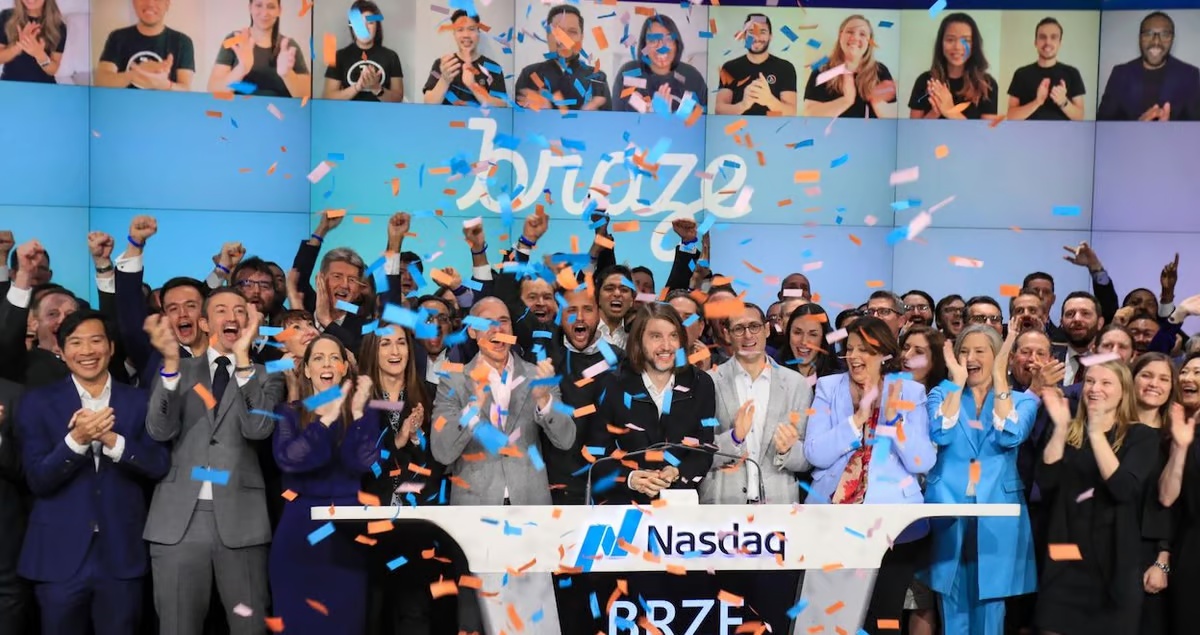
The Nasdaq celebration is an excellent photograph of the outcome: colleagues gathered together, fists raised, confetti doing what confetti is paid to do. The older hackathon project had involved temporary rights to items in a shopping cart. A decade later, the company's shares could be bought through a broker. Both events involved a market. The intervening experience had made the stakes and the paperwork considerably larger.
A burger-sized demonstration
One of Magnuson's favourite illustrations of what the technology could enable was Burger King's Whopper Detour campaign. Its creative idea used location and mobile technology to turn proximity to a rival restaurant into a promotional opportunity. Braze worked within a wider technology ecosystem that included Branch, mParticle and Radar. The campaign won a Titanium Lion at Cannes in 2019. An enterprise platform had found itself helping a burger brand make a very public joke.
The example suits Magnuson's stated respect for hard work and tasteful irreverence. A complicated system can be useful precisely because it lets somebody else execute a playful idea. That also helps explain his interest in customer relationships across channels. The person receiving a message experiences the whole interaction. The division between databases, app infrastructure and marketing teams belongs to the people building it. A customer has no special obligation to admire how many departments cooperated.
He has compared Braze's architecture to a high-frequency trading system: take in new information, update an understanding of the current situation, and decide whether to act. In marketing, the possible action becomes a message or an experience. The comparison connects his financial-engineering background with the mobile problem he wanted to tackle. Timing matters because a person's circumstances change. A message can be technically correct and arrive after its reason for existing has wandered off.
Pink boots and the problem with average
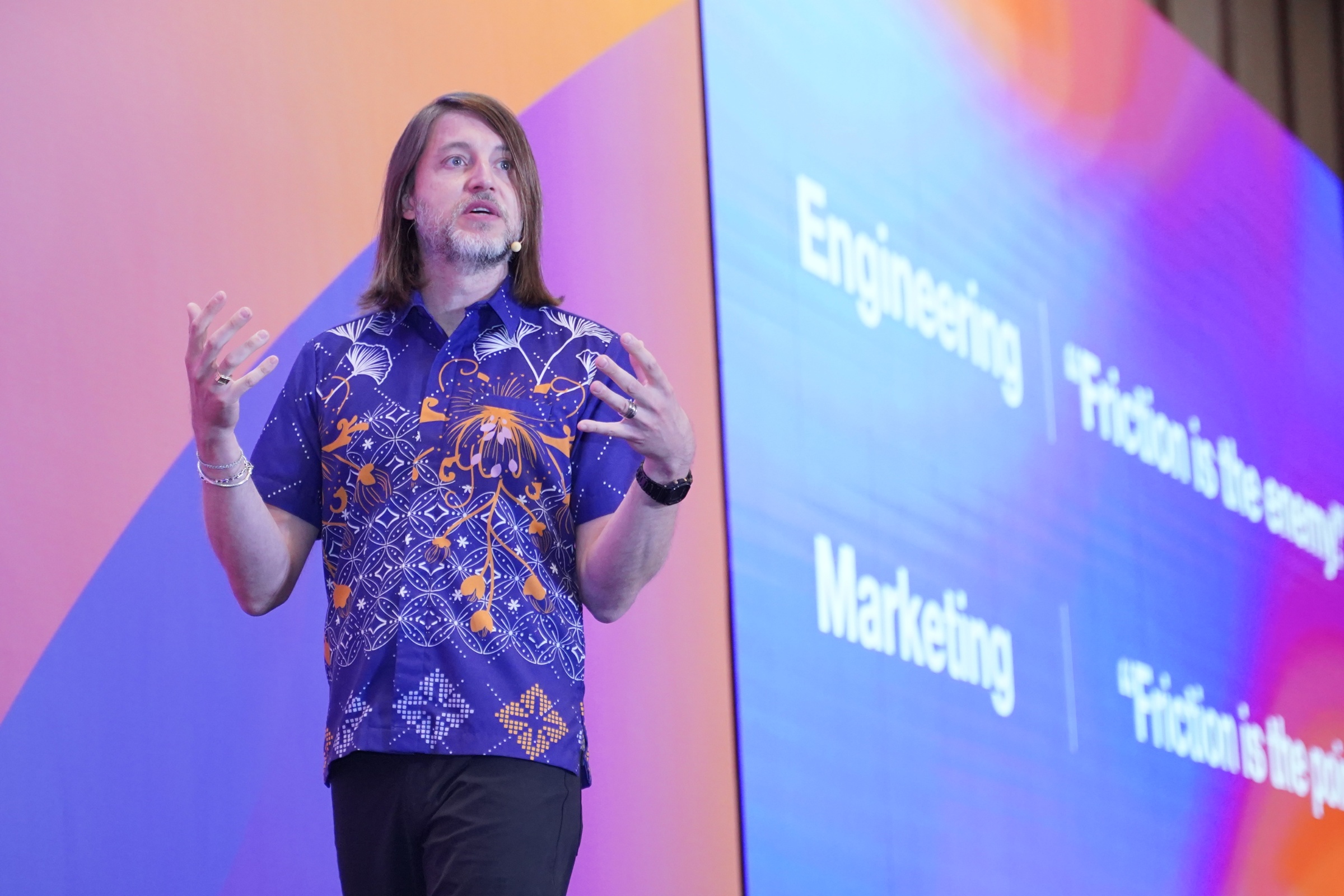
By September 2026, Magnuson was discussing another technology shift. At Grow with Braze Jakarta, he used bright pink football boots to introduce his concern about businesses converging on the same ideas. His analogy was the wind tunnel: optimisation can remove resistance while making the resulting designs resemble one another. Applied to AI, his argument was that using similar tools and signals could encourage similar marketing. Getting more output would still leave the question of whether anybody cared about it.
The company's September 29 announcements placed that argument alongside products for personalised decision-making, campaign quality assurance and working with Braze through other AI tools. The capabilities were announced in beta, with some scheduled for broader availability in October. The distinction matters: an announcement describes work entering customers' hands, not a finished verdict on its effects. Magnuson's current challenge is to connect another wave of technical capability with the business results people are actually trying to achieve.
His life outside those announcements retains a few useful edges. He is a cycling commuter and an adventure enthusiast. His official biography includes an ambition to explore ice caves on Europa. Jupiter's moon is an extravagant destination for someone who began near a Minnesota homestead, but the preference is consistent with the college story: an unfamiliar place has considerable appeal. An engineering degree is helpful. The transport arrangements may need a little more work.
The crosswalk anecdote has endured because it makes a company seem briefly human-sized. Two friends have built something; one is on the phone; the other talks to someone nearby. Magnuson's career keeps returning to that ordinary act of attention, whether the setting is an Android project, an app user's next visit or a marketer wondering what AI should do. Before the platform and the public listing came the willingness to look past an established route, and to hear what someone else might have to say.