Long before Noah Dinkin was selling companies a faster way to create email, he was helping musicians reach the people who might actually listen. A concert needs an invitation. A campaign needs to get out of the building. Between the idea and its audience, time disappears.
Dinkin’s first education in that gap came in music. He grew up in Westport, Connecticut, and interned at local radio stations during his freshman year of high school. At NYU Stern, he combined his studies with jobs at a record label he had co-founded, UFO, and the artist-management business Invasion Group. He also co-founded Verge Records with Emmanuel Zunz, bringing international hip-hop and a commitment to supporting artists’ communities into the same business.
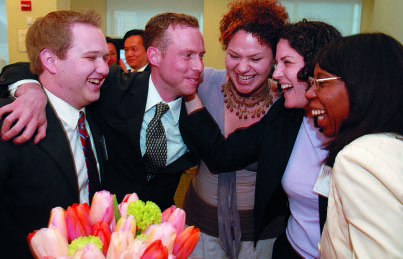
Verge won the social entrepreneurship track of Stern’s 2005-2006 venture competition. There is a photograph of the team celebrating: Dinkin at the left, a group leaning together, flowers in front. The corporate inbox is still some distance away. He had already found a use for a business degree, however. As he joked about university, “My extracurricular GPA was a 4.0.”
A fan is more than a friend request
FanBridge began in 2006. Dinkin and his friend Spencer Richardson wanted a project they could build around their day jobs. They settled on a practical question: how could an artist maintain a direct relationship with fans? Their first product handled email lists, geographical targeting, scheduling, and sending. Dinkin freely acknowledged that its appearance left something to be desired. Bands signed up anyway.
The usefulness was easy to explain with a map. A musician playing Manhattan did not need to alert every fan in New York State. FanBridge could select people within a radius of the venue. The invitation became more relevant, and a fan in Buffalo could be spared news of a gig several hours away. Geography was doing rather more work than a handsome interface.
Dinkin also urged musicians to own their audience lists. In 2009, with MySpace, Facebook, and Twitter competing for attention, he was already asking what information artists actually possessed about their followers. A platform could be fashionable without giving a band a portable relationship with its audience. His advice had an unglamorous durability: collect permission, keep the connection, and have a way to reach people when the fashionable destination changes.
“Own YOUR List!”
Noah Dinkin, advice to musicians, 2009
The pop fan with a practical streak
There was a pleasing complication in this music-business résumé. Dinkin admitted he had grown up listening to Z100 and preferred a good song to allegiance to a particular artist. Asked to defend his taste, he declined the invitation. A founder can build tools for musicians without auditioning for the role of most discerning person in the record shop.
By 2011, he named John Legend, Lady Gaga, and Imogen Heap among FanBridge’s clients. Heap, he said, had joined in the company’s second week. Bigger artists often meant working with managers, labels, and digital teams as well as the performers themselves. His description of the job centered on conversations: hearing suggestions, discussing ideas, and passing along what the company learned across clients.
Those conversations gave Dinkin a way to notice where a system was frustrating people.
Finding a company inside a delay
Stensul emerged from FanBridge, carrying the email experience into enterprise marketing. Dinkin’s attention moved upstream from sending a message to the process of making it. The question was deceptively ordinary: why did an email require so much coordination before anyone could send it?
His answer concerned the way work was divided. A marketer needed designers, developers, and other specialists. Brand rules had to survive each handoff. Reviewers needed the right version. The email might be short; the chain of people and tools could be long. In Stensul’s 2018 funding announcement, Dinkin described production that routinely consumed weeks and argued that a nontechnical user should be able to create an on-brand email in minutes.
The proposed freedom came with boundaries. Stensul built brand, design, and legal requirements into the creation environment. Marketers could work within those rules rather than repeatedly discovering them at the end. The company connected to the systems customers already used to deliver their campaigns. Dinkin was choosing a particular stretch of the journey and trying to make it work.
A queue can decide whether an idea reaches its audience while it still matters. Dinkin had found a problem with a calendar attached.
A very unconvincing music manager
In September 2020, Nathan Barry, ConvertKit’s founder, looked at Mandy Moore’s website and noticed FanBridge underneath its email signup. He called the company and, unexpectedly confronted with a real person answering, improvised. He said he was a music manager looking for a platform. Scott, FanBridge’s general manager, helped him through the product.
The disguise was not destined for a long career. Scott noticed Barry’s Idaho area code, investigated, and connected the number to ConvertKit. This was corporate reconnaissance conducted with the caller’s own mobile phone. The useful consequence was a conversation about buying FanBridge.
Dinkin was then focused on Stensul while remaining on FanBridge’s board. He was also raising Stensul’s $16 million Series B. Barry found that FanBridge was profitable and its owners had no urgent need to sell. An initial offer was too low, but Dinkin kept the discussion open.
The eventual deal used an upfront payment rather than a more complicated arrangement involving later payments and performance targets. It closed on February 17, 2021, and ConvertKit announced the acquisition in April. A business that had begun as a spare-time project had carried thousands of musicians into a larger creator platform. Meanwhile, its co-founder had another set of email problems on his desk.
Money raised, money watched
Stensul’s financing grew in steps: a $7 million Series A in 2018, a $16 million Series B in 2020, and a $34.5 million Series C in November 2023. The last round, led by Sageview Capital, brought total funding to $57.5 million. LaunchDarkly co-founder Edith Harbaugh participated as an angel investor.
Dinkin’s ambitions had widened, too. In his 2023 announcement, he described a creation platform extending beyond email. Landing pages had joined the product, along with tools for dynamic content and generative AI. He wanted marketers to spend the time they recovered on testing ideas and improving results. Faster assembly had value because of what people could do afterward.
Asked about the difficult fundraising environment, he emphasized investors who were human and shared his view of growth. Asked about money, his advice was decidedly plain: keep believing in the business, execute, and pay attention to daily spending. He said Stensul remained careful with its finances even after raising the round.
The ambition has to justify years of work. The bill still arrives at the end of the month.
A company selling speed, with a sloth
The enterprise-software business need not resemble a tax seminar. At Oracle CloudWorld in 2022, Stensul offered visitors a stuffed sloth in exchange for a short pitch and a badge scan. Dinkin’s own session concerned creating emails without the back-and-forth. The animal was a nicely chosen accomplice: a company arguing against slow work could give the slowness a face.
The sloth had also made the leap to a screen. In October 2020, Dinkin invited people and their families to a free Zoom call with sloths for International Sloth Day. A marketing event had acquired the possibility of children arriving as well as marketing operations professionals.
When he later looked back on Stensul, Dinkin singled out the trade-show playbook as a source of fun and occasionally a reason to arrange extra crowd security. Enterprise buyers had serious workflow questions. They could still leave the booth carrying something ridiculous. The invitation to smile was part of how the company introduced itself.
More drafts, the same approval queue
Dinkin’s interest in collaboration preceded the AI rush. In 2020, he talked with Scott Brinker about self-service marketing technology: tools that people outside a central operations group could use, and the permissions, preparation, and principles needed around them. Giving someone an editor was only part of enabling them to work.
By 2025, Stensul was adding an AI email generator that could produce an initial draft from a campaign brief inside a preapproved template. Dinkin shared the launch publicly. The old concern about rules remained visible in the new feature. More content still needed to fit a brand and reach a usable state.
Sageview’s account of its investment described the same practical stakes. Customers wanted fewer scattered versions, fewer unnecessary approvals, and less dependence on outsourced production. Its argument was that guardrails and review would matter whether a human or an algorithm made the draft. That is a fairly direct continuation of Dinkin’s original interest: finding the work that slows down everything else.
Returning to the starting room
In 2025, NYU named Dinkin among the mentors for its Summer Launchpad founders. Nearly two decades after the Verge competition, he was back in the university’s entrepreneurship orbit with a different kind of experience to offer.
There is continuity here with his earlier enthusiasm for helping people enter startups. In 2011, he described reducing someone’s idea to a first version, introducing them to people with experience, and helping would-be employees find a suitable team. Those are modest interventions. They also address a familiar pause: the time between wanting to make something and actually beginning.
His public celebrations of Stensul’s employer recognition likewise centered on colleagues. When the company made Forbes’ 2025 startup-employer list, he pointed to collaboration and new leaders across marketing, product, and customer success. The founder’s name might lead the announcement; the work required a growing cast.
The chair changes hands
On May 11, 2026, Stensul appointed Manlio Carrelli as CEO, effective immediately. Dinkin stepped down after more than a decade leading the company. His statement called founding and leading Stensul “one of the most meaningful experiences of my life.” He expressed pride in the team and customers and wished his successor success.
In his personal reflection, he described a team of more than 160 people working across continents. He remembered awards, trade shows, and a customer survey that had named Stensul its most adopted marketing technology. He also said he intended to experiment with AI. The curiosity that had led him into new projects was still present at the handover.
The route to that point had been unusually consistent for a career that crossed radio, records, musicians’ mailing lists, and enterprise software. Dinkin kept coming back to the arrangements that let other people reach an audience. First, the artist needed a relationship with fans. Later, the marketer needed a way through production and review. Each business began with work somebody had to do before the interesting part could happen.
The Send button is small. The distance to it can be surprisingly large. Dinkin spent a decade building a company in that distance, with room along the way for a hip-hop label, a badly disguised acquisition call, and a few sloths.