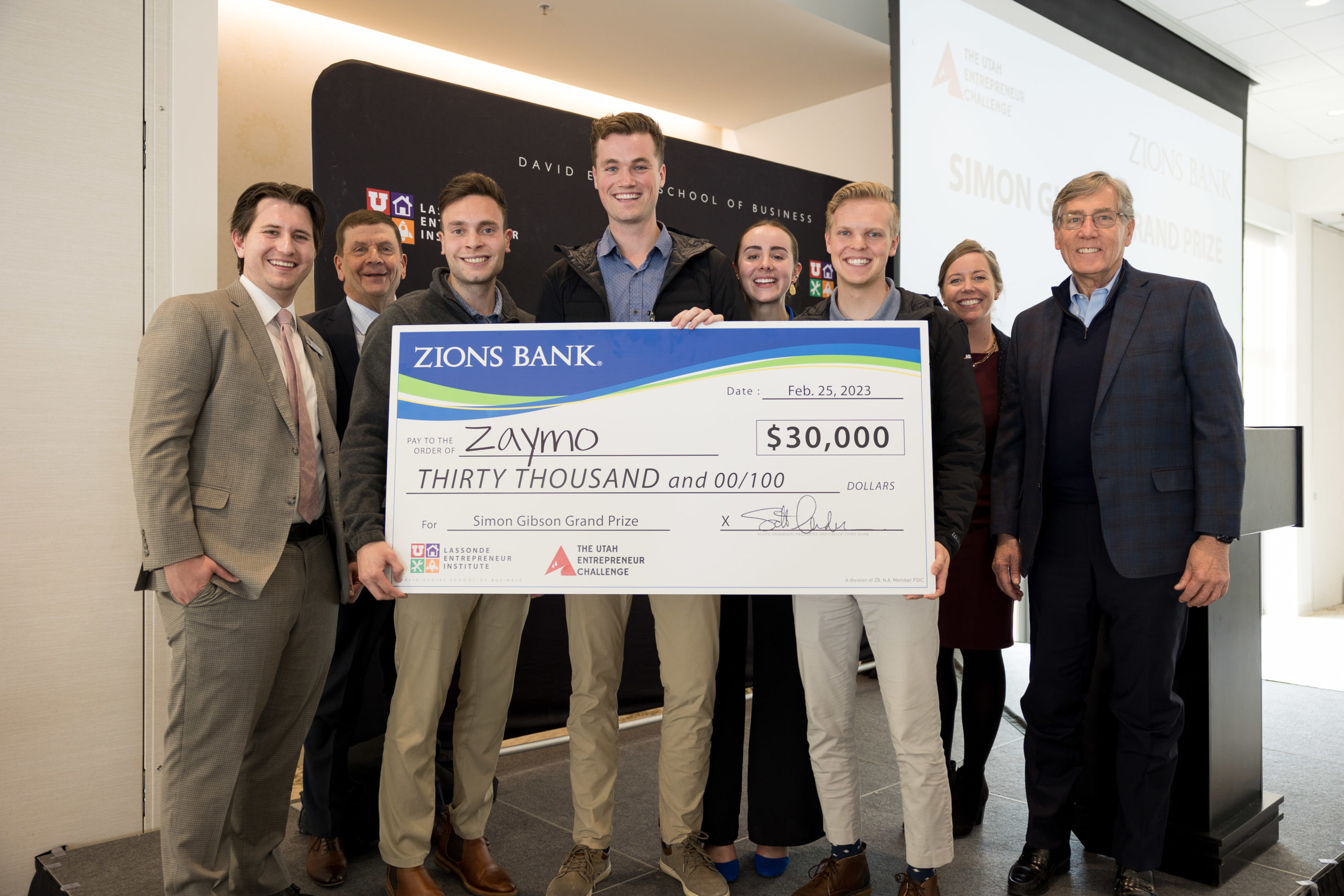
Brice Douglas had a company that could win a pitch competition before it had an app ready for a proper launch. In February 2023, Zaymo collected a $30,000 prize in Utah. In May, the team finished third at the Rice Business Plan Competition and attracted $875,000 in investment awards. The photographs are cheerful. The amounts are substantial. Neither tells you whether a customer will keep paying.
That question became Douglas's work. As CEO and co-founder of Zaymo, he handles the commercial side of an idea that sounds almost offensively reasonable: let people do something inside an email. Change an order. Choose a different product. Adjust a subscription. Spare them the expedition through a website that begins with a promising button and ends with a password they last remembered during another presidential administration.
His public career traces the distance between making that idea persuasive and making it useful. There is a trip to Italy, a departure from college, a stint in corporate strategy, and a growing business in Utah. The thread running through it is his willingness to put the proposition in front of customers and let their behavior answer back.
An economics student finds his people
Douglas came to Brigham Young University from Bentonville, Arkansas. He studied economics with a minor in strategy. Those subjects suggest an interest in how resources move and decisions get made; his next steps gave him opportunities to watch both at close range. He became involved with University Growth Fund and worked as a corporate strategy analyst at Weave.
The university also supplied something less tidy than a syllabus: people to build with. Douglas met Santiago Gomez Paz and Daniel Jones through a hackathon. Their early experience together included winning a trip to Italy. The Levinthal Fellowship gave the group exposure to founders and investors, followed by time abroad devoted to creativity and developing business ideas.
The three did not move straight from a good trip to a finished company. They gained experience separately and stayed in touch. Douglas interned at Weave. Eventually, they compared three startup ideas in a private pitching exercise and settled on interactive email. Even the founders, it seems, had to sell the founders.

In his account of the team, Douglas is comfortable assigning himself the less glamorous sounding role. His co-founders are the technical builders; he is, as he put it, “the guy who talks.” Sales and operations fall on his side of the table. The joke has a practical point. A product needs someone who can listen to a merchant, explain a proposal, and discover which part of the explanation fails to survive contact with a budget.
A campus can make a gamble possible
Douglas has been explicit about the help behind his decision to become a founder. He credits BYU's Sandbox program and mentors including Chris Crittenden and Scott Evanson. When discussing the team's Utah competition win, he described the difficulty they would have faced without that guidance in terms of an enormous multiple. His telling leaves plenty of room for other people's contribution.
That matters in a dropout story. Leaving university can look wonderfully decisive once there is a company logo to place beside the decision. Douglas's own explanation is more conditional. In a testimonial for Sandbox, he says the environment made him willing to exchange a safe career for the risks of a startup. Support came before the leap.
He also gives some of that experience back. His LinkedIn profile lists him as a Sandbox alumnus and founder advisor, helping later cohorts build companies. The relationship with the program continues beyond his own participation. There is a pleasing symmetry in a founder returning to the place that helped make founding seem possible.
Douglas names Sandbox mentors Chris Crittenden and Scott Evanson among the people who helped Zaymo's student team.
The check is large. The question stays small.
On February 25, 2023, Zaymo won the Utah Entrepreneur Challenge at the University of Utah. It was a statewide business model competition, with a final field of 20 student teams and more than 30 judges involved across the judging rounds. Douglas described the ambition in terms of clearer, more direct, more interactive communication between brands and customers.
Rice supplied another test of the pitch. The team finished third in the 2023 competition, winning six investment awards. The $875,000 total was described as cash investments. That distinction is useful: investment awards and ordinary prize money belong to different columns, however splendid they look on a ceremonial check.
February 2023
May 2023
2024
In August 2023, Zaymo announced a $700,000 pre-seed round involving Handshake, Peak Ventures and angel investors. Mike Levinthal and Craig Earnshaw were among the people backing the business. These were concrete signs that outsiders were willing to commit resources, alongside the university competitions that had already helped the team make its case.
The danger of arranging those events in a neat row is that they resemble instructions. Win competition, raise money, enter accelerator, succeed. Customer software has a less courteous sense of sequence. A judge can understand a product in a few minutes. A merchant must integrate it into work that will still exist next Tuesday.
The long wait behind “fail fast”
Douglas dates the start of the company to August 2022. In his account of the early period, the team spent roughly a year to 18 months consulting, speaking with brands and trying individual solutions before the app launch. He recalls about 30 initial attempts that failed to behave as the team expected.
It is an unusually useful detail in a founder's story. Testing did not produce a reassuring answer on command. The attractive idea needed repeated adjustment. The early work involved rewriting important email templates and checking what happened, a sequence closer to patient commercial experimentation than a dramatic reveal.
In December 2022, Douglas's stated advice was to build, release and respond to feedback without getting stuck in corporate deliberation. Speed, in that formulation, meant shortening the distance to an answer. It did not guarantee that the answer would be pleasant.
Zaymo went through Y Combinator's Winter 2024 batch. By 2024, the team had accumulated both outside backing and the experience of trying to make the product work. The useful lesson is in the order of effort: recognition can arrive while the difficult work remains very much in progress.
Give the customer a button worth pressing
Interactive email addresses a small but persistent mismatch. A brand sends a message at a moment when an order is relevant. The customer reads it in one place, then must travel somewhere else to make a change. Douglas's work centers on bringing the action closer to the moment of attention.
In a 2026 guide co-written with Piyush Jain, Hattie Gilpin and Adam Kitchen, his contribution describes subscription upgrades, adding products to an upcoming order, accelerating a shipment and changing the delivery cycle. These are ordinary decisions. Their ordinariness is the point: the customer should not need to make a special occasion of changing a refill.
His examples also include an undo action inside the email. That is a quietly revealing product detail. Making a choice quick creates another responsibility: making a mistake recoverable. Convenient software ought to have a little patience for its user.
Let the experiment spoil the argument
Douglas publicly committed Zaymo to showing customers transparent data. In a 2024 post, he described the pleasure of a merchant asking to end a comparison test and move its reminder emails onto Zaymo's templates after seeing stronger performance. The satisfying part was a customer's request grounded in a result.
His later discussion of billing reminders puts that preference into practice. He described a coffee brand that had stopped sending upcoming order messages because it feared cancellations. A test split subscribers between receiving no reminder and receiving an interactive reminder offering ways to adjust the order.
According to the results he discussed, cancellation rates were the same between the groups, while total spend was 10% higher in the group receiving the reminder. This was a reported result for that test. It offers a concrete example of the question Douglas wants merchants to ask: what happens when a customer receives useful choices?
By 2026, his concern extended to the measurement system itself. In a public post, he argued that retention teams struggle to experiment because lifetime value takes so long to observe, while immediate email metrics may tell them too little about it. He asked marketers for input as he worked on rethinking testing, iteration and analytics.
“I'm pouring an inordinate amount of time into solving this problem this year.”Brice Douglas, on retention measurement
The next problem is larger than an email
Zaymo's current company description has widened to an AI marketing agency for Shopify brands, with agents handling content and iteration while retention marketers oversee strategy and outputs. That expands the job from making an email interactive to helping run the work around it. Douglas's concern with measurement gives that broader ambition a recognizable starting point.
There is also the everyday business of building a team. In his public comments about financial planning, Douglas discusses comparing forecasts with actual results and modeling whether a hire makes sense. He admits that spreadsheet scenarios can be pushed down his list of priorities. A tool that makes the question faster to answer helps him actually answer it.
Outside work, his stated interests include skiing, climbing and running. He has also used LinkedIn to ask for Dallas barbecue recommendations while attending SubSummit. It is a small interruption in the stream of demos, hiring and product discussion: a founder can evaluate software all day and still need help finding dinner.
Douglas's story remains in motion. The competitions helped finance a beginning. Mentors helped make the risk conceivable. Customer tests gave the product something firmer than a convincing pitch. Now he is applying the same appetite for evidence to a larger marketing problem. For someone who describes himself as the talking co-founder, his most consequential move may be to keep giving customers a way to answer.