In February 2025, the menswear brand Jordan Craig put four website visitor identification providers on the same shop. Each supplied contacts to the same welcome email series. It was a pleasingly unfashionable experiment: keep the message steady, change the data, count the purchases. In CustomersAI’s published account, its contacts converted at 2.79%. Retention.com’s converted at about 0.01%. A list of names had become a test of whether anyone useful was attached.
- CustomersAI connects shopping behavior to identities so brands can follow up.
- Its current focus is Shopify brands using Klaviyo, plus their agencies.
- The lesson to copy: measure correct matches and purchases, not list growth alone.
Those are vendor-published results from one retailer, over ten days. They deserve that qualification. But the question behind them travels well. When marketing software hands you an email address, what exactly has it handed you? A customer? A probable customer? Or someone destined to wonder why a trouser company has developed an interest in their afternoon?
The platform owned the rules
Larry Kim’s company began in 2018 as MobileMonkey, helping businesses automate chats. Facebook Messenger offered an enormous audience and an appealing idea: make conversations scalable. Kim already knew the machinery of online advertising from founding WordStream. With MobileMonkey, he was working closer to the conversation that might turn attention into a sale.

The difficulty was ownership. Meta could alter what the software was allowed to do. In his account of the rebrand, Kim says popular features could disappear at the platform’s discretion, while competition crowded the market. After three years, he concluded that what they had built was insufficient for a sustainable business.
“We needed more control over our own destiny.”Larry Kim, on the MobileMonkey pivot
The team had been assembling tools for its own outbound marketing. That experience suggested a different product: combine consumer data and outreach automation. In 2023, MobileMonkey became Customers.ai. The old name had acquired a comic problem. A business selling consumer prospecting data had remarkably little to explain about monkeys.
The change required money. In an August 2023 interview with Nathan Latka, Kim described $400,000 of Founderpath financing in 2021 and reported passing $2 million in annual recurring revenue in 2022. In April 2023, the company announced a $4.99 million Series A led by ScOp Venture Capital, with New York Angels and Beyond Angels participating. DoubleClick founder Kevin O’Connor joined the board.

A name is a hypothesis
The next revision went deeper than branding. In a 2026 public update, Kim said the company had tested visitor identification data, including the data behind its own earlier product, against known first-party sessions. A purchase gave the team something unusually valuable: an identity to check the prediction against. He reported finding serious inaccuracies and described building an extended first-party identity system in response.
That is the revealing admission. Automation can dispatch the message with immaculate punctuality while being wrong about the recipient. A larger contact list then increases activity without necessarily increasing useful activity. CustomersAI’s present positioning stresses identity quality and what it calls True Match Rate, rather than treating every returned email as a victory.
- 01 Observe a session
- 02 Resolve an identity
- 03 Check against a purchase
- 04 Measure the outcome
Illustrative workflow. Correct identification and commercial performance are separate checks.
Jordan Craig’s experiment belongs here. Holding the welcome sequence constant made contact quality easier to examine. Its marketing director, Rob Varon, reported 4.6 times the revenue per identified contact compared with the next best option. The result does not establish a universal ranking. It does give another retailer a useful starting design for a trial.
Alfred tends the guest list
Today, the website’s central audience is more specific: ecommerce brands on Shopify using Klaviyo. CustomersAI sits between the store’s behavior signals and the systems that send messages or buy ads. Its homepage reports more than 500 Shopify brands. Named customers in its published stories include shortyLOVE, Prana Pets, Haverhill, and Cove Smart.
X-Ray is the identity product. It reconnects returning shoppers to existing profiles across sessions, browsers, and devices, and offers optional new-visitor identification. That distinction matters. Recognizing an existing subscriber who returns on another browser is a different task from finding a previously unknown person’s email address.
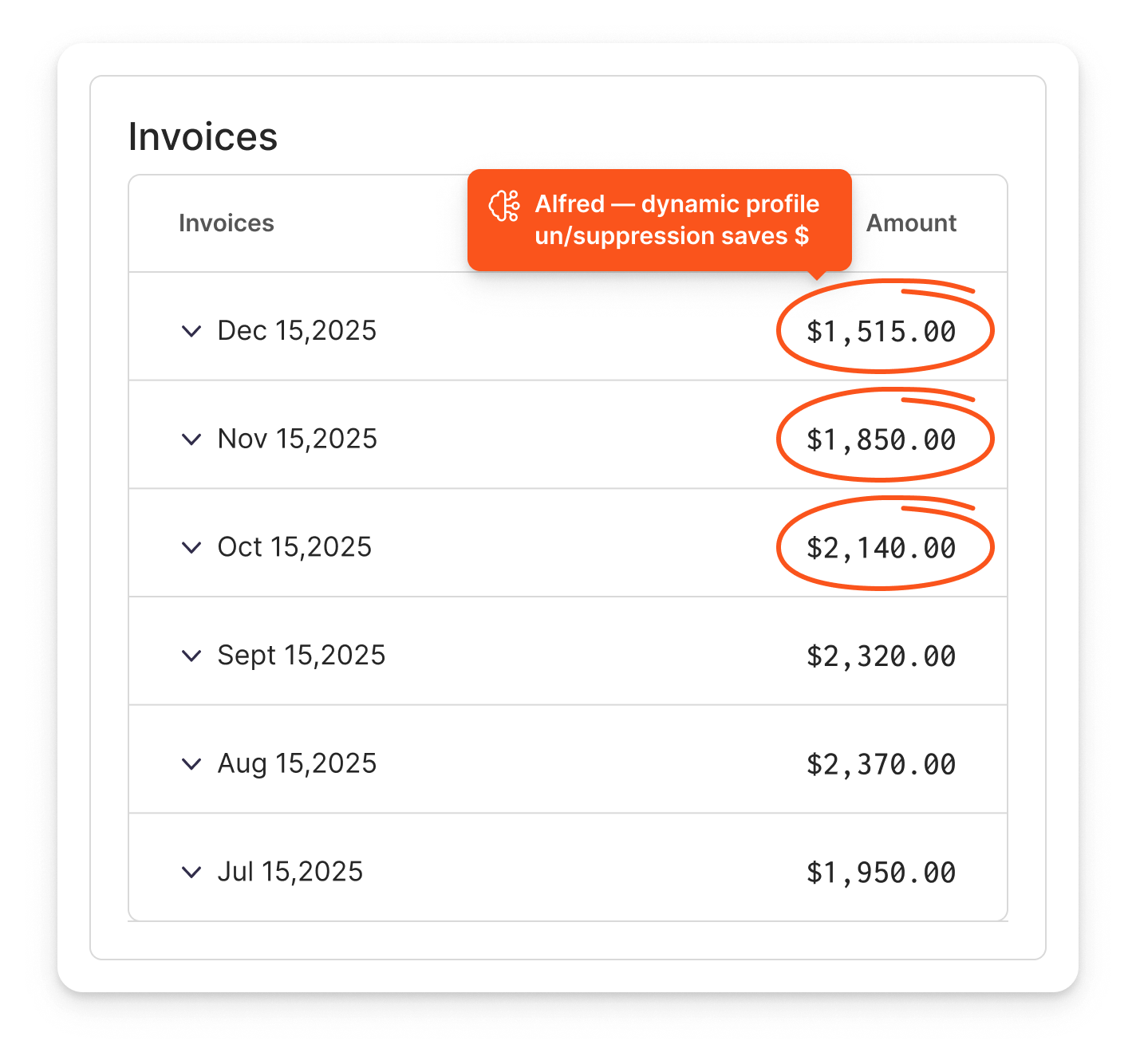
Alfred, the AI audience agent, takes the next decision: who should hear from the brand? Its product page describes daily recommendations for purchase-ready audiences, profiles to suppress, and suppressed contacts showing renewed engagement. For a retention team, the attraction is less manual sorting and a closer relationship between shopping intent and the next send.
Inboxer and the broader deliverability suite address whether the message is seen. Super CAPI supplies server-side signals to Meta advertising. APIs and webhooks let developers move identity and event data into other systems. The company lists partnerships with Klaviyo, Shopify, Meta, and Google. Its expertise increasingly concerns the connection between identity, audience decisions, and delivery.
The bill counts the quiet people, too
The business model is modular software subscriptions. Current pricing depends on total Klaviyo profiles, including suppressed and unsubscribed records, selected products, and contract settings. CustomersAI says it needs the full database to distinguish visitors and respect opt-outs. A buyer should therefore price the whole account, not merely the active mailing list.
The pricing page offers a seven-day trial with up to 500 visitor resolutions. It also advertises a four-times directly attributable ROI guarantee. These are commercial terms to inspect in the agreement. The practical calculation includes subscription fees, integration work, email costs, and the margin on additional orders.
Fit depends on what is already there. A store with useful traffic, customer records, and functioning email flows has material for the software to work with. Sparse traffic limits the experiment. Poor offers and unwanted messages remain poor offers and unwanted messages. For anonymous email identification, the company’s compliance page says it excludes EU citizens and residents; the US acquisition pitch should not be projected onto every market.
Count the purchases
Alternatives include Retention.com, Opensend, Wunderkind, and Black Crow AI. CustomersAI positions its extended tracking alongside tools such as Elevar and Triple Whale. The sensible comparison is a trial on the buyer’s own store: inspect identity accuracy, overlap, purchases, complaints, and revenue per contact. Better recognition earns its keep when it leads to better decisions about whom to contact, when, and why.
Follow the experiment
Explore CustomersAI, its pricing calculator, customer stories, and blog. Follow LinkedIn, X, Instagram, or Facebook.