The honest answer to “Mailchimp or Klaviyo?” begins in a place software comparisons tend to avoid: your gross-margin spreadsheet. Mailchimp can cost less for a list of roughly 10,000 contacts. Klaviyo asks for more money in exchange for a richer account of what shoppers do between opening an email and placing another order. Neither fact settles the purchase. The useful question is whether the second fact can reliably pay for the first.
A static quote makes the choice look tidier than it is. The supplied comparison puts Mailchimp Standard near $100 a month and Klaviyo near $175 at this audience size. Prices move. By mid-2026, independent checks of Klaviyo's public slider placed its tier covering up to 10,000 active profiles closer to $150, while Mailchimp continued to vary its quote by contacts, send allowance, billing term, and promotions. Those figures are guide rails, not a purchase order. A merchant should open both calculators on the same afternoon and use the same list and send assumptions.
The gap is still meaningful. A $50 monthly premium is $600 a year. A $75 premium is $900. Yet a commerce brand with a 50 percent gross margin needs only $100 to $150 in truly incremental monthly revenue to cover those amounts before labor and implementation costs. That sounds easy until “truly incremental” enters the sentence. A dashboard may claim revenue from an email sent before a customer bought. It cannot automatically prove the customer would not have bought anyway.
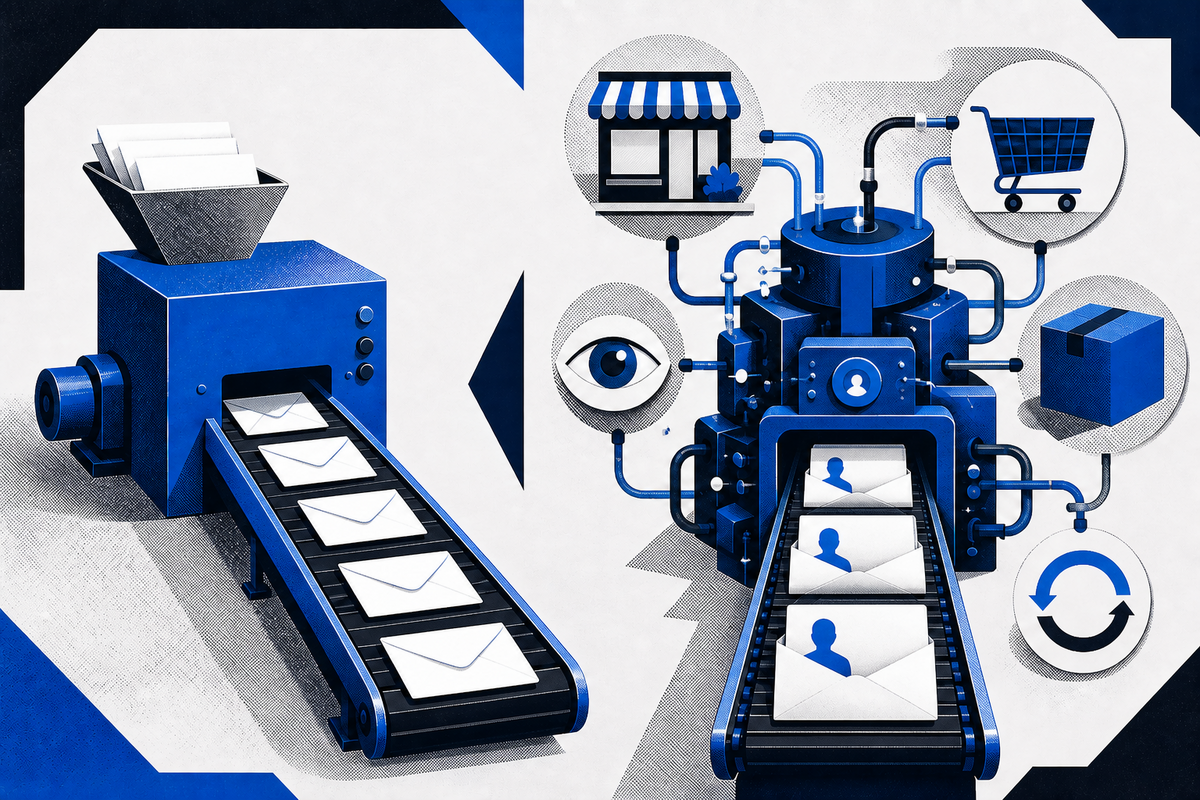
One sends mail. The other watches the shop.
Mailchimp is not merely a newsletter machine. Its ecommerce tooling supports abandoned carts, product retargeting, product recommendations, order notifications, and purchase follow-ups. Its automation flows can start from shopping activity, contact activity, dates, integrations, reviews, or an API call. For a small team that also markets events, services, editorial content, or a local business, that breadth is an advantage. The product is familiar, the editor is approachable, and the lower operating burden has value.
Klaviyo begins with a more particular obsession: the customer event. Its Shopify data reference lists events including Viewed Product, Added to Cart, Checkout Started, Placed Order, Fulfilled Order, Refunded Order, and delivery milestones. New Shopify data syncs in real time after the historical import. The WooCommerce integration also syncs commerce data in real time and can track site activity, checkouts, product views, and orders. Those events can become triggers, filters, branches, and exclusions inside a flow.
The premium does not buy a better email. It buys a better guess about why this person should receive one now.
Consider browse abandonment. A known visitor looks at a pair of shoes but never adds it to the cart. Klaviyo can recognize the Viewed Product event and show that product in a later message. Its own guidance recommends a lighter touch than a cart reminder because a view indicates less intent. That detail matters. Useful automation is not simply faster pursuit. It is the ability to distinguish a glance from an unfinished checkout.
Now consider replenishment. A customer buys coffee, skincare, filters, or pet food on a somewhat predictable cadence. Purchase data can start a timer; product, order count, or customer value can alter the message; another purchase can cancel it. A generic broadcast asks everyone to shop. A replenishment flow asks one customer whether it is nearly time to replace one thing. The second message can feel less like marketing because the store remembered the product's useful life.
The hidden cost is operating the machine
Feature access is not capability. A team has to install tracking correctly, map product data, define consent, write variants, set sensible delays, create exclusions, watch deliverability, and inspect where people fall out. It must also suppress profiles that should not remain billable. Klaviyo bases its Profile and Email plans on active profiles and monthly sends; a profile that can be emailed counts as active, while suppressed profiles do not. Mailchimp says archived, cleaned, and deleted contacts do not count toward a marketing plan's contact total. The labels differ, but the lesson is shared: list hygiene is finance work.
This is where Mailchimp can win without having the deepest event model. If the marketing team is one founder who sends a monthly letter, the theoretical value of a sophisticated flow builder is mostly decorative. If the catalog has long, irregular replacement cycles, replenishment logic may be weak. If a store has little identified traffic, browse events cannot attach themselves to many reachable people. If the product margin is thin, a discount-heavy recovery program may generate attributed revenue while losing contribution profit.
Where each platform's practical value tends to concentrate
The opposite case is equally clear. A Shopify or WooCommerce brand with repeat purchases, enough identified traffic, clean catalog data, and a marketer who works in the system every week can use Klaviyo as more than a sender. First-time buyers can receive different education from loyal customers. High-value customers can be spared an unnecessary coupon. A person who just ordered can leave the browse flow. A customer approaching an expected reorder date can receive a useful prompt. These are modest decisions repeated thousands of times.
Run the premium test before you migrate
Start with three flows rather than a grand lifecycle map. Browse abandonment tests whether the store can identify interest before a cart exists. Post-purchase tests whether order and product data can improve education, cross-sell, or care. Replenishment tests whether purchase timing predicts a helpful return. For each one, write down eligible profiles, holdout logic, expected conversion lift, average order value, gross margin, discounts, returns, and the hours required to maintain it.
Then calculate the hurdle. Suppose the premium is $75 a month and implementation consumes another $1,200 in the first year. The first-year cost is $2,100 before staff time. At a 50 percent contribution margin, the flows need $4,200 in incremental annual revenue to break even, about $350 a month. This is still attainable for many stores. More importantly, it is testable. The exercise converts a vague argument about “power” into a falsifiable operating plan.
Choose Mailchimp
When newsletters dominate, the team values ease and breadth, purchase frequency is low, or advanced flows will not receive weekly attention.
Choose Klaviyo
When live commerce events, repeat purchases, clean product data, and disciplined flow ownership can turn timing into measurable contribution profit.
A migration has its own costs. Templates need rebuilding. Sending domains and authentication need care. Historical engagement and suppressions must survive the move. Flows should be staged so customers do not receive duplicates. Reporting windows will not match perfectly, and attributed revenue may jump or fall merely because the new system counts differently. A sensible operator runs the migration as infrastructure work, not as a weekend import.
Measurement deserves the same discipline. Reserve a small, randomized holdout group when traffic permits, and compare purchases over a window that matches the buying cycle. Look beyond opens, which privacy features have made less dependable. Track clicks, orders, contribution margin, unsubscribes, spam complaints, and the share of recipients who would have received another message anyway. A flow that lifts orders while exhausting the audience is borrowing from next quarter.
Watch the human signals too. Customer-service replies can reveal when timing feels creepy, when a replenishment interval is wrong, or when product data placed an unavailable item into a message. The best automation programs have a feedback route from support to marketing. Behavioral precision increases the obligation to be tactful. Knowing that someone looked is permission to be relevant, not permission to follow them around the internet with a megaphone.
There is also a useful warning in Intuit's 2021 acquisition of Mailchimp for approximately $12 billion in cash and stock. Mailchimp is not a neglected lightweight. It sits inside a company with a large small-business data and software footprint. Meanwhile, Klaviyo has continued deepening its Shopify relationship, including localized catalog support for Shopify Markets and a 2026 connection to Shopify Sidekick. Both products will move. Today's gap is not a permanent law of nature.
Buy the behavior your team can use
Mailchimp is the sound default for organizations that need to communicate well without turning every customer action into a data problem. Klaviyo earns its premium when the shop itself becomes the editorial calendar: a product viewed, a checkout started, an order fulfilled, a consumable nearing its replacement date. That is a narrower promise, and for the right merchant a more valuable one.
The final choice should feel almost boring. Clean the list. Pull current quotes. Name three flows. Set a gross-profit hurdle. Assign an owner. If the additional signals clear that hurdle, pay for them. If they do not, keep the cheaper tool and invest the difference in better offers, photography, service, or products. Software is at its best when it makes a customer decision more legible. The rest is buttons.