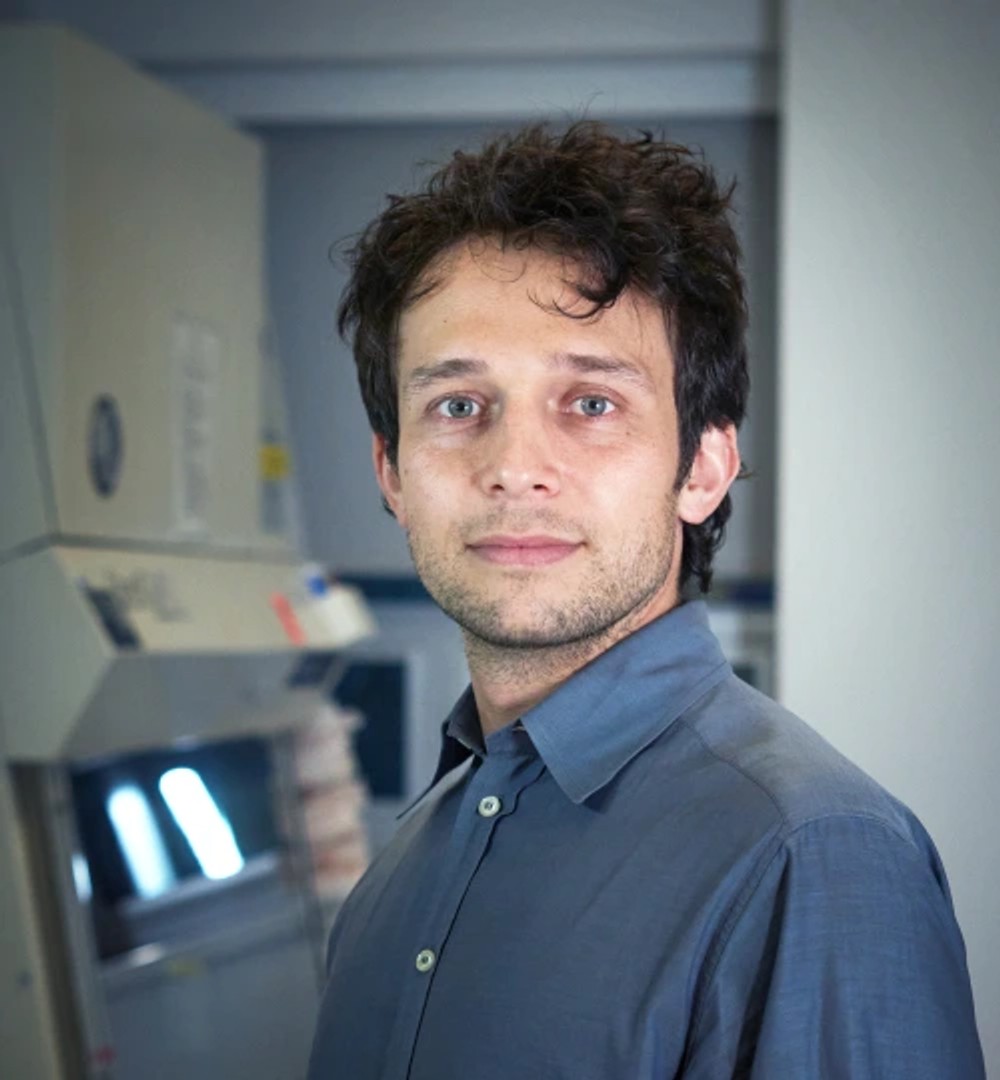
A drug factory that fits in your hand
Dimi Kellari runs a biotech company whose central instrument is one of the oldest objects in the kitchen. At Neion Bio, the New York company he co-founded in 2024, the chicken egg is not breakfast. It is a bioreactor, precision-engineered to grow the complex proteins that modern medicine is made of.
Neion's proprietary system, called the Raptor platform, uses genetic engineering to restrict recombinant protein production to the egg itself. The result, the company says, is the ability to produce complex, glycosylated proteins - the kind used in monoclonal antibodies - at meaningful scale, within days, and at a fraction of the cost of a conventional facility. In June 2026 investors backed that thesis with an oversubscribed $23 million Series A led by Caffeinated Capital, following roughly $11 million disclosed when Neion stepped out of stealth three months earlier.
Kellari's framing of the problem is blunt. "Biopharma manufacturing has not changed in decades," he has said, calling it a "major bottleneck" in getting new breakthrough medicines to patients. The industry's workhorses are giant steel bioreactors filled with hamster cells, an approach that is capital-intensive, slow to build, and vulnerable to supply shocks. Neion's pitch is that most of that apparatus can be replaced by a system nature spent millions of years optimizing to produce and stabilize large quantities of protein in sterile conditions.
"We want to make the production of all therapeutics more affordable, more accessible, and more resilient. We also want to, through unlocking new biology, make new things that weren't previously possible."
How the egg becomes a factory
The core idea reframes the egg as, in the company's words, nature's most prolific protein factory. Through precision genetic engineering, Neion programs recombinant protein production to happen inside the egg and nowhere else, which keeps the process reproducible and consistent. The company has described the advantages in terms an engineer would appreciate: scalability, resilience, capital efficiency, lower cost, and rapid iteration cycles.
That claim of an order-of-magnitude lower cost is the hinge of the entire business. If it holds at scale, it changes the economics of biosimilars, reagents, animal health products, and eventually novel medicines. Neion's first commercial move, announced when it emerged from stealth in March 2026, was a co-development and supply agreement with a major pharmaceutical company covering up to three monoclonal antibodies - a multi-product biosimilar collaboration that gave the platform an early real-world test.
From rockets to recombinant proteins
Kellari did not come up through biology. He is an MIT-trained systems engineer with a second graduate engineering degree from Imperial College London, where he studied aerospace. His early career reads like a tour of hard, systems-heavy problems: a senior analyst role at McKinsey & Company, a product and strategy post at X, Alphabet's moonshot factory, and an investing stint at Sidewalk Infrastructure Partners.
Then came roughly four years at Cavnue, where he ran product and engineering on infrastructure for autonomous vehicles. Building physical systems for self-driving roads is about as far from a wet lab as engineering gets. But it was there, Kellari has said, that he concluded the most consequential frontier lay at the intersection of biology and engineering. He left to chase it.
"Significant advances in foundational engineering tools in biology are enabling Neion Bio to unlock the next bioindustrial revolution."
The question that started a company
Neion began with an introduction. A mutual connection put Kellari in touch with Dr. Sam Levin, an evolutionary biologist. The two aligned around a single, deceptively simple question: why, in 2024, are we still making our most important medicines in hamster cells? Neither had a satisfying answer, and the search for one became the company. Kellari brought the engineer's instinct for systems and scale; Levin brought the biology. Together they set out to replace nearly every component of a modern bioprocessing facility with the egg.
The pairing shows up in how Kellari talks about the mission. He is precise about the engineering - capital intensity, process constraints, resilient production - but the throughline is access. Lowering the cost of biologics is not, in his telling, an efficiency exercise. It is a way to widen who gets to benefit from them and to build supply chains that do not buckle. The company frames its goal as democratizing global access to life-changing therapies and establishing resilient domestic production.
What the money buys
The $23 million Series A was, by Neion's account, oversubscribed - a signal that the deep-tech investor base bought the thesis. Caffeinated Capital, an early backer, led, joined by new investors Digitalis Ventures, Ensemble VC, and Trust Ventures, with follow-on checks from existing backers Haystack and Basis Set Ventures. Kellari said he was "grateful to partner with forward-thinking deep technology investors who share our conviction in both the challenges facing biologics manufacturing today and the opportunity to fundamentally reshape it."
The proceeds are earmarked for expanding the pipeline across four fronts: biosimilars, innovative medicines, critical reagents, and animal health. It is a broad surface area for a young company, and it reflects the platform bet underneath Neion. If the egg really can be programmed to make almost any biological therapeutic, the constraint stops being the science of a single drug and becomes a question of how many products the team can advance at once.
"Neion Bio's platform removes the capital intensity and process constraints of traditional biomanufacturing, enabling highly scalable and resilient production while materially lowering the cost of development and supply."
For now, Kellari sits at the center of a company that is still early and still proving itself. The Raptor platform's biggest claims - order-of-magnitude cost reductions, virtually any therapeutic, at scale - are the kind that get settled in the lab and on the balance sheet over years, not press releases. What is clear is the shape of the bet, and the person making it: an engineer who kept walking toward harder problems until he ended up staring at an egg and seeing a factory.
Whether the rest of biopharma comes to see it the same way is the open question. Kellari has staked a company on the answer being yes.