Peter Davidson’s first federal job came with a rather awkward inheritance: a clean-energy lending program that had become a political punching bag. In 2013, the former New York investment banker took charge of the Department of Energy’s Loan Programs Office. Soon he was facing senators, prepared notes in hand, explaining a portfolio whose public reputation had been shaped by failure. A banker might ordinarily prefer a quieter introduction.
The office had backed Solyndra, the solar manufacturer whose collapse attracted years of scrutiny. Davidson arrived afterward. His task was to manage the portfolio and make the case for what the program could still accomplish. He brought experience raising money, building companies, and working in New York government. Washington offered him a new audience, and considerably less patience for nuance.
“We can’t be defensive,” he said that year. His response was to discuss the work the office could do. More than a decade later, as CEO and co-founder of Aligned Climate Capital, he is still occupied by the same stubborn interval: the distance between an energy project that makes sense and an energy project that actually gets built.
Six companies before the energy office
Davidson’s route into climate investing began well outside a solar field. He earned a bachelor’s degree at Stanford and an MBA at Harvard Business School, worked in Morgan Stanley’s investment banking division, and founded and managed six businesses. Their activities included broadcasting, publishing, marketing, and Spanish-language markets. Latin Communications Group was among them.
That early career gives his present work a different texture from the familiar scientist-to-founder story. Davidson had already dealt with companies as organizations that needed customers, financing, and management. His experience crossed industries before it crossed into government. The continuity was entrepreneurship, even when the products and institutions changed.
He left the private sector in 2009 for Empire State Development, New York’s economic development agency. A subsequent role as senior adviser for energy and economic development at the Port Authority of New York and New Jersey brought infrastructure and clean energy closer together in his working life. His longtime friend Ed Hatcher recalled that this was when Davidson began talking frequently about sustainable energy’s economic potential.
By 2013, he was in Washington. The move enlarged the scale of the problem and put his financial judgment inside a public institution. He would serve at the Loan Programs Office until 2015, overseeing a portfolio Aligned now describes as $32 billion, spanning renewable power, storage, advanced vehicles, and other low-carbon technologies.
The clean-energy loan portfolio Davidson oversaw at the Department of Energy. Portfolio oversight is distinct from personally originating every loan.
A matchmaker with a balance-sheet vocabulary
Leaving government did not mean abandoning its central question. In September 2015, Davidson joined Columbia University’s Center on Global Energy Policy as a non-resident fellow. His proposed work addressed financial tools that could lower energy costs and the uneven availability of capital for America’s energy future. The research agenda was recognizably that of someone who had spent time trying to finance physical things.
At Aligned Intermediary, he then worked to connect clean-energy businesses with long-term investors. Pension funds, endowments, insurers, sovereign wealth funds, and family offices held the pools of money he wanted to reach. He called the role “matchmaker.” It was an unusually modest title for an undertaking that depended on translating between very different expectations.
A developer needs financing to advance a project. An institution needs an investment that fits its obligations and risk appetite. Both can agree that renewable energy matters and still fail to sign a deal. Davidson’s work occupied the space between those two positions, where agreement has to become something more specific than shared enthusiasm.
In 2017, he co-authored Financing Solar and Wind Power: Insights from Oil and Gas with Travis Bradford, Lawrence Rodman, and David Sandalow. The question was almost cheerfully impolite: could renewable energy learn financing techniques from the industry it was trying to displace? The paper explored borrowing against renewable resources, future electricity revenue, and capacity payments.
The authors presented those tools as proposals requiring further work. Their broader point was practical. Established energy industries had developed ways to attract large amounts of money; renewable developers could study those mechanisms. Davidson was looking for financial machinery that could travel from one sector to another, carrying investment with it.
The small projects that add up
At Aligned Climate Capital, that interest takes two forms. The Aligned Climate Fund invests in venture-stage businesses. Aligned Solar Partners acquires and operates distributed energy infrastructure. One strategy backs companies; the other owns projects. Together they give Davidson a view of both the organizations selling solutions and the assets expected to deliver electricity.
The firm’s venture sectors include clean energy, efficient and resilient infrastructure, electric transportation, and sustainable land use. Its solar work focuses on the middle market, including community solar and commercial and industrial projects. These are investments with specific sites, construction needs, and operating responsibilities. A compelling presentation gets them only so far.
That emphasis also appears in Davidson’s description of company culture. In a public LinkedIn post, he named intellectual honesty, data, and execution as priorities. His rule puts a useful limit on the mission: enthusiasm must survive the investment analysis.
“If a deal doesn’t underwrite, we don’t find a way to make it underwrite. We walk away.”
Peter Davidson, on Aligned’s investment culture
His board work keeps him close to businesses operating in that world. Aligned lists Summit Ridge Energy, Nyle Water Heating Systems, and BrightNight among his board appointments. He also participates in the Commodity Futures Trading Commission’s Climate-Related Market Risk Subcommittee. Finance, policy, and operating companies remain recurring company in his calendar.
Aligned Solar Partners’ stated approach to distributed solar and storage.
When the institutions finally arrived
The fundraising figures suggest how far this approach has travelled. In May 2025, Aligned Solar Partners 6 closed at $240 million, above its original $200 million target. Davidson said 95 percent of the fund’s investors were large institutions. Earlier funds had been dominated by individuals and family offices.
For someone who had spent years trying to connect renewable projects with long-term capital, the composition mattered as much as the total. The pension-fund-and-endowment conversation had acquired a concrete result. The fund was also about eight times the size of its 2022 predecessor. That comparison describes fundraising scale, rather than an investment return.
In September 2026, Aligned announced the first close of Aligned Solar Partners 7, targeting $500 million. Repeat investors included the Bush Foundation. By June 30, the six earlier infrastructure funds had acquired 56 projects across 10 states; operating projects had generated more than 218 gigawatt-hours of clean electricity.
The new fund had identified more than 500 megawatts of potential projects. Potential is the operative word: a pipeline is a set of opportunities, and those opportunities still need investment and execution. Davidson’s current assignment is to convert another round of commitments into construction and operating assets. The firm reported approximately $2.2 billion in assets under management at the end of 2025.
A shovel in Brooklyn
There is another place to see Davidson thinking about things that last. On May 23, 2023, he joined a groundbreaking at Green-Wood Cemetery in Brooklyn, where he serves as chair. More than 100 people gathered beside the restored Weir Greenhouse for the start of an Education and Welcome Center. The Gothic Arch stood in the background; the participants supplied hard hats and shovels.
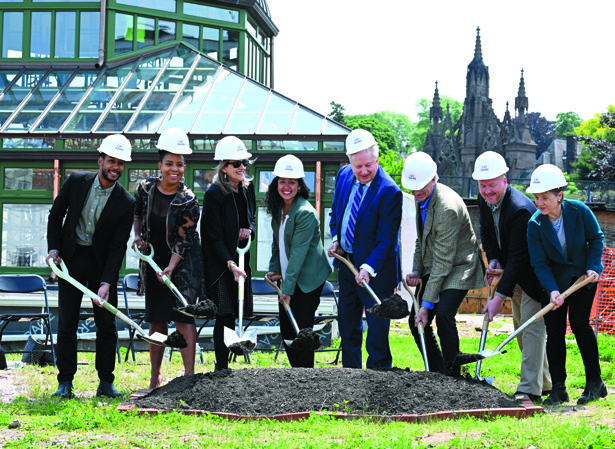
The planned $34 million center brought together education, exhibitions, research, and community space. Its design included water efficiency, low-energy lighting, and a high-performing thermal envelope. At the ceremony, Davidson spoke about sharing Green-Wood with a larger audience. His involvement places him in the preservation and public life of New York as well as its investment business.
He also chairs the J.M. Kaplan Fund. In a 2017 essay with Amy Freitag, he described a grant-making experiment that sought ideas too early or untested for conventional philanthropy. The first J.M.K. Innovation Prize supported 10 projects with up to $175,000 each over three years. By the 2025 announcement, the prize’s network had grown to 60 recipients since 2015.
The distinction between his two approaches is instructive. Commercial investments have to satisfy financial requirements. Philanthropy can give an untested civic idea room to develop. Davidson has worked with both kinds of capital, each with its own permission to take risk. Preserving a Brooklyn landscape and supporting an emerging social enterprise ask different things of a checkbook.
The next round might be debt
In a May 2026 episode of Climate CEOs, Davidson returned to a subject he has been discussing since his government years: debt. The conversation covered why a company’s second financing round might use borrowing rather than more equity, and how founders should think about financing structure, ownership, and working capital. The former federal lender still has advice about loans.
His earlier account of a favorite Aligned memory was considerably less technical. He recalled the New York and Los Angeles teams getting together for meals, retreats, and mini golf. After the billions, the committees, and the construction schedules, there was a small ball and a shared afternoon. It is a welcome detail in a career easily mistaken for a sequence of balance sheets.
Davidson’s story keeps returning to practical arrangements: the lender a founder needs, the investor a project can persuade, the team that can carry construction through. The ambition is visible in the fund targets. The test comes afterward, in the less photogenic business of getting work completed. A power plant cannot run on the quality of its fundraising announcement.
Keep reading, keep listening
- Aligned Climate Capital
- Peter Davidson on LinkedIn
- The 2013 Washington profile
- The 2017 financing paper
- The 2025 career interview
- ASP6 and institutional investors
- September 2026 fund announcement
- Green-Wood’s groundbreaking
- The J.M.K. Innovation Prize
- Listen: Solar Maverick, February 2026
- Listen: Climate CEOs, May 2026