Eduardo Esparza remembers the water. Born in Mexico City and raised from the age of eight in Mexicali, he lived at the far end of the Colorado River, where a continental watershed arrives tired at the desert. Much later, after a career spent studying systems and selling growth, he followed the plumbing backward. The water he drank, the water in his food, the water from the shower: nearly every drop had made the long trip south. A river he could not see in full had quietly supplied a life.
This is the sort of observation that can rearrange a career. It connects the intimate to the infrastructural, breakfast to headwaters, a childhood kitchen to decisions made hundreds of miles away. For Esparza, it also created a useful question: if a watershed behaves as one system, why does money approach it as a pile of separate properties and projects?
BlueDot Project, the company he founded in 2022, is his attempt to work on that mismatch. Its territory is regenerative finance, a phrase broad enough to invite both possibility and suspicion. Esparza's version is specific in its ambition. He wants to develop capital structures that can fund ecological restoration, resilient communities and long-lived stewardship while respecting the Indigenous knowledge already rooted in a place. The product is less a gleaming object than the plumbing behind one: funds, governance, standards, alliances and time.
An engineer learns the growth trade
Esparza did not arrive at climate finance through environmental science. He came through industrial engineering. He earned a master's degree in Industrial and Systems Engineering from Georgia Tech after undergraduate study at CETYS Universidad. Early work in manufacturing-system design, distribution networks, human factors and management consulting trained him to look for bottlenecks, feedback loops and incentives. A factory floor and a watershed are radically different places, but both punish anyone who mistakes a local improvement for a healthy whole.
The next chapters looked more commercial. Esparza moved through strategy, finance, mergers and acquisitions, marketing and web design. He eventually built Market 8 into an agency focused on B2B software companies. His public biographies describe work with dozens of SaaS businesses, and his old writing is full of positioning, conversion and the unglamorous mechanics of making a website sell. He also became an angel investor, backing more than 20 technology startups according to a mentor biography published by RegenEarth Studio.
This was a profession built around acceleration. Find the message. Remove friction. Turn attention into a lead, a lead into revenue, revenue into a steeper line. Esparza was good enough at it to spend more than a decade at the controls. Yet the engineer's habit of zooming out remained. Growth makes sense only after one asks what is growing, at whose expense, and where the waste goes when the chart reaches the edge of the slide.
“Think in bets. Invest in systems.”Eduardo Esparza, Blue Dot Brief
The agency gets smaller; the brief gets larger
Concern had been accumulating for years. Esparza has written that seeing Al Gore's An Inconvenient Truth prompted him to follow climate change closely and calculate his own carbon footprint. The arithmetic produced guilt, but not yet a vocation. The decisive move came in 2022, when he downsized the successful agency he had led and spent a year researching where his experience might be useful. He did not retrain as a soil scientist or pretend that a marketing résumé conferred ecological authority. He went looking for the leverage he understood: capital, strategy and the design of systems.
The resulting pivot is tidy only in hindsight. Leaving a business built over years is not the same as changing a line in a biography. It means shrinking revenue, rearranging obligations and accepting that the new field has its own language, practitioners and earned trust. Esparza supplemented his experience with executive education in venture capital and private equity at Columbia Business School and in FinTech through HarvardX. Then he began assembling BlueDot Project around capital formation for regeneration.
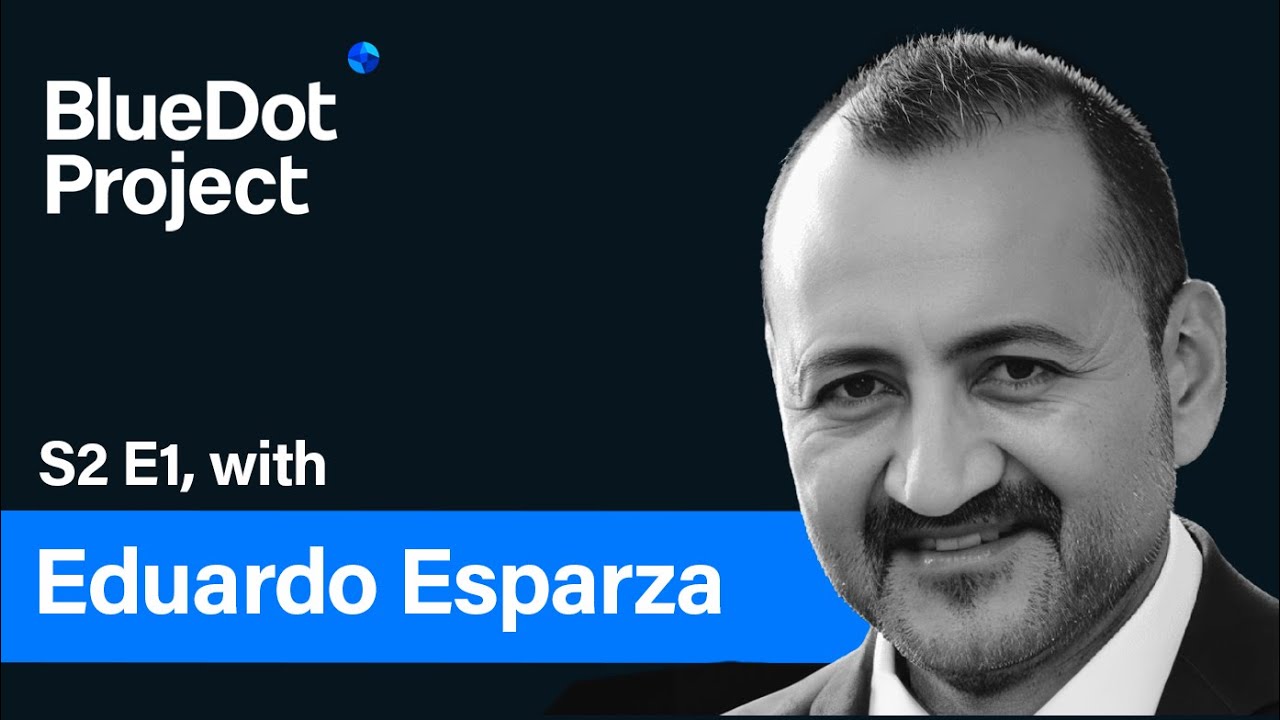
In March 2024, after a podcast season spent interviewing people working on climate and regeneration, he made himself the guest. The episode's charm is its refusal to turn the pivot into instant sainthood. It presents an entrepreneur in his forties changing both work and life, carrying business tools into a problem that will not respect quarterly boundaries. His stated immediate aim was to finance projects and communities that regenerate nature. The longer aim was resilient food supplies and a more durable relationship with the natural world.
Capital meets a place with a memory
The work has drawn Esparza toward the Sierra Nevada de Santa Marta in Colombia, known by several Indigenous peoples there as the Heart of the World. His public materials describe collaboration with Kogi, Arhuaco, Wiwa and Kankuamo communities and an effort called the Fifth Fire, conceived as a laboratory for humanity. At the 2024 United Nations Biodiversity Conference in Cali, the official participant list identified him as a cooperating adviser connected with the Association of Arhuaco Authorities of the Sierra Nevada.
That proximity introduces a harder standard than ordinary impact branding. Indigenous wisdom cannot be treated as a decorative slide between the fund thesis and the fee structure. The relationship has to shape governance, purpose and who gets to decide. Esparza's more recent language emphasizes reciprocity: organizations should return value to the living and human systems that make them possible. It is an idea with moral weight and plenty of operational questions, which is precisely why he has been working on leadership tools, accounting and management structures rather than leaving reciprocity as a mood.
BlueDot Project describes two core areas. One is the support of wisdom centers and laboratories where ancestral and modern knowledge can meet through learning, governance, ecology and community practice. The other is the design of capital platforms intended to create resilient, long-term financial flows. Between them sits an awkward translation task. Investors want comparability and risk controls. Living systems are specific, relational and fond of ignoring spreadsheet borders.
“We have to secure the Colorado River.”Eduardo Esparza
The useful tension
Esparza's advantage is that he understands the people across the investment table because he used to sound more like them. He has discussed financial analysis, portfolio logic, algorithmic trading and private debt. He knows that capital rarely moves because it has been scolded. It moves when incentives, risk, governance and a credible path to return line up. His argument is that ecological resilience belongs inside that calculation, not outside it as philanthropy or a handsome annual-report photograph.
In the Blue Dot Brief, he has urged impact investors to think in bets and invest in systems. The distinction matters. An isolated asset can look green while depending on a brittle food supply, a depleted watershed or a community excluded from decision-making. A systems bet looks beyond the fence. It asks whether the larger place becomes more capable of feeding, watering and governing itself. This is more difficult to underwrite. It may also be closer to the world in which the asset actually exists.
BlueDot Project's podcast functions as a public notebook for that thesis. Episodes have explored regenerative real estate, food production, biomimicry, post-growth economics and certification. A 2024 conversation on regenerative-community standards treated certification as both investor protection and a prompt for developers. The underlying problem was familiar from Esparza's earlier career: a promising category becomes meaningless when anyone can borrow the label. The solution is not a better slogan. It is a clearer operating standard.
His network now crosses finance, sustainability and community practice. Conference programs have placed him at AREDAY and Earthx. RegenWorld 25 listed him in a conversation about new funding mechanisms. He serves as a global adviser to Y on Earth Community and has been publicly identified as a board director of ReCommon. These connections are less a victory lap than the working material of a business built on alliances. No single firm can restore a bioregion, and a six-person platform cannot pretend otherwise.
A second act without a clean ending
There is an appealing circularity to Esparza's route. The industrial engineer became a consultant, the consultant became a marketer, the marketer became an investor, and the investor returned to systems. But the object of optimization changed. Instead of asking how a company can extract more value from a funnel, he now asks how money can circulate through a place without exhausting it.
The work remains early. Its vocabulary can outrun the evidence if left unattended, and the gap between a regenerative thesis and a regenerated landscape is measured in years. Esparza's response appears to be more architecture: longer financial flows, standards that can be inspected, communities with governing power, and investment vehicles designed around the true duration of the work. It is not glamorous plumbing. Plumbing, however, is what lets a good intention reach the tap.
The Colorado River still offers the cleanest explanation. A child in Mexicali drinks from a system whose headwaters are far away. Decades later, that child learns the languages of engineering, marketing and money, then notices that none of those professions can afford to ignore where the water begins. Esparza did not abandon growth. He made it answer a more interesting question: after the capital passes through, what is capable of growing back?