BREAKING Public Grid puts your power on autopilot◆25,000+ households on the platform◆NO HARDWARE - just software on top of your utility◆Renewable energy in one click◆Backed by Redbud VC & Hamilton Ventures◆Formerly Cottage Energy◆Member of Greentown Labs◆BREAKING Public Grid puts your power on autopilot◆25,000+ households on the platform◆NO HARDWARE - just software on top of your utility◆Renewable energy in one click◆Backed by Redbud VC & Hamilton Ventures◆Formerly Cottage Energy◆Member of Greentown Labs◆
Company Dispatch // Climate Tech
Public Grid
A power company built out of software, not smokestacks. It sits on top of the utility you already have and quietly switches you to cleaner, cheaper energy.
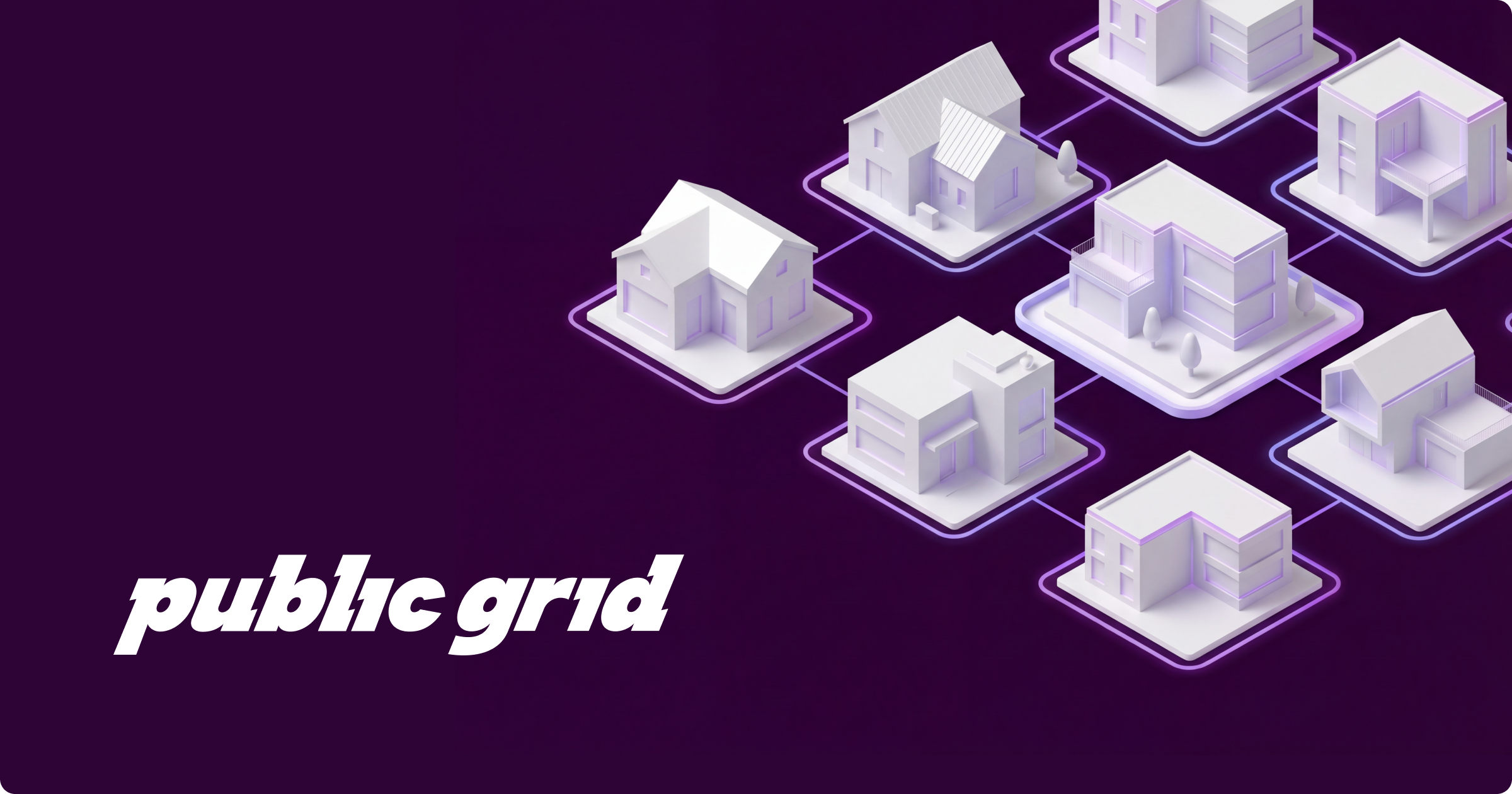
FIG. 1 - The wordmark, lowercase and unhurried, floating over a lattice of little white houses. Public Grid pictures the grid the way it wants you to feel it: neighborly, orderly, and yours. No towers. No transformers. Just homes on a quiet purple field.
Somewhere tonight, a household clicks a button - and the grid tilts a little greener.
No installer shows up. No panel bolts to a roof. The same wires carry the same current from the same utility. The only thing that changed is a line of software deciding, on your behalf, that clean power should also be the cheap and easy one.
That is Public Grid's entire trick, and it is a good one. The company - born in 2022 in New York City, originally under the name Cottage Energy - looked at the residential energy system and concluded it was not broken by technology but by paperwork. Rebates you never claim. Rates you never compare. Renewable options buried three clicks deep in a portal you never open. Public Grid reads the fine print so you do not have to, then makes the switch itself.
The pitch fits on a sticker: your power, on autopilot. The consequence is larger. Aggregate enough of those one-click decisions and individual households stop being customers and start being leverage - a quiet, collective vote for a cleaner, more resilient grid.
Make energy accessible and affordable - no paperwork, no hassle, no gatekeeping.
- Public Grid, mission statement
What It Actually Does
A software layer over a century-old machine
Public Grid does not replace your utility. It sits on top of it - like a smart thermostat for the whole account - and optimizes the parts you were never going to optimize yourself.
SERVICE 01
The Platform
Connects to your existing utility account, scans for savings, applies local incentives, and surfaces cleaner options. No service interruption, no hardware.
SERVICE 02
Renewable Switching
Brokers renewable and community-solar energy in bulk from wholesalers, so you can move to 100% clean power in one click - often at or below your current rate.
SERVICE 03
Bill Autopilot
Usage tracking, impact monitoring, bill alerts, and auto-pay. The boring parts of being a ratepayer, handled quietly in the background.
SERVICE 04
Property Partners
Plugs into the multifamily move-in flow and shares revenue back to property owners. Residents get clean energy; landlords get a new line item, not a construction project.
How The Trick Works
Four steps, one click, zero drilling
Link your utility account
Public Grid connects to the account you already have. Your utility keeps the wires and the responsibility for the lights staying on.
Let it read the fine print
The platform scans for rebates, better rates, solar credits, and renewable programs - the money hiding in plain sight.
Approve the switch
One click moves you to cleaner or cheaper supply. No installer, no downtime, no signature you'll regret.
Stay on autopilot
Alerts, tracking, and auto-pay keep it running. Move to a new address - even a new state - and your account follows you.
By The Numbers
Small actions, aggregated
The company's own north star is reach: convert enough households and the sum becomes infrastructure. Here is where it stands, and the frictions it is designed to erase.
25,000+
Households on platform
1
Clicks to go renewable
$0
Hardware cost to user
Seed
Funding stage
Friction removed: paperwork— 100%
Hardware required— none
Account portability across a move— full
Customer data sold to advertisers— zero
FIG. 2 - Not a growth chart. A friction chart. The bars Public Grid is proudest of are the short ones.
A tech entrepreneur with a master's in EECS / Integrated Design & Management from MIT and a business degree from UT Austin. Formerly a senior consultant at Deloitte focused on energy innovation. Brings design thinking to a system that has very little of it.
CO-FOUNDER
Joseph Robbins
Clarkson University graduate with a background in environmental consulting. Co-built the platform that turned a broken residential energy experience into a one-click product.
We believe renewable energy should be accessible for everyone.
- Public Grid
The Paper Trail
A short history, still being written
2022
Founded in New York City as Cottage Energy, chasing accessible residential energy.
2023 · MAY
Raises seed funding from Redbud VC and Hamilton Ventures; product live in New York City.
2023 · OCT
Redbud VC publishes its investment thesis, framing Public Grid as a fix for how residents interact with electricity providers.
2025 · APR
Named among the Hudson Valley region's most promising companies via SUNY New Paltz's HV Venture Hub.
2025 · OCT
Regulatory filing lists Zack Schmitz as CEO of Cottage Energy Inc., dba Public Grid, with New York's Department of Public Service.
Why It Matters
Guilt doesn't scale. Convenience does.
There is a hard truth buried in every climate pitch: people will not choose the harder path to feel virtuous, not at scale. Public Grid's wager is that you do not have to ask them to. Make the clean option also the easy option - the default, the one-click, the thing that happens without a second thought - and adoption stops depending on willpower.
The competitive set is crowded: Arcadia, Uplight, GridX, Arbor, OhmConnect, plus every traditional retail supplier. Public Grid's differentiator is not a bigger battery or a slicker panel. It is a smaller ask. And a promise it repeats often: your utility data is yours, and it is not for sale.
renewable energycommunity solarenergy savingsclimate techmultifamilyno hardwaredata privacyseed stagenew york
Back To The Scene
The button, one more time
Return to that household from the top - the one that clicked and changed nothing you could see. The lights still work. The utility still bills. The wires still hum the same current down the same street.
But the electricity behind the click is cleaner now, and a little cheaper, and it took no roof, no drill, no afternoon lost to a portal. Multiply that by 25,000 and the picture on Public Grid's own banner starts to make sense: not power lines and towers, but rows of quiet houses on a purple field, each one a small, deliberate choice. The grid did not get replaced. It got, one account at a time, handed back.
Your power, on autopilot.
- Public Grid
Watch & Explore
See it in motion
Product walkthroughs and founder conversations are best found on the company's own channels below. Start here.
Sources: onepublicgrid.com · publicgrid.energy · Redbud VC · Greentown Labs · LinkedIn · Tracxn · PitchBook.
Compiled from public sources. Figures such as household counts and funding stage are company-reported and approximate.