An architecture firm can tell you the load on a beam, the setback on a site and the exact tint of a lobby wall. Ask what a half-finished project will earn, however, and the answer may be hiding across a timesheet, a staffing plan, an invoice draft and a spreadsheet named FINAL_v7. BQE Software has spent three decades turning that scavenger hunt into a product.
The company’s flagship, BQE CORE, is cloud software for the business of professional services. It pulls project management, time and expense entry, billing, payments, accounting, reporting, CRM, HR and payroll toward one shared record. The target has narrowed with age: architecture and engineering firms are now the center of the pitch, although consultants and other billable-hour businesses also use it.
That sounds like a familiar all-in-one software promise. BQE’s credibility comes from the oddly specific route it took there. Co-founders Shafat Qazi, an engineer, and David Breiholz, an architect, did not begin with a grand theory of enterprise software. They began in 1995 with their own administrative irritation. Manual workarounds, inconsistent processes and disconnected systems were getting between project work and getting paid. Qazi built the original BillQuick in a garage.
The timecard was small. The problem around it was not.
BillQuick attacked the obvious leak: work happened, hours were recorded late or poorly, invoices took too long and managers learned the economics of a job after the useful moment had passed. It became a durable time-billing and project-management product. BQE later acquired ArchiOffice and EngineerOffice in 2009, gaining more project-accounting and people-management depth in the industries its founders already understood.
But desktop-era success created its own ceiling. A collection of capable products could still leave information in separate places. A time entry should not merely make an invoice. It should update a project budget, affect a utilization number, inform a staffing choice, flow into payroll and show up in the books. The cloud made that shared chain possible - and made the old portfolio look fragmented.
“CORE gave us the visibility to understand every project, every dollar, and every hour.”Clint Harris, CEO and president, Corsair Consulting
BQE’s answer was not a quick browser skin. It says CORE took five years and $25 million of bootstrapped investment to build before its July 2017 launch. That figure is the most revealing line in the company’s history. The business had to spend heavily to make its own hit product obsolete. Today BQE calls BillQuick and ArchiOffice legacy products, says neither is actively sold, and puts new customers on CORE.
One data model, sold one quote at a time.
CORE’s foundation covers the daily machinery: timesheets, receipts, project budgets, allocations, forecasting, Gantt charts, invoices, payments, dashboards and reporting. Native mobile apps let field and traveling staff enter time or capture expenses. Optional Accounting, CRM and HR modules widen the footprint. Payroll, powered by Gusto, now links approved time to a payroll run and feeds labor cost back into project financials.
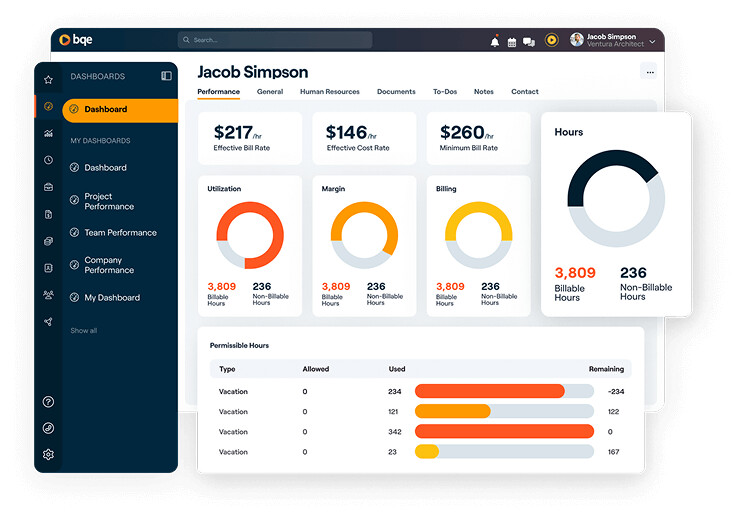
The point is less “we also have a CRM” than what happens when the modules share context. A won opportunity can become a live project. Approved time can become both payroll and job cost. Backlog can be spread across future months to help forecast workload. Intercompany billing can move labor and expenses when one office works on another office’s project. CORE’s 2024 Project Center puts progress, performance and invoicing on the same screen.
BQE does not publish a menu price. It charges per user, varies the quote by modules and headcount, and says customers can choose only the additions they need. Public group training and 24/7 support are included; extra one-on-one training can be purchased. The answer to “what did it cost?” is therefore split: CORE cost BQE a reported $25 million to build, while a buyer’s cost remains a custom subscription plus the very real labor of migration, configuration and adoption.
03 / The wedge is the differenceGeneric software counts tasks. BQE counts billable consequences.
BQE sits between several markets that refuse to stay separate: professional-services automation, project accounting, ERP, resource planning and practice management. Buyers might compare it with Deltek Ajera or Vantagepoint, BigTime, Unanet, Kantata or NetSuite. A smaller firm may instead assemble QuickBooks, a project tool, a time tracker and enough spreadsheets to make the connections by hand.
Its distinction is industry grain. Architecture and engineering projects have phases, fee schedules, change orders, reimbursable expenses, utilization targets and labor-heavy margins. A generic task app can show that a drawing is due Friday. A firm-management platform has to show whether the team assigned to draw it is burning the fee too quickly - then turn approved work into an accurate invoice.
That specificity creates useful proof. BQE says more than 3,000 firms and 50,000 users manage over 500,000 projects a year in CORE, with more than $7 billion in annual invoice volume. It says the average customer tenure exceeds 10 years. In a featured case study, Shear Structural reported shrinking invoicing from 10 hours to 30 minutes. Those are company and customer claims, but they illustrate the correct unit of value: time returned, leakage found and cash collected sooner.
An all-in-one system does not remove the need for clean data. It makes dirty data travel farther. A firm still has to agree on project codes, rates, approval rules, accounting practices and who owns the rollout.
The market moved from recording work to predicting it.
The strategic change was a shift from transaction software to a cloud system of record. BillQuick recorded and billed work. CORE’s more ambitious job is to guide decisions while work is still underway. BQE’s 2025 releases make the direction plain: automated invoice reminders, revenue recognition, payroll, multi-entity billing and a distributed backlog report. In 2026 it previewed CORE Insights, embedded analytics built around interactive datasets, visualizations and KPIs, while rebuilding Project Planner.
There is also a new owner’s discipline in the background. BQE accepted a significant, undisclosed growth investment from Serent Capital in 2021. Matt Cooper, who had spent eight years at Serent working with software companies, became BQE’s CEO in 2023. His public refrain is customer obsession. The company’s published values add openness, respect and excellence, while its operating evidence includes regular automatic releases, a user community, free training and always-on support.
Partnerships fill gaps without forcing BQE to build everything. SPRCHRGR resells and implements CORE, including advanced configuration and custom API work. Zapier expands the integration catalog, while an open API supports bespoke connections. Gusto supplies the payroll engine. This is the pragmatic version of an all-in-one strategy: own the common data and workflows, then connect where a specialist already has leverage.
05 / The part worth stealingDo not copy the suite. Copy the sequence.
BQE’s first wedge connected labor to invoices. Pain becomes budget when a workflow delays payment or hides margin.
Time data becomes more valuable when it powers staffing, budgets, payroll and reporting. Expansion works when the shared record improves every step.
Phases, utilization, WIP and fee schedules tell an A&E buyer that the product understands the business behind the drawing set.
A legacy hit can block a better architecture. BQE made a long, expensive replacement bet instead of pretending the old center would last forever.
The playbook is most copyable when a niche has repeatable workflows, expensive handoffs and data that becomes more useful in combination. It works when one operational record can serve employees, project managers, finance leaders and owners without making each group maintain a private version of reality.
It works less well when a firm has highly unusual processes, is deeply committed to best-of-breed tools, needs a fixed public price before engaging sales, or cannot dedicate people to implementation. Very small teams may find a full practice-management system heavier than their problem. Large global firms may require enterprise controls or integrations that demand substantial configuration. And no platform can create timely timecards by moral force.
BQE’s real product, then, is not a dashboard. It is an argument about where the truth should live. For a project business, delivery and finance are not two stories. They are one story told at different speeds. CORE tries to make them arrive at the same time - ideally before FINAL_v8.