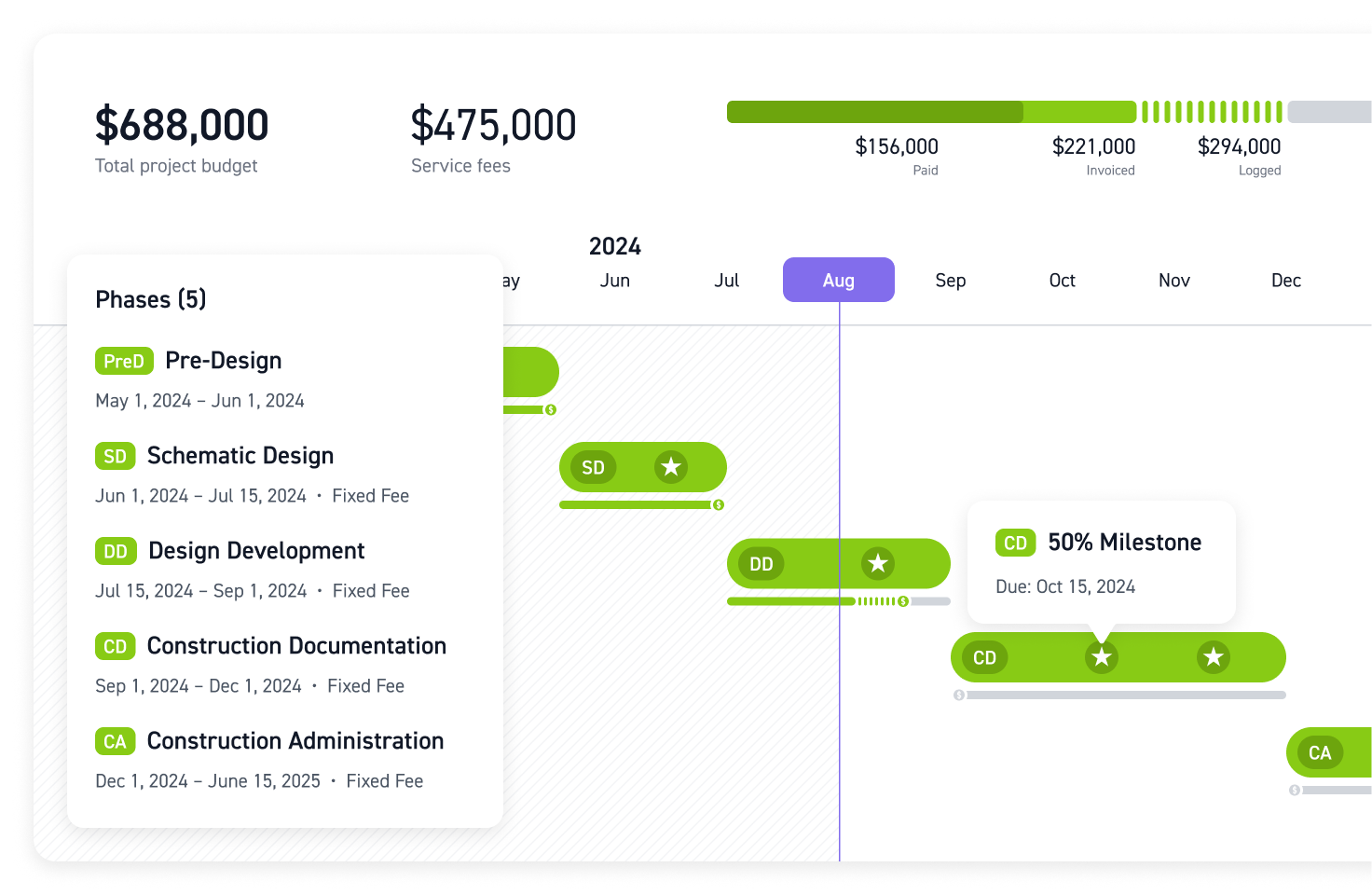
Somewhere right now, a principal at a 12-person architecture firm is opening Monograph instead of a spreadsheet. She can see, in real time, which projects are bleeding hours and which are quietly profitable. Five years ago she would have found out at tax time. That shift - from hindsight to live visibility - is the whole company.
Monograph is a San Francisco software company that builds practice-operations tools for architecture and engineering firms. Budgets, staffing, time tracking, invoicing, forecasting - the unglamorous machinery that keeps a design practice solvent, gathered into one cloud platform. More than 15,000 professionals use it. It has helped firms manage over $550 million in projects.
The pitch sounds dull until you remember what it replaced.
The Problem They Saw
The profession ran on guesswork
Here is an industry that obsesses over a millimeter of reveal detail and then tracks its own finances on a spreadsheet last updated three Tuesdays ago. Roughly 81% of architecture firms are small businesses. Most have no CFO, no operations team, and no software designed for how they actually work. They bought generic project tools meant for ad agencies and software teams, then bent themselves to fit.
The cost was quiet but constant. A firm would discover a project was over budget only after the budget was gone. Timesheets were a Friday-afternoon act of fiction. Invoicing took a week of cross-referencing. Nobody could answer the simplest question - is this project making money? - without a forensic dig.
Generic software treated a design firm like any other business. It is not. Its product is hours, its margins are thin, and its phases - schematic design, design development, construction documents - have a grammar no off-the-shelf tool ever learned to speak.
The Founders' Bet
Three architects, one grudge
In 2019, Robert Yuen, Alex Dixon and Moe Amaya started Monograph. All three trained as architectural designers. They had lived the spreadsheet problem from the inside, which is the kind of credential you cannot fake to a skeptical principal.
Their bet was specific and a little contrarian: design firms do not need more software, they need software made for them. Not a horizontal project tool with an "architecture template," but a vertical system that understands phases, fee structures, consultant bills and utilization rates as first-class ideas. Vertical SaaS for a market most venture investors had never thought about twice.
RY
Robert Yuen
Co-founder & CEO
The market they were chasing is enormous and almost entirely offline. The architecture, engineering and construction world runs on trillions of dollars of work and a startling amount of paper. Building the back office for it was either a niche or a foundation, depending on how far you squinted.
The Product
An OS for the design practice
Monograph stitches the operational lifecycle of a firm into one place. Its most-loved piece is also its most quietly radical: the MoneyGantt, which plots a project's schedule and its budget on the same timeline, so a manager sees money and time as the single linked thing they always were.
MoneyGantt & Budgets
Real-time budgets and phase planning where schedule and spend live on one timeline.
Time Tracking
Lightweight billable-hour and expense logging that users repeatedly call the best part of the product.
Resource Planning
Staffing and workload across projects, so firms plan capacity instead of discovering it.
Invoicing & Payments
Invoices generated straight from tracked time and budgets, with automation and payment processing.
Forecasting & BI
Revenue forecasts, profitability analysis and dashboards that answer "are we okay?" before quarter-end.
Integrations & AI
QuickBooks Online sync plus AI-assisted workflows across the project lifecycle.
The Proof
Numbers that survive scrutiny
Adoption is the argument. Tens of thousands of professionals log into Monograph, and the projects flowing through it add up to more than half a billion dollars. The investor list - Tiger Global, Index Ventures, Homebrew, Base10 Partners, with Tishman Speyer along for the real-estate read - is the kind that does diligence on vertical SaaS for a living.
Funding, round by round
USD millions raised // seed through 2025 // sources: TechCrunch, ArchPaper, FinSMES
Bars scaled to round size. The two $20M rounds, three years apart, bookend the climb.
The number that matters most is harder to chart: a principal who now knows, on a Tuesday, whether the work is profitable. That is the product doing its job.
Why It Matters Tomorrow
The back office gets a brain
The AEC industry is one of the largest and least-digitized markets on earth. As AI moves into operations, the firms with structured, real-time data - the firms already on a system like Monograph - are the ones positioned to forecast, automate and price their work with something better than instinct. The spreadsheet firms will be guessing against opponents who are not.
So return to that principal at her 12-person firm. The version of her from five years ago closed the books in spring and learned, too late, which projects had quietly lost money. Today's version opens one screen and sees it live, on a Tuesday, in time to do something about it.
That is the entire company. Not a new way to design buildings - a new way to keep the firms that design them in business. Monograph didn't make architecture more beautiful. It made it solvent, in real time, on purpose.