The first Deltek computer arrived from Sears. In 1983, Donald deLaski, an accountant who understood the baroque rules of federal contracting, and his son Kenneth bought an IBM XT, placed it on a table and enlisted two programmers to turn three decades of accumulated accounting knowledge into code. The founders knew the problem better than the machine. That imbalance proved useful.
Their customers were not asking for prettier bookkeeping. Government contractors had to record labor daily, separate direct from indirect costs, allocate overhead consistently and produce invoices that could survive official scrutiny. A missed entry could mean delayed cash. A weak accounting system could make a bidder ineligible for certain work. Paper ledgers and adding machines were the first things to fail under the weight of the rules.
The deLaskis put up about $250,000, and the early software sold for roughly $10,000. Deltek made around a dozen sales in 1984. Its first customer was Cost Engineering Research, already a client of Donald's accounting practice. There was no grand horizontal-platform pitch. There was a practitioner, a specific buyer and a painful job that existing software handled badly.
The ledger was the wedge
System I, released in 1985, was purpose-built cost accounting for government contractors. By 1991, Deltek says hundreds of small and midsize customers had used it through thousands of Defense Contract Audit Agency audits. The software eventually became Costpoint, the core ERP that now covers project accounting, contracts, time and expense, procurement, workforce planning, manufacturing and billing.
That history explains what Deltek actually sells. It is less a database of transactions than a model of how a project-based firm makes money. A retailer asks what moved off a shelf. A contractor asks which employee spent which hour against which task on which contract, under which rate structure, and whether that treatment is consistent with federal rules. An architecture firm asks whether a senior engineer is available next month and whether today's utilization will protect the fee. A consultancy wants to connect pipeline, staffing, delivery and revenue without reconciling five spreadsheets at month-end.
The founders knew the accounting rules and barely knew the computer. In vertical software, that is often the correct order.YesPress
A product portfolio that reads like a project
Deltek's catalog looks crowded until it is read in sequence. GovWin IQ tells a government contractor what agencies may buy, who has won before and where a teaming partner might help. ProPricer turns an opportunity into a cost proposal. Costpoint carries the award through accounting and delivery. Replicon captures labor across borders; Polaris manages professional-services work. TIP Technologies handles quality in regulated manufacturing. Dela, the company's AI layer, now writes summaries, flags anomalies and powers task-specific agents across that chain.
The company repeats the pattern by industry. Vantagepoint connects CRM, people, projects and finance for architecture, engineering and consulting firms. Ajera offers smaller A&E practices a lighter project-accounting system. Maconomy targets larger global professional-services organizations. ComputerEase covers job cost, payroll and field operations for construction. Specpoint and ArchiSnapper address specification writing and field reports. The names differ, but the organizing object remains the project.
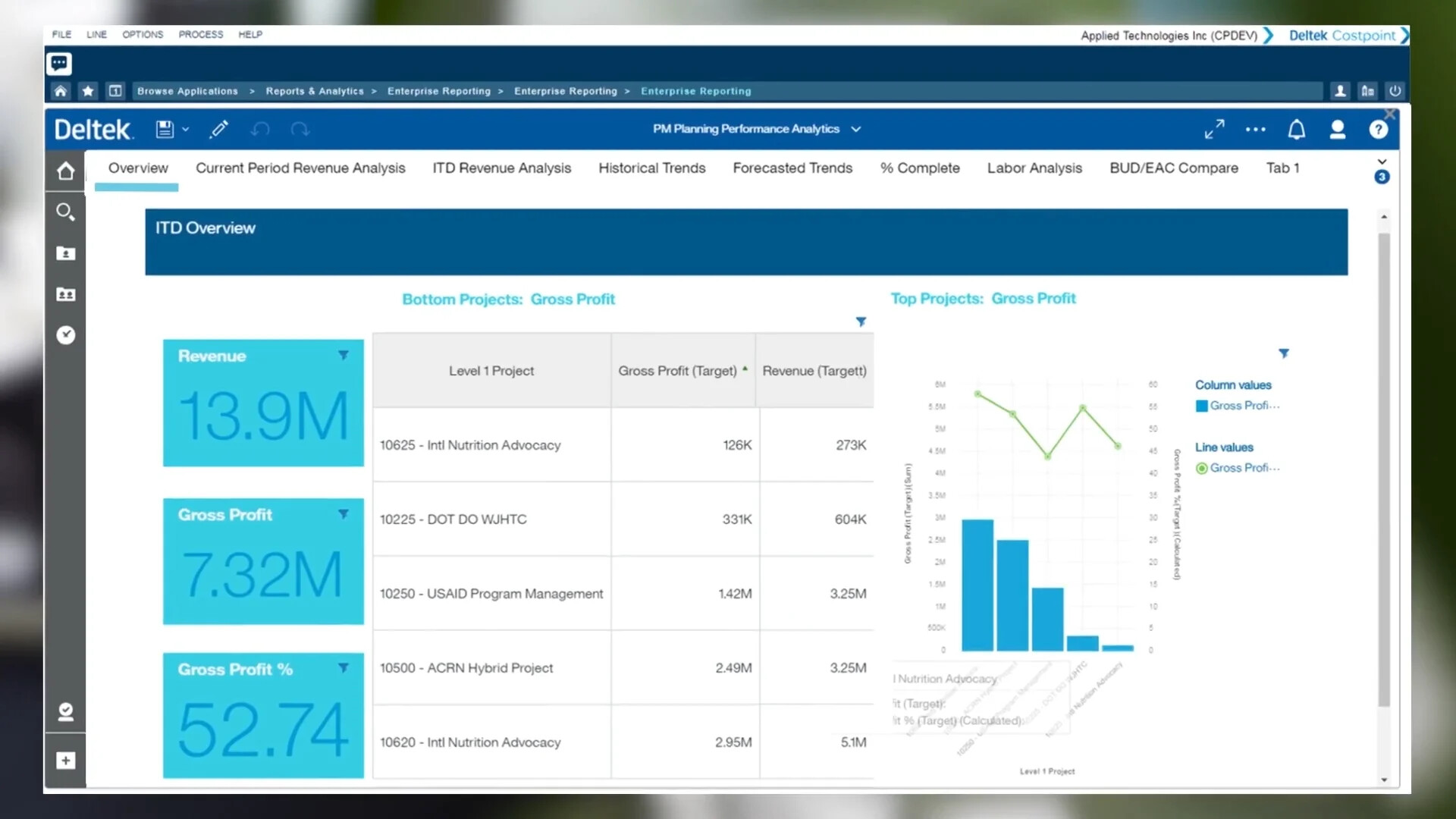
Customers include small federal subcontractors, global consultancies, research organizations and aerospace manufacturers. Deltek highlights Battelle, which standardized processes for 1,800 employees on Costpoint and GovWin IQ; Zutari, which manages more than 2,000 projects with Vantagepoint; and Teledyne, which uses TIP Technologies for quality. The company says 30,000 organizations use its products in more than 80 countries.
The moat is context, with a switching cost attached
A general ERP can be configured to do many of these jobs. Deltek's argument is that a customer should not have to invent the government-contracting data model, audit trail or project-accounting vocabulary during implementation. It ships the nouns and the rules: indirect rates, cost pools, contract types, labor controls, earned value, backlog, utilization and project margin. Its market intelligence also reaches upstream of accounting, where most ERPs do not go.
That specificity produces a familiar enterprise-software bargain. The buyer gets less translation and more relevant control. In return, implementation can demand process decisions, clean data, trained administrators and an experienced partner. Deltek does not publish broad standard pricing; most buyers request a quote based on modules, user types, deployment and services. The meaningful cost is therefore not only the subscription. It is migration, configuration, training and the management attention needed to make one system authoritative.
The ownership history is a rough proxy for the value of that position. New Mountain Capital made a reported $180 million investment in 2005. Deltek returned to the public market in 2007, then Thoma Bravo took it private for $1.1 billion in 2012. During the next four years, Thoma Bravo says Deltek grew recurring revenue by 60 percent, completed six add-on acquisitions and expanded margins. Roper Technologies paid $2.8 billion in cash in 2016. The purchase was not venture funding; it was the price of a mature vertical-software asset with embedded workflows and recurring customers.
AI arrives wearing an audit badge
Deltek's latest turn is Dela, an orchestration layer woven into its existing products. Costpoint's 2026 releases added custom-agent tooling, AI-assisted voucher creation, financial and cost-pool anomaly detection, smart manufacturing summaries and Model Context Protocol connectivity. Vantagepoint uses AI to inspect expense reports against company policies before approval. Planned and emerging tools assist proposal creation, contract setup, risk review and financial close.
The interesting part is the constraint. In regulated work, a hallucination is not a charming product flaw. An expense flag, contract record or proposed journal entry needs permissions, traceability and a person who can defend the action. Deltek's advantage will not come from attaching a chat box to an ERP. It will come from letting an agent act inside a governed workflow without dissolving the controls customers bought Deltek to obtain.
A 2026 Forrester Consulting study commissioned by Deltek modeled a composite Costpoint cloud customer with $1 billion in annual contract revenue and 2,000 employees. It calculated 126 percent return over three years and payback in under six months, helped by faster close, lower infrastructure cost, less overrun and access to work requiring stronger compliance. Those are modeled results, not a universal promise. They are also a clue: the product pays when compliance and operational visibility unlock revenue or prevent expensive leakage, not merely when a clerk saves clicks.
The part a reader can copy
Start where expertise still lives in paper, policy and one veteran's head.
Deltek encoded federal accounting before it expanded into the rest of the project.
A vertical product should sound native before it looks impressive.
Contract types, indirect rates and earned value are product architecture, not marketing garnish.
Own the next decision around the core job.
Deltek moved from accounting toward opportunity, pricing, people, quality and analysis.
Time saved is pleasant. Eligibility, cash flow and audit confidence carry budgets.
The sharper the consequence of failure, the clearer the value of purpose-built software.
The conditions are equally important. This playbook works when a market has shared rules, expensive errors, repeatable workflows and buyers willing to standardize. It weakens when every customer behaves differently, regulation is light, projects are simple or the buyer cannot dedicate an owner to implementation. A ten-person agency with straightforward billing may prefer a general ledger plus a lighter project tool. A contractor preparing for complex cost-reimbursement work has a different risk calculation.
A narrow company with a long runway
Deltek sits between the vast suites of SAP, Oracle and Microsoft and narrower specialists such as Unanet, JAMIS Prime, Kantata, Procore and Autodesk Construction Cloud. It will rarely win by offering the most generic flexibility. It wins when a buyer recognizes its own operating life in the default workflow.
That is the durable lesson in a company born before SaaS had a name. Deltek did not make federal contracting simple. It made the complexity legible, repeatable and increasingly connected. The first product replaced a paper ledger. The current ambition stretches from spotting a public-sector opportunity to pricing it, delivering it and asking an agent why the margin moved. The technology changed. The wager did not: difficult work is a market when the difficulty repeats.
Go deeper
Explore Deltek's current platform, product releases, customer library and public channels.