There is a peculiar kind of blindness in a well-inspected factory. Someone has counted the defects. Someone has written the report. Someone has even sent the email. Yet the person who can change the next production run may still know nothing. The inspection happened; the useful information has yet to arrive.
Inspectorio built its business in that interval. Its proposition sounds modest: put the inspection, the supplier, the purchase order and the follow-up in a shared system. But consider what happens when these records can talk to one another. A defect becomes something a team can compare, assign and investigate while there is still time to act.
- The job: connect factory quality, compliance, testing, traceability and production work.
- The buyers: brands and retailers managing supplier networks, alongside the people doing the work.
- The wager: useful AI begins with consistent operational records.
- The lesson: shorten the journey from evidence to action.
01 / The report that arrived too late
In Inspectorio’s Barco Uniforms case study, quality director Jose Martinon describes reports reaching him roughly a week after inspections. Factory conversations ran through chat apps. Auditors initially worried about adopting unfamiliar software; their reservations eased when they could see the information they needed before a factory visit.
The telling detail is a shared defect classification. Martinon puts it this way: “For defect classification, it doesn’t matter the language - the defect code is the defect code.” A standard creates a small island of agreement between people who may otherwise describe the same problem differently.
That is a useful way to understand Inspectorio’s origins. Its four founders - Carlos, Fernando and Luis Moncayo, and David Klein - had encountered delayed reporting, defective goods and expensive third-party inspections while running a sourcing agency in Ecuador and China. They began building the company in 2016. Their problem was already sitting on their desks.

02 / The spreadsheet acquires neighbours
The original inspection focus widened. Sight, Rise and Tracking became the quality, responsible-sourcing and production components of a connected platform. Today Inspectorio also offers lab-test management, traceability and supply-chain network intelligence. The ambition is to keep related work from disappearing into separate departmental systems.
The quality workflow makes the idea concrete. Teams standardize inspections, collect results, compare supplier performance and manage corrective and preventive actions, usually abbreviated to CAPA. Risk signals help teams decide where to concentrate attention. The point is to make the next inspection more informed by the last one.
Production Management adds another clock. Its time-and-action plans track milestones and material readiness, with alerts and recorded reasons for delays. For a hypothetical seasonal clothing order, a missed fabric approval would be useful context for a later production problem. Joining those records gives a team a chance to ask a better question before the shipment date becomes a surprise.
03 / The people who needed it
Inspectorio’s customer list includes Target, Gildan and DICK’S Sporting Goods. It also reported wins involving Urban Outfitters, Mango and Komar. These are businesses with supplier relationships to coordinate, standards to communicate and product records to maintain. Its market includes apparel, footwear, home furnishings, grocery and multi-category retail.
The users extend beyond the brand’s headquarters. Suppliers, factories, inspectors and testing laboratories participate in the work. That matters commercially: software purchased by one organization may need daily cooperation from many others. A beautifully configured buyer dashboard has limited value if nobody updates the factory-side records.
Company-reported activity figures. They describe different things; neither is Inspectorio’s revenue.
Its 2025 recap also cited $340 billion in revenue across the customer base. That is a description of the companies it serves. The more interesting operating question is whether a shared network lets a quality team recognize a recurring issue sooner than a stack of isolated reports would.
04 / An AI with a paper trail
Paramo is Inspectorio’s AI layer. The published offering includes a Compliance Copilot that reviews records and suggests actions, a Traceability Agent that cross-checks supplier submissions, and a Regulation Agent that connects product specifications with market requirements and tests.
There is a pleasingly unromantic quality to the traceability example: a purchase-order PDF and a packing list disagree with chain-of-custody information. The system flags the inconsistency. A document mismatch is a narrower, more assessable task than asking a chatbot whether a global supply chain is ethical.
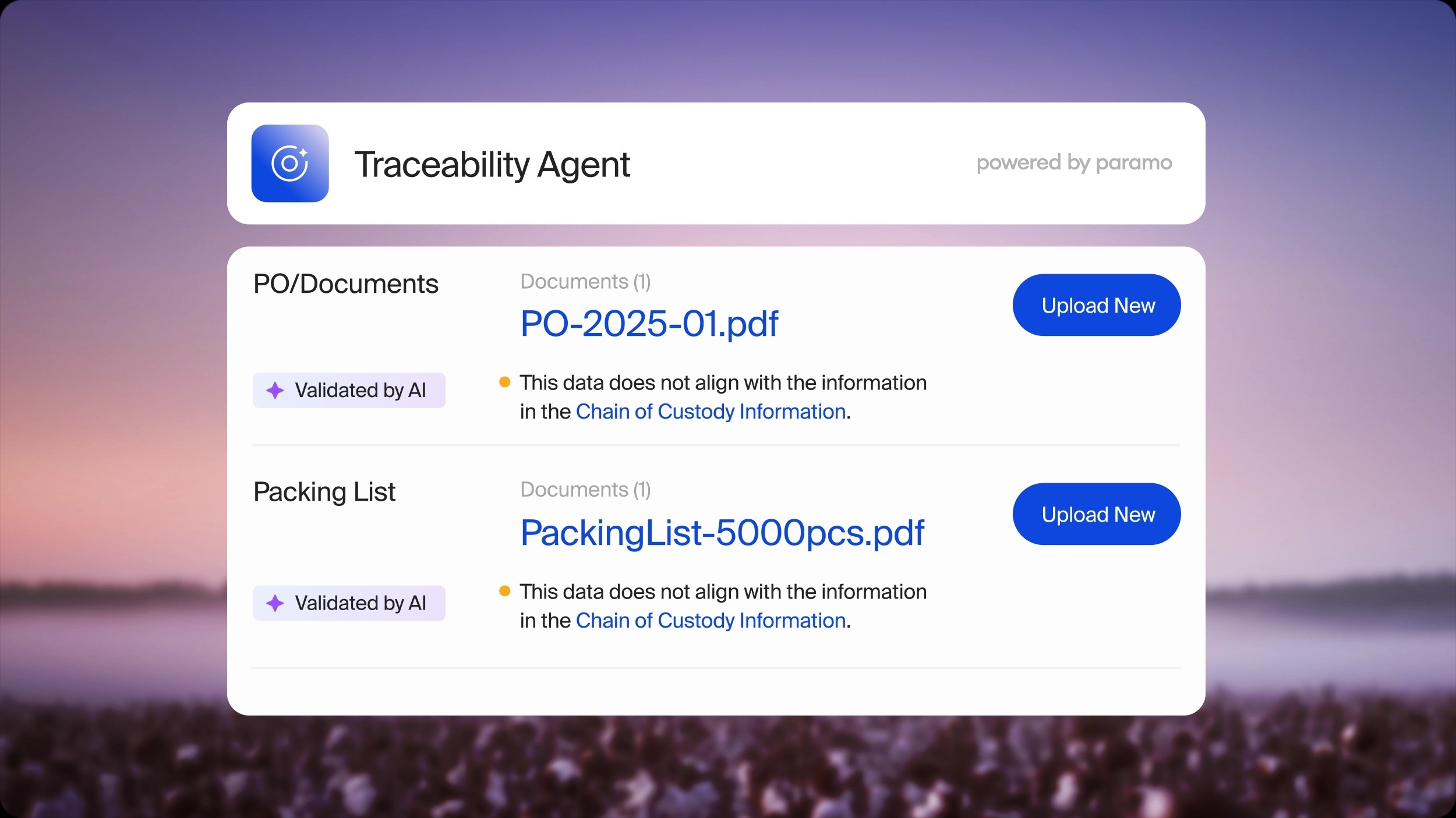
The distinction matters. Matching records can improve confidence in a claim, but matching paperwork alone cannot establish every physical fact about a material. The value depends on the evidence supplied, how discrepancies are investigated and who has authority to resolve them. An unanswered warning is still an unanswered warning, however sophisticated its author.
Lab Test Management supplies another piece of that evidence: requests, results and certificates in structured records. Linking material tests to finished goods can help teams reuse applicable results and avoid duplicate testing. Applicability is the operative word. A previous test is useful when it actually covers the material, product and requirement in question.
05 / A QR code needs a past
Two partnerships show where Inspectorio fits. Its March 2025 integration with Open Supply Hub brings open production-location data into the platform. External facility information can give an internal supplier record useful context. A supplier’s identity becomes easier to connect with evidence elsewhere.
Then, in September 2026, Inspectorio announced a partnership with EON. Inspectorio supplies product, material, supplier and traceability information; EON provides serialized Digital IDs and the experience through which that information reaches consumers and other stakeholders. The direct integration is intended to reduce manual transfers between the systems.
A product passport can only tell the history somebody has bothered to record.The editorial lesson of the Inspectorio-EON integration
A QR code on a garment can look reassuringly modern. The difficult part is assembling a credible past for the garment behind it. This partnership puts Inspectorio upstream of the consumer experience, collecting and connecting the records that make the experience useful.
06 / The bill behind the dashboard
Inspectorio sells business software through enterprise sales and demo conversations. Implementation brings its own work: supplier onboarding, training and integration. The company’s Academy and customer-success offering acknowledge that people need to learn the system before a shared workflow becomes an everyday habit.
The integration documentation is refreshingly specific about the work involved. ERP and product-lifecycle systems provide operational data. Customers can connect through APIs, automated file transfers or imports, with webhooks returning events. Teams must adapt source data to Inspectorio’s formats. A buyer evaluating the cost should scope that effort alongside the software contract.
The financial milestones are concrete. A $10 million Series A in 2018 included Target and Ecolab alongside Techstars and Matchstick Ventures. An Insight Partners-led $50 million Series B in 2022 supported product, research and commercial expansion. In July 2026, Apax Digital Funds announced a growth investment aimed at further AI development and market expansion.
There are overlapping alternatives: QIMAone covers collaborative supplier quality workflows; EiQ focuses on supply-chain risk intelligence. Buyers can also combine existing ERP or PLM capabilities with specialized tools. Inspectorio’s case rests on connecting several production-chain jobs and their participants. The useful comparison is how much of your actual work each approach covers.

07 / Borrow the method, then buy the tool
A reader can copy the operating discipline before signing a software agreement. Pick a recurring quality problem. Give it a consistent definition. Connect each observation to the relevant supplier and order. Assign the next action to someone who can complete it. Check whether the problem returns. These are practical conclusions from the workflows, rather than promises of a particular result.
The conditions matter. Thin evidence, inconsistent classifications and reluctant suppliers leave less for analytics to work with. A team handling a small, simple production network may need fewer tools. A complex network needs agreement about access, responsibility and verification as well as software. Centralizing confusion merely makes it easier to find.
Inspectorio’s most useful idea is that an inspection should improve a decision. The report is a beginning. Its worth is revealed in what the people who receive it can do next - preferably before another week has gone missing.