The decisive moment in Sanjoe Tom Jose's career did not arrive with a term sheet, an award or a flash of code. It arrived in 2012, when his son was born and delay began to look like a decision of its own. Jose had graduated from IIT Bombay, taken the respectable corporate route and kept the less respectable itch to build something. Fatherhood reset the clock. If he waited longer, he later recalled, it might become too late. So he left the path with the clearer salary and entered the pre-owned car business.
MerryWheels was an online marketplace, and it lasted a little more than a year. Competition was stiff. The venture ended. This is where many founder biographies hurry past the debris on their way to the company everybody has heard of. Jose does the opposite. He has said that a large portion of his learning came from things that did not go right. Failure, in his telling, is not a dramatic furnace that produces wisdom on schedule. It is evidence. You have to be willing to read it.
That habit - examining an ending closely enough to extract the next beginning - became the governing pattern of his work.
A problem hiding inside a mock interview
The seed had appeared earlier at IIT Bombay. Jose and his classmate Mani Ka were involved with mock interviews. The ritual was useful and cumbersome: a candidate, an interviewer and a room all had to be available at once. Smartphones were spreading. Internet access was improving. Video could unbundle the appointment from the place.
After graduation, Jose worked as a territory manager at National Instruments in Bengaluru. He and Mani kept thinking about the interview tool while holding their jobs. They brought in Jobin Jose, a school friend with audio-video engineering experience, and Tom Jose, then a management consultant at KPMG. Three of the four founders happened to share a surname, an arrangement that sounds like a family firm and was not. It was a network of classmates, school ties and family friendships turned into a company.
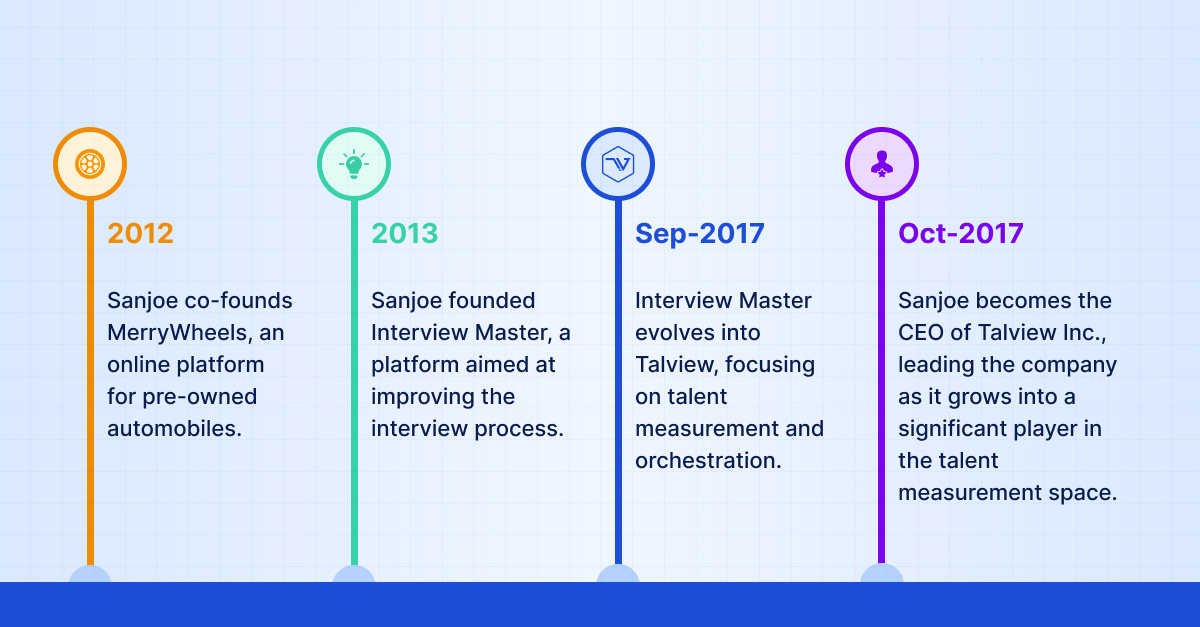
They formed Interview Master, a video-interview platform, in 2013. The early business worked. Small and midsize companies bought the software. Revenue reached roughly $300,000 over two years. Two rounds of funding followed. Yet Jose and the team saw a structural problem: video interviewing was early, inbound demand was limited and the mid-market path did not look large enough for the enterprise software company they wanted to build.
“A large portion of my learnings has always been from the things that have not gone right.”Sanjoe Tom Jose
There is a peculiar cruelty in a modest success. An obvious failure sends you home. Traction invites you to remain indefinitely, tending a business that may never become what you intended. Jose and his co-founders chose the harder reading. After a conversation with a US investor, they arranged an exit for Interview Master's investors, closed the company and started again.
The founder's working draft
MerryWheelsA marketplace meets heavy competition. Lesson: inspect the market, not merely the idea.
Interview MasterA product earns revenue but reveals a ceiling. Lesson: traction and scale are different facts.
TalviewThe question expands from video interviews to how institutions measure and trust capability.
The apartment office and the larger ambition
The beginnings were more improvised than the product language. The team worked from a two-bedroom flat in Bengaluru's Electronics City. Money was short. A software firm that was restructuring gave the founders five tables and 20 chairs. Their landlord saw the predicament and paid for the partitions and interior work that made the apartment function as an office.
Furniture is not strategy, but it is difficult to execute strategy while sitting on the floor. The anecdote offers a better picture of company formation than the usual founding myth. Networks matter before they are called networks. A spare chair, a patient landlord and an introduction to the right investor can alter the survival odds of an idea.
Talview arrived in 2017 with a wider scope. Its name is a compression of “talent view,” and the premise was that a résumé gives employers too thin a view of a person. The platform grew beyond recorded interviews into scheduling, assessments, candidate insights and proctoring. Hiring was the first use case, especially for companies processing large numbers of candidates. Certification, education and other forms of talent measurement followed.
The company says its systems have now assessed more than 10 million candidates in over 120 countries. That geographic reach connects to Jose's own explanation of the mission. He grew up in India, spending time around his parents' NGO and seeing the obstacles faced by women trying to become economically independent. He came to believe that geography, demographics and access to information should not decide who gets a career opportunity.
Technology can widen the doorway. It can also install a new lock. Automated interviews and remote exams raise questions about bias, surveillance, consent and the reliability of what a machine observes. Jose has argued for awareness of how bias appears and for systems that supply a consistent experience. His language has gradually shifted from hiring speed toward trust: identity verification, assessment integrity and evidence that a person can do what a credential claims.
When convenience became a question of trust
Remote work and remote learning accelerated the change. An interview could happen without travel. An exam could continue when a testing center could not open. The convenience was immediate; the trust problem followed close behind. Who is on the other side of the camera? Are they receiving outside help? Does a behavioral system mistake difference for deceit? What must remain under human review?
Talview moved further into proctoring and candidate authentication. In 2024 it launched Alvy, an AI proctoring agent designed for online and test-center environments. Its stated job is not only to flag suspicious behavior but also to guide candidates through setup and technical trouble. The distinction matters. An exam-security system that creates confusion can manufacture the very behavior it is meant to interpret.
Jose's recent writing has pressed the same argument into a new AI era: adoption is easier to count than proof. Whether the setting is corporate learning, hiring or certification, he returns to measurement. Did the tool improve the result? Can the institution establish that a learner acquired a skill? Can an employer distinguish fluent assistance from genuine capability? The questions are less fashionable than a product demo and more useful after the invoice arrives.
“At Talview, we believe in making every professional successful in their career.”Sanjoe Tom Jose
Recognition accumulated along the way. Talview won an IBM Beacon Award in 2017. Microsoft later recognized an AI application used with the Head Held High Foundation, which helps people from underserved communities become work-ready. In 2021, Jose received a Gold Stevie for technology innovation in services and a Bronze Stevie for entrepreneurship. That year he also received a North American thought-leadership and HR excellence award, while Talview announced a $15 million Series B round.
Awards make convenient punctuation. The connective tissue is less ceremonial: a founder repeatedly enlarging the problem after a product proves too small for it. MerryWheels asked how to match buyers and used cars. Interview Master asked how to remove place and scheduling from an interview. Talview asks how an institution can judge ability at a distance, and how that judgment can remain credible when cameras, algorithms and generative AI complicate the evidence.
Keep the problem; replace the answer
Jose now works from Austin, while Talview is headquartered in California and operates globally. The distance from rural India to Texas could be arranged as a triumphal line. His actual career looks more like a set of revisions in the margin. The used-car company ended. The first interview company found customers and still had to end. A broader company emerged because the founders were willing to distinguish attachment to a product from commitment to a purpose.
That distinction may be the most practical thing about his story. Perseverance is praised because it photographs well. Stopping is harder to frame. Yet stopping can require equal conviction, particularly when the numbers are respectable and the destination is wrong. Jose did not abandon the idea that technology could distribute opportunity. He abandoned answers that no longer carried the weight of the question.
The question is still expanding. As artificial intelligence makes answers easier to produce, institutions need better evidence of identity, knowledge and judgment. As assessments move online, access and integrity must be designed together. A fair system cannot merely invite everyone into the room. It must also make the room intelligible, the rules visible and the result worth trusting.
Jose began by trying to save people a journey to an interview. He ended up in the more difficult business of deciding what the interview, the exam and the credential can honestly tell us. There is no final version of that problem. For a founder shaped by useful endings, that may be precisely the point.