There is a straight line from the phone book to an AI recruiter, but it runs through a very strange corporate family tree. Radancy's ancestor, Telephone Marketing Programs, began in 1967 by placing Yellow Pages ads for large businesses. It later built a recruitment division, bought The Monster Board in 1995 and helped turn that wonderfully blunt name into Monster.com. Then the internet business became the famous sibling. The recruitment-advertising operation was spun out in a $45 million management buyout in 2006, spent years replacing print work with websites and software, and renamed itself Radancy in 2021. Today, the company sells a Talent Acquisition Cloud that reaches from the first job ad to screening, scheduling and analytics.
This is not the usual garage-to-cloud tale. Radancy is a case study in keeping the customer problem while repeatedly throwing away the delivery mechanism. The old problem was distribution: an employer had an opening and needed the right people to notice it. The new problem is still distribution, except attention is scattered across job boards, search engines, social platforms, career sites, employee networks, virtual events and overflowing applicant queues. Radancy's answer is to put those channels inside one measurement and automation layer.
01 / The actual productThe software around the system of record
Radancy is often mistaken for an applicant tracking system. It is better understood as the busy layer wrapped around one. A Workday, SAP SuccessFactors or Oracle installation can remain the official home of requisitions and applications. Radancy connects to it, then handles the public-facing and promotional work: career sites and content management, programmatic job advertising, candidate relationship management, employee referrals, hiring events and full-funnel reporting. The 2025 acquisition of myInterview pushed the product deeper into AI-assisted screening, video interviews, scheduling, feedback and onboarding.
The phrase “unified platform” does heavy lifting here. Radancy assembled part of that breadth through acquisitions: Firstbird brought employee referrals in 2022; Brazen brought virtual and in-person hiring events in 2023; myInterview brought screening and coordination in 2025. The other half is an agency inheritance that most pure software vendors do not possess. Radancy still sells employer-brand strategy, creative work, media planning and campaign optimization. Customers can buy the dashboard and the people who know what to put through it.
“The moat is not an AI label. It is the combination of workflow, hiring data, media plumbing and people who have bought recruitment ads since ads came in phone books.”YesPress analysis
02 / Who paysA consolidation pitch for companies with too much hiring machinery
The target customer is a large employer with a recognizable brand, several recruiting teams and enough open jobs to make waste expensive. Radancy says more than 675 employers use its platform. Its customer pages name SAP, Sanofi, Capital One, UPS, Santander, Sony Pictures, PG&E, Audible, BAE Systems, Boston Pizza and Coca-Cola Europacific Partners. The ecosystem connects to more than 60 ATS, HCM and application platforms, more than 100 sourcing integrations and over 10,000 global talent sources.
That scale explains the sales model. There is no public checkout page or neat $99-per-seat tier. Buyers request a demo, choose modules and receive a tailored proposal. Contract value will depend on the number of markets and jobs, integrations, media spend, implementation work and services. The only historically disclosed price in the company's own story is the $45 million paid to buy the operation out of Monster Worldwide - not the cost of the software. For procurement teams, the relevant calculation is not license price alone. It is whether one platform can retire point tools, reduce agency work, move recruiter hours and make advertising spend attributable to hires.
Company-reported aggregate outcomes shown on Radancy's platform page. They are evidence of the sales case, not a promise for every deployment.
03 / Proof, with paperworkSAP's referral program is the useful case study
The cleanest example of what the platform can do is not a futuristic AI agent. It is an employee referral program at SAP. The software company began with 12 percent of hires coming from referrals and set a 20 percent target. Radancy's system automated the referral flow and connected it with SAP SuccessFactors. Six months after implementation began, it was live across SAP locations. In the following 11 months, the program produced 1,500 hires, 171,332 job views from employee sharing and a 22 percent referral hiring rate.
The number to copy is not 22 percent; it is three pilot countries. SAP tested in the United Kingdom, China and the United States, while technical support, data protection, security, recruiting and the works council participated. That is the unphotogenic work behind an enterprise success story. The automation mattered because the organization had agreed on process, governance and ownership first.
“Bringing Radancy and Workday together has really simplified how we work.”Andrew Phillips, Sanofi employer brand manager
Other published customer outcomes show where Radancy is strongest. PG&E reports a 227 percent increase in organic career-site traffic after research, employer-brand positioning and a redesigned candidate experience. Boston Pizza reports 78 percent more career-site traffic after Radancy interviewed more than 60 employees and built a personalized site. Audible reports 88 percent higher employer-brand awareness and 150 percent more candidate visits. These are marketing and conversion problems solved with software plus creative execution, not software alone.
04 / What failed firstThe channel died; the customer problem did not
Print was the first failure mode. Phone directories had once concentrated local commercial intent, and TMP knew how to buy that attention. When audiences moved online, the value of the placement channel collapsed. The company had already seen where the traffic was going: its own recruitment division helped create Monster. But the 2006 split meant the remaining business could not simply coast on the job board. Under CEO Michelle Abbey, who started as an account executive and has spent more than 30 years inside the organization, it moved from print to digital services and then toward recurring software.
What changed management's mind was not one dramatic epiphany in the public record. It was a sequence of market signals and ownership events. Gemspring Capital acquired the company alongside management in 2018, describing TalentBrew as software that powered candidate experiences at large scale. The 2021 rebrand gathered a collection of regional agencies and products under Radancy. New Mountain Capital invested in 2022 to accelerate the software roadmap; Gemspring kept a minority stake. Each step moved the center of gravity from project work toward a connected subscription platform, while preserving services as an implementation advantage.

05 / The next reinventionAI agents meet a hiring process full of sharp edges
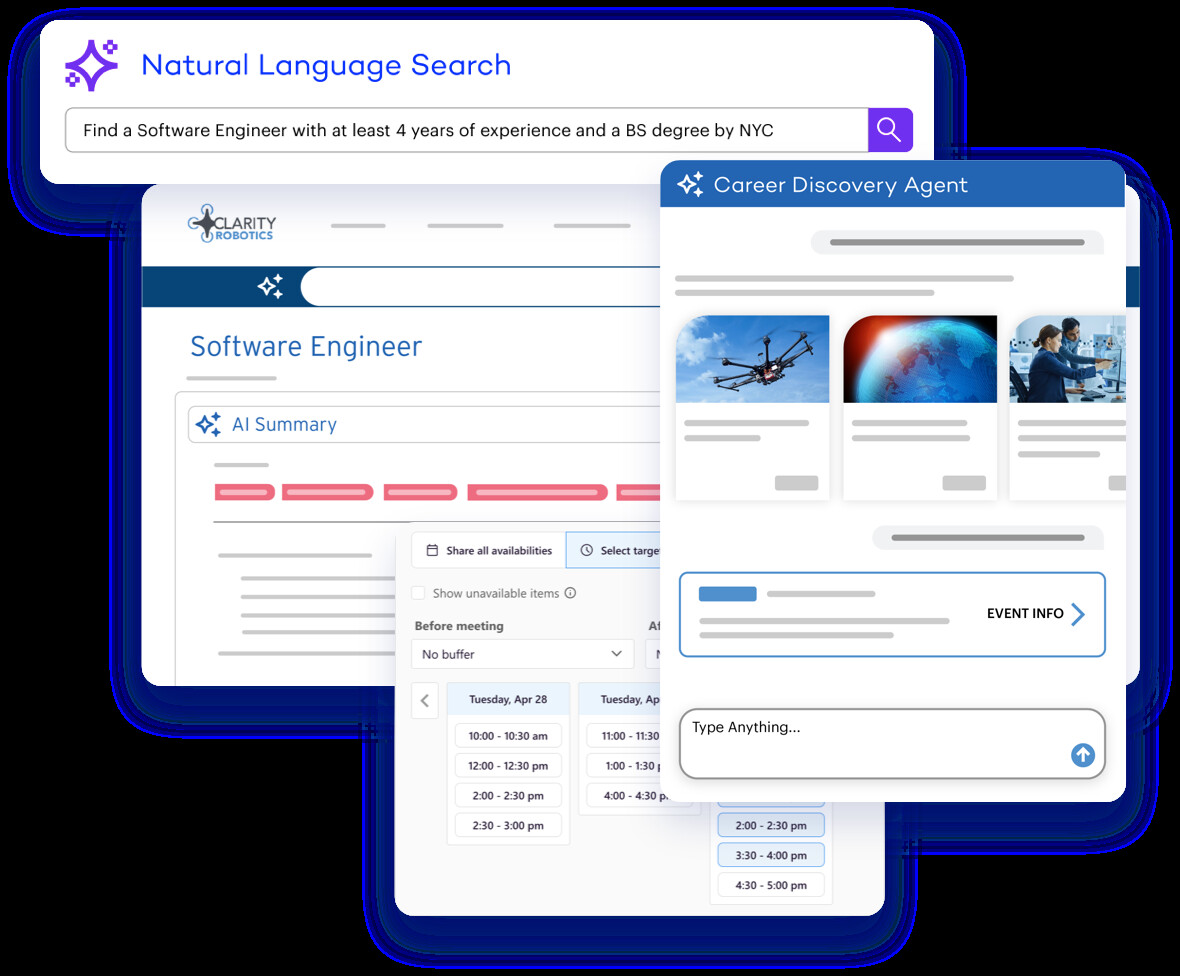
Radancy now describes its platform as agentic AI powered. Candidate-facing agents can interpret natural-language searches, summarize job descriptions and recommend roles. Recruiter-facing tools can help screen applicants, schedule conversations and move feedback along. The company says these systems draw on billions of talent interactions. It also says personal data is never used to train its AI models and that human oversight, fairness, transparency and brand protection are formal principles overseen by an AI Governance Council.
This is where Radancy competes with Phenom, Beamery, Appcast, Gem, Avature, Eightfold, Symphony Talent and a long tail of point products. “We use AI” is no longer differentiation. Radancy's better argument is that it can act across the funnel because it sees the ad, site visit, event, referral, message, interview and application. Its risk is the mirror image of that advantage: acquisitions can make a brochure complete faster than they make a workflow coherent. If identities, permissions and analytics fracture at the seams, customers merely acquire a larger bundle of point solutions.
What another company can copy
- Keep the expensive customer problem, even when its original channel disappears.
- Integrate with the system of record instead of demanding a risky rip-and-replace.
- Pilot in unlike markets before a global rollout, then bring privacy and security in early.
- Use acquisitions to fill clear workflow gaps, not merely to add fashionable features.
- Measure the result closest to money - qualified hires, recruiter time and cost per hire.
06 / Buying conditionsWhen the big suite earns its weight
Radancy works best when the employer has genuine complexity: many requisitions, markets and candidate channels; an established ATS; a meaningful media budget; and leaders willing to standardize data and process. It is especially credible when employer brand, career-site experience and programmatic advertising must be managed together. Its service bench can help a company that lacks specialist recruitment-marketing talent internally.
Strong fit
Global or high-volume employer; several sourcing channels; expensive fragmented tools; mature ATS; need for measurable recruitment marketing and governance.
Weak fit
Small hiring team; few annual openings; desire for instant self-service setup; need for a simple core ATS; little capacity for integration or change management.
It will be less convincing where hiring volume is low, existing tools are already coherent or the buyer wants transparent pricing and a quick swipe of a credit card. The same breadth that can lower total cost for a multinational can feel like machinery for machinery's sake at a 100-person company. Nor can software repair an employer proposition that employees do not believe. Radancy can sharpen distribution and improve the journey; it cannot make a bad job good.
That restraint is the useful ending to a story that spans three technological eras. Radancy has survived by learning where attention moved and rebuilding the bridge between employers and candidates. AI agents may be the next bridge. Whether they become another durable layer or merely another crowded channel will depend on the least glamorous parts of enterprise software: clean integrations, trusted data, human judgment and proof that a better conversation produced a better hire.