At Wolseley, a British plumbing and heating merchant, a change of hiring software created a rather ordinary disaster: the tracking stopped working. The company was already trying to escape manual job postings and scattered advertising channels. Now its new applicant tracking system threatened to send recruiters back to the spreadsheet. Appcast helped restore the connection. In a business sold on algorithms, this was plumbing of another kind: keeping information moving between the advertisement and the person eventually hired.
- Appcast buys and adjusts recruitment advertising across job sites, search and social.
- Hiring-system feedback helps distinguish cheap applications from useful candidates.
- Its software comes with media specialists, creative services and candidate conversion tools.
The Wolseley case offers a compact explanation of the company. After launching in August 2024, the customer reported 65% more applications, 38% more qualified candidates and a 26% reduction in average cost per application in less than eight months. The numbers are Appcast-published customer results. The revealing detail is the repaired tracking. An automated buyer needs to know what its purchases produced.
01 / The click has an afterlife
Appcast began in 2014 with Chris Forman and a proposition recruiters could understand: pay for a completed application. Its exchange spread jobs across career and consumer sites, replacing individual posting decisions with software. Employers could reach beyond a favorite board without managing every publisher themselves.
Consider the economic problem. An employer needs drivers in one town and warehouse staff in another. The roles have different candidate supplies, different application rates and different urgency. A fixed advertising allocation treats those differences as an inconvenience. Programmatic buying makes them inputs: adjust where the job appears, how much it receives and when spending should stop.
There is another distinction hiding inside the word “result.” A click is measurable. So is an application. Neither necessarily fills a shift. By connecting advertising performance with an employer’s applicant tracking system, Appcast can direct spending toward sources that yield qualified candidates and hires. That is its central expertise: joining media buying to recruiting outcomes.
- 01Buy attentionJobs · search · social
- 02Watch conversionApplication · qualification
- 03Count hiresATS outcome data
02 / The deals the software couldn’t win
The original focus eventually became a commercial limitation. In a 2024 interview, Forman described enterprise customers asking for search, social, traditional advertising and employer branding alongside job ads. They wanted fewer partners. Appcast lacked those capabilities and began losing deals.
In July 2023, it bought Bayard Advertising, founded in 1923. The acquisition added the agency skills customers were requesting. The announcement put the combined customer base above 2,000, with hiring needs across the United States and ten major international markets. A software company had acquired a century of advertising experience to widen the problem it could solve.
“we actually started losing deals”
Chris Forman, on the missing capabilities before Bayard
That history explains today’s mixture of products and people. AppcastOne brings programmatic, search, social and traditional media into an enterprise offering. Xcelerate handles programmatic job advertising. Search Ads reaches people through search and display; Brand Ads captures social interest and follows up with prospective applicants. Account teams help interpret results and adjust campaigns.
The business sits between advertising technology and a recruitment marketing agency. Alternatives include Joveo, PandoLogic and JobTarget, alongside managing campaigns directly. Appcast’s particular pitch combines buying software, hiring data and service breadth. A job board sells access to its audience; Appcast manages choices across audiences.
03 / Sometimes the landing page is the problem
Buying another click makes little sense if the application experience wastes the previous one. Appcast’s portfolio now includes Apply, Connect and Quality Connect, plus Xtend for engaging and converting career-site visitors. In September 2025, it announced AppcastEngage, a connected engagement layer within AppcastOne. Career Sites followed as a new offering in July 2026, emphasizing discoverability and conversion.
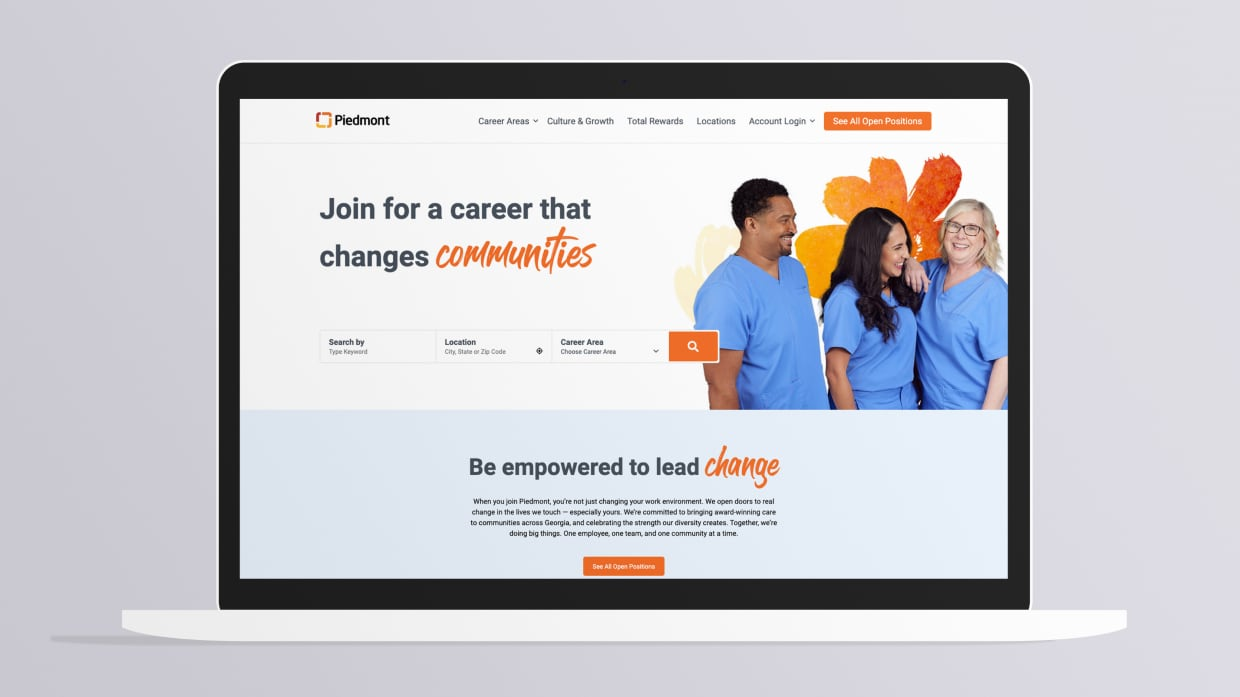
Its Piedmont Healthcare work makes the service side tangible: a career site, recruiter toolkit, campaign assets and an employee photo shoot. Designers and project managers joined the healthcare team on location for two days. Real colleagues supplied the faces; writers and strategists supplied a consistent message across channels.

04 / Change the denominator
At Brakes UK, the foodservice supplier, Appcast combined programmatic distribution with click-to-hire tracking and centralized reporting. Its customer account reports four times as many qualified applicants in the first six months and twice as many hires for key roles. Recruitment advertising became something the team could inspect across the funnel, rather than reconcile across separate sites.
in the first six months
key roles
The price question requires the same precision. Appcast’s original exchange charged per applicant. Today’s enterprise proposition combines media, technology and managed expertise, so a buyer needs a proposal separating advertising budget from service charges. A reduction in cost per application does not establish the total bill, and these case studies do not disclose enough to calculate it.
The research business adds context. Appcast’s 2025 benchmark analyzed 379 million clicks and more than 30 million applications from over 1,300 US employers. Its 2026 report added candidate disposition and international data. The point is to compare a campaign with relevant roles and markets, rather than a comforting company-wide average.
05 / Borrow the habit
Under Matt Molinari, who became CEO in January 2025, Appcast continues expanding around the same measurement problem. The practical lesson travels beyond its products: define a qualified candidate, connect that definition to spending, and check the connection whenever hiring systems change.
The inference is straightforward. Missing outcome data limits optimization. Advertising also cannot manufacture scarce credentials or make an unattractive offer competitive. Recruiters still have to respond, assess and persuade. Before increasing a budget, trace one candidate’s route from advertisement to decision. Somewhere along that route, a cheap click may be becoming a very expensive silence.