A marketing idea can arrive anywhere: a meeting, a customer call, even the shower. Shehzad Karkhanawala is happy to let inspiration enjoy its entrance. He simply refuses to let it appoint itself king. Once the spark arrives, his preferred ritual is less romantic and more useful. Put the idea in front of an audience. Watch what people do. Keep what works. Cut what does not. Then repeat without becoming precious about yesterday's cleverness.
That habit has followed Karkhanawala through a career spent translating complicated technology into reasons to care. He has marketed enterprise networking at Aryaka, cloud automation for digital commerce at Webscale and, now, the machinery of modern recruiting at Joveo. The categories have changed. The central problem has not: make an invisible system understandable, give it a human consequence and prove that it earns its place.
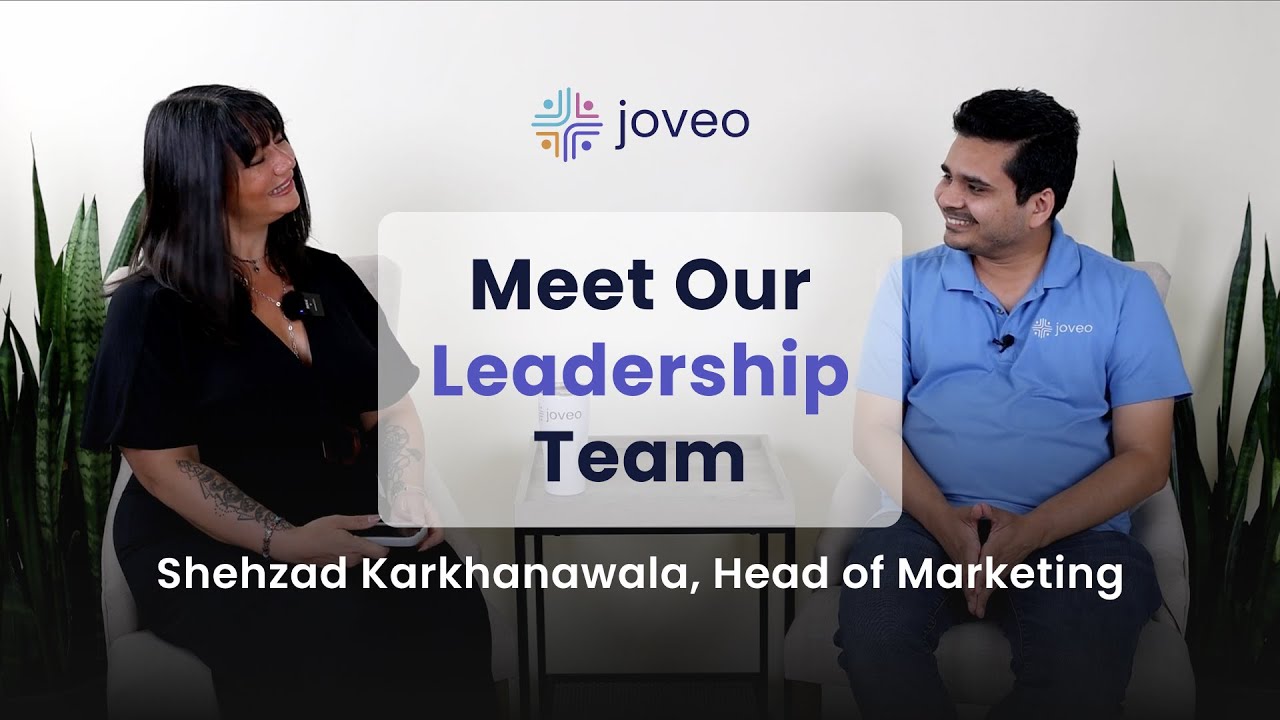
Today, from the Washington DC-Baltimore area, he serves as Joveo's Chief Marketing Officer, leading work across product and content marketing, demand generation, communications and sales enablement. His remit is broad enough to encourage grand theories. Karkhanawala's own theory fits into three familiar words: people, process, technology. PPT, he calls it. An acronym that sounds like office software is doing serious work here.
The gold medal before the dashboard
There is an academic clue in the operating style. Karkhanawala studied at IIT Kharagpur's Vinod Gupta School of Management from 2012 to 2014. When his MBA class graduated, he received the Mrs. Shelu Sanyal Memorial Endowment Gold Medal for the best academic performance among the program's graduating students. The line sits in the institute's annual report with bureaucratic calm. In a career later built around scorecards, rigor arrived early.
His professional path included Wipro and Frost & Sullivan before the more visible stretch at Aryaka. There, he rose into the director of marketing role and worked on messaging, public relations, content, product marketing and regional programs. Joveo's biography credits Aryaka's marketing leadership team with supporting revenue growth of more than 500 percent across three years. In 2018, that organization was a Marketers That Matter finalist in two categories: Driving Growth and Transformation Journey.
The articles Karkhanawala published during that period show the translator at work. His subjects included the move beyond MPLS, the rise of software-defined wide-area networking and what Asia-Pacific enterprises should look for in a network. None is an easy dinner-party topic. He framed them through recognizable business decisions: speed, geographic reach, application performance and the cost of keeping old infrastructure. A later academic lecture on computer networks even cited a 2018 presentation of his while explaining how packet loss, latency and distance degrade performance. Marketing had wandered into the footnotes. More importantly, the habit was established: start with an imposing machine, identify where it touches ordinary work and give the audience a way to evaluate the difference.
At Webscale, Karkhanawala became Assistant Vice President of Marketing and General Manager for India operations. The job again joined story with system. He helped build the demand-generation engine during a period of more than 100 percent year-over-year growth. By 2020, he had moved to Joveo to run customer experience and marketing, a pairing that reveals something important. Marketing was not merely the promise at the front door. It extended into the experience after someone entered.
MBA gold medal at IIT Kharagpur, then a career in technology marketing.
Marketing leadership at Aryaka during a period of rapid company growth.
Marketing and India operations leadership at Webscale.
Customer experience and global marketing leadership at Joveo.
A small operating system for big ideas
Karkhanawala's PPT framework begins with people who think about the funnel and its evidence every day. Process means choosing the few metrics that actually describe a campaign's purpose, then staying honest about them. Technology automates the repetitive work, makes attribution possible and lets the team spend attention where judgment is required. The order is sensible. Software receives the last word in the acronym, not the first.
Build a team that studies the audience and the funnel.
Choose a few meaningful metrics and review them on rhythm.
Automate toil, attribute outcomes and support judgment.
The useful detail is scale. He recommends one, two or three important measures, not a wall of green and red tiles. Campaigns and assets are reviewed weekly, monthly, quarterly or annually, depending on the work. The cadence matters because memory is a talented defense lawyer. Without a scheduled look backward, a team can turn every result into a flattering story about its original plan.
Karkhanawala has a phrase for this preference: promises do not work, systems do. A system preserves creativity by giving it a way to learn. The audience, in his view, decides whether an idea is good. Taste proposes. Behavior disposes. A marketer can still have a hunch, but the hunch must eventually leave the building and meet other people.
The candidate behind the conversion
Recruitment gives this philosophy moral weight. In a 2022 conversation recorded at HR Tech in Las Vegas, Karkhanawala was offered an imaginary magic wand and asked what he would change about talent sourcing. His first wish was better decision-making. Employers should move away from intuition, he argued, and measure the whole funnel: not only traffic, clicks and applications, but hires and retention.
His close second was humanizing candidate conversion. After a person sees an advertisement, fills out a form or enters a hiring process, the experience often becomes fog. The industry calls this a funnel, a word that turns people into liquid and silence into plumbing. Karkhanawala's question was pointed: how do you keep a job seeker from getting lost in a black hole?
Communication, useful content and thoughtful personalization are his remedies. Chatbots and conversational AI can help, but the ambition is not a more efficient void. It is personalization at scale that makes the process feel more human. That distinction is central to his work at Joveo, whose products sit where advertising budgets, recruiting workflows and individual hopes meet.
He is also interested in the plumbing. In consumer advertising, a campaign can stop almost instantly. Job advertising can carry latency because emails and text campaigns remain scheduled. Attribution becomes harder when impressions, clicks, applications and hires live in different systems. Karkhanawala's instinct is to bring lessons from consumer ad technology into recruiting while rebuilding for the particular responsibilities of hiring.
Fresh eyes, kind arguments
Data discipline can make a team brave or merely nervous. Karkhanawala's leadership philosophy tries for the former. One principle is constant reinvention: markets and technologies change, so teams need the objectivity to examine old work with fresh eyes. History supplies knowledge, but it can also supply handcuffs. A campaign should not survive because everyone remembers how exhausting it was to make.
The companion principle is openness with care. He wants creative teams where people can criticize one another's work without converting critique into judgment of the person. Colleagues should be able to challenge the standard, leave the room and return as friends. This is harder than it sounds. Many companies advertise candor and practice ambush. Compassion is the piece that keeps honesty from becoming sport.
Public recommendations from former colleagues describe the same energy from another angle. One called him a “marketing machine” and praised the range of responsibilities he carried at Aryaka. Another wrote about his contagious workplace energy and ambition. On a more recent Joveo post, a colleague described him as kind and genuine. The portrait that emerges is not a dashboard in a suit. It is an operator who likes numbers, motion and the social conditions that let a team disagree productively.
Product managers for marketing AI
Karkhanawala's one-word description of marketing's future is AI. His longer version is more interesting. Marketing teams, he believes, will become product managers for marketing AI, stitching together agents and human workflows. The phrase shifts attention from prompting a single tool to designing a working system: deciding what should happen, which machine can handle it, where data enters and where a person remains responsible.
His recent writing at Joveo reflects that educational project. In August 2026, his byline appeared on explainers about text recruiting, share of voice in job advertising, the difference between AI agents and copilots, and agentic screening. These are pieces for practitioners who need definitions, boundaries and useful mechanics before they need futurist confetti.
The fundamentals, he insists, remain. People still need to think systematically. Process still has to turn an idea into measurable learning. Technology should enable human judgment rather than replace it. The aspiration is to free recruiters and marketers from repeatable cognitive load so they can apply domain knowledge and compassion where a workflow cannot.
Even his lighter preferences fit the pattern. Asked for a favorite channel, he chose digital and called himself a student of it. Asked which campaign he wished he had made, he chose Apple's Think Different. It is a revealing pair: the endlessly measurable medium and the famous anthem to imagination, held in the same hand.
That may be Karkhanawala's most portable lesson. Creative and analytical work do not have to tolerate each other across a conference table. They can share an operating system. Let imagination make the opening bid. Let a few honest metrics answer. Build a team kind enough to hear the verdict. Then return with fresh eyes and make the next version better.