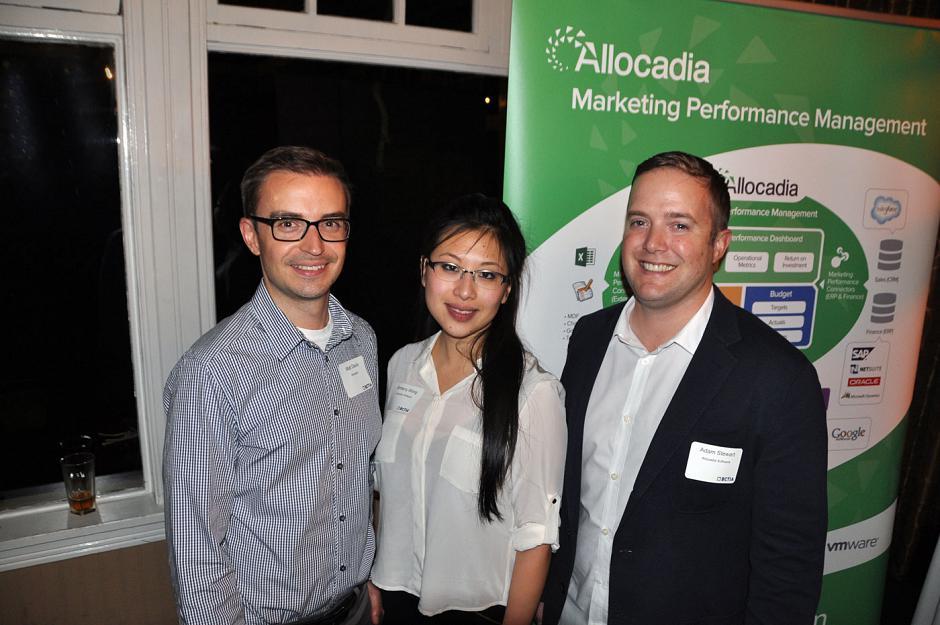
In a photograph from a Vancouver technology mixer in January 2014, Brittany Wong stands between two Allocadia colleagues. A green banner behind them reads “Marketing Performance Management.” The phrase is pure enterprise software: precise, practical, a little bloodless. Wong, then a marketing manager for programs and performance, would spend the next decade making a career from the problem hidden inside those three words. Performance can be measured. People still have to make it happen.
Today she is Chief Marketing Officer at Bucketlist Rewards and Recognition, a Vancouver software company built around the moment one person notices another person's contribution. The product category looks different from marketing analytics, customer intelligence, operational technology, fintech, or commerce software, all sectors that appear on her résumé. Yet the operating question is familiar. A company makes a promise. A team needs a system that turns it into something observable. Then somebody has to care enough to keep the system alive.
Wong's path to the C-suite began in 2006 with marketing coordination and specialist roles. There was no single leap. There were programs, campaigns, consulting projects, regional responsibilities, acquisition targets, and teams. The progression matters because it gives her current assignment an unusual shape. She is a marketer of measurable growth working in a category full of words that can become vague very quickly: appreciation, belonging, motivation, culture.
The long route to a simple idea
Early roles at Meridex Network Corporation and Hotfusion Communications gave way to work at Aquatic Informatics, then Allocadia. By the time of that 2014 mixer, Wong was already close to a defining concern of modern marketing: how to connect spending and activity with outcomes. Allocadia sold the promise that marketing could manage its own performance with greater discipline. It was an education in turning a broad function into a legible operating model.
At Vision Critical, she moved from Director of Marketing for Asia Pacific to VP of Marketing and Customer Acquisition for the region. The scope widened from programs to markets, from Vancouver to Sydney, and from execution to leadership. A subsequent global demand-generation role at SafetyCulture added another kind of translation: a product used in the daily flow of work had to find its way into organizations through a mix of product adoption and enterprise growth.
Then came Flare, the Australian workplace-finance company, where Wong served as VP of Marketing. The category brought employer systems and personal lives unusually close together. In a 2021 company interview, she described an experience from her twenties. She worked, studied, traveled, and paid the next credit-card bill. At 25, a friend bought a home without outside financial help. Wong was startled. The friend's method was almost disappointingly simple: since starting work at 16, she had saved 20 percent of every paycheque, following a rule taught by her mother.
“Simple financial habits can go a long way.”Brittany Wong, reflecting on the lesson she learned at 25
The anecdote reveals an instinct that also suits an operator. Big outcomes often arrive disguised as small, repeated behaviors. A savings rate is not a house, but over time it can become one. A campaign is not a market position, but a coherent sequence can build one. A thank-you is not a culture, but thousands of specific, credible moments can shape how a workplace feels.
Programs + performance
APAC + acquisition
Culture + recognition
Recognition needs an operating system
After Flare, Wong led demand generation and account-based marketing at Vendasta, a Canadian platform serving businesses that sell technology to local companies. She joined Bucketlist as VP of Marketing in 2024 and became CMO in 2025. The titles chart increasing scope, but the more interesting shift is in the object being marketed. Her earlier work often helped companies understand customers, allocate resources, or acquire demand. At Bucketlist, the software helps employers notice people.
Notice is the important verb. Most companies already possess the vocabulary of appreciation. Values are printed in decks. Managers know they should say thank you. Milestones arrive on a calendar. The difficult part is turning that ambient good intention into a reliable practice, particularly when teams are distributed across locations, shifts, and screens.
This is where Wong's demand-generation background becomes relevant. Good demand generation depends on timing, relevance, segmentation, and feedback. Useful recognition does too. A generic message sent everywhere may produce activity, but it rarely produces meaning. Effective appreciation names a behavior, connects it to a shared value, and reaches someone while the contribution is still fresh. Scale helps only if specificity survives it.
A recognition loop worth stealing
- Observe the concrete behavior, not just the final number.
- Name who benefited and how the contribution helped.
- Connect the moment to a value people can recognize again.
- Respond close to the event, while the context is still alive.
- Use systems for consistency and judgment for meaning.
The category carries a productive tension. Rewards are visible and easy to count. Recognition is relational and harder to reduce to a dashboard. One can support the other, but they are not interchangeable. A gift card can mark a contribution. It cannot explain why the work mattered. That explanation is management in miniature.
Wong's own public language favors action over abstraction. Asked what businesses could do to build a more inclusive workplace, she began with two words: “Start somewhere.” The phrase sounds modest. It is also a refusal of the corporate habit of waiting for a complete framework before changing a behavior. She urged companies to educate themselves, examine how hiring criteria shape candidate pools, and source deliberately when they want broader representation.
Culture becomes credible when a value is specific enough to recognize in someone else's work.The operator's test
A career built by accumulation
There is a temptation to retell an executive career as destiny. Wong's looks more useful when read as accumulation. Her early work supplied craft. Allocadia made performance visible. Vision Critical expanded her geographic and managerial range. SafetyCulture brought high-value acquisition into a product-led environment. Flare put workplace technology beside personal financial behavior. Vendasta deepened the machinery of demand and account focus. Bucketlist brings those threads to the question of how organizations express what they value.
The accumulation also explains why the word “operator” fits beside “executive.” An operator lives with the second-order questions. Who maintains the program after launch? What behavior does a metric encourage? Can a manager use the system in the middle of a busy shift? Does the message reach a field employee as naturally as it reaches someone at a desk? Does a company value describe anything concrete enough to reward?
Those questions are less glamorous than announcing a new category. They are also where categories become companies. Bucketlist says it wants to help organizations build strong cultures through recognition and rewards. Wong's job is to make that proposition legible to buyers while her company makes it usable for employees. The external story and the internal experience have to meet.
The smallest unit of culture
For all the software in Wong's career, the smallest unit of her present work is a moment between people. Someone stayed late to solve a problem. A colleague made a difficult handoff easier. A frontline worker handled an ordinary task with unusual care. A manager noticed and described what happened. The system records the moment, distributes it, perhaps attaches points or a reward. But the meaning comes from the evidence that somebody was paying attention.
That is the practical insight to steal from her path. Broad promises need narrow behaviors. “Build a great culture” is too large to execute on Tuesday afternoon. “Name the action, connect it to the value, and thank the person today” is small enough to do. The same logic powered the financial habit Wong admired in her friend. It is repeated before it is impressive.
Wong has moved through enough software categories to know that a platform cannot rescue an incoherent practice. It can make a coherent one easier to repeat. Her marketing challenge at Bucketlist is therefore more interesting than selling perks. It is making the case that recognition belongs in the operating rhythm of a company, near performance and retention, while protecting the human texture that gives it value.
Back in that 2014 photograph, the banner promised marketing performance management. Twelve years later, Wong's work still concerns performance, but the frame has widened. Metrics can tell a company what moved. Recognition can tell a person that someone saw them move it. A durable workplace needs both kinds of evidence.