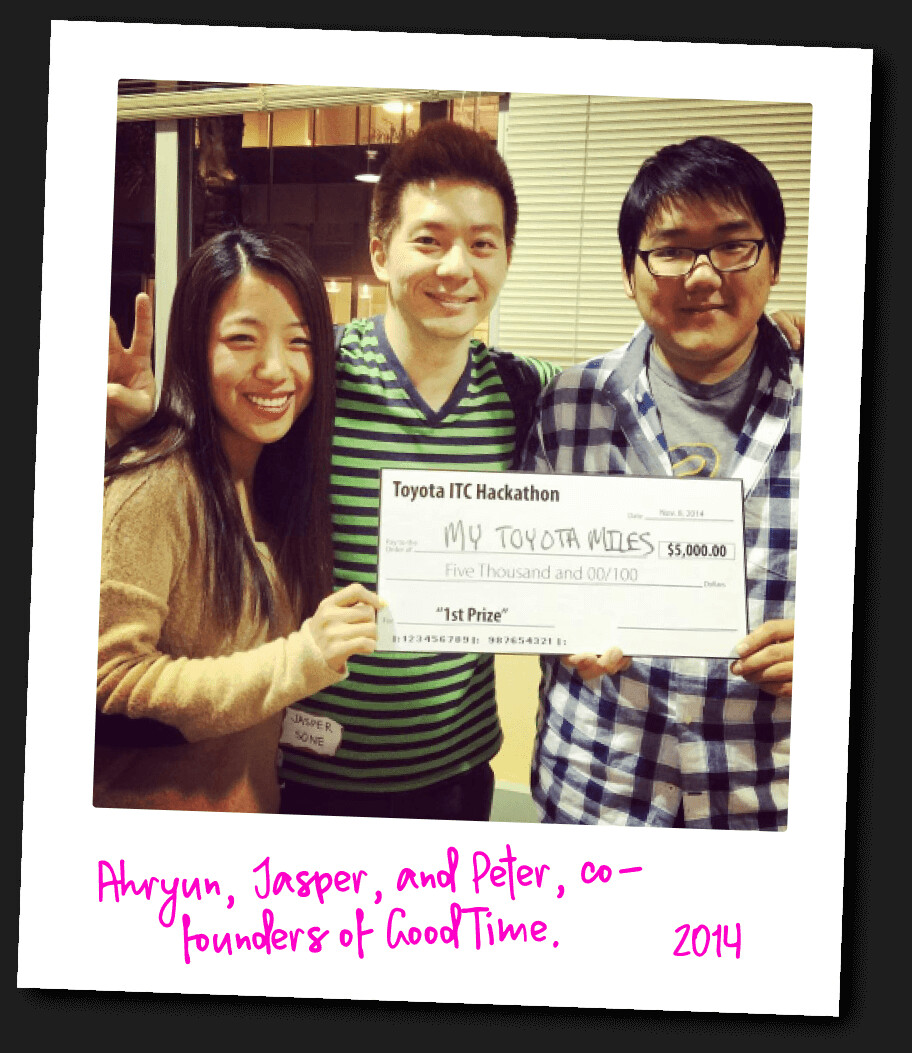
The photograph looks like startup prehistory because it is. Three friends grin behind a novelty check at the 2014 Toyota ITC Hackathon. Ahryun Moon flashes a peace sign. Jasper Sone wears a striped shirt and the pleased expression of someone who has just won $5,000. Peter Lee steadies the other end. They would go on to build GoodTime, but the company hidden in that picture was not yet an AI agent or an enterprise hiring platform. It was a conviction that a tedious handoff could become software.
The handoff was interview scheduling. Recruiters could find candidates and managers could judge them, but between those moments sat days of email, shifting calendars, time zones, conference links and the recurring discovery that the one qualified interviewer was on vacation. Moon heard the complaint directly from a recruiter, then shadowed recruiting teams to understand the job. GoodTime's first product treated the company calendar as an organizing system and used software to match candidates with appropriate interviewers.
That is still the foundation. GoodTime connects to applicant tracking systems such as Workday, Greenhouse, Lever, iCIMS and SmartRecruiters; calendars from Google and Microsoft; video tools including Zoom and Teams; and communication channels such as Slack, SMS and WhatsApp. A recruiting coordinator can build a panel, enforce interviewer rules, offer candidate self-scheduling, replace a cancellation, generate a coding link and push the finished record back into the ATS. The product does not merely find an empty box on two calendars. It choreographs a small, failure-prone production.
The first thing that failed was the spreadsheet
GoodTime's customer stories repeat the same opening scene with different logos. At Toast, global growth and multi-day technical panels turned scheduling into what its talent team called “calendar Tetris.” Miro's global coordinators were juggling time zones and disconnected tools during hypergrowth. Red Hat's recruiters were buried in tickets and manual slot hunting. The breaking point was not a shortage of interview skill. It was coordination volume.
The numbers come from GoodTime's published customer case studies, so they should be read as selected outcomes, not controlled experiments. Still, the underlying mechanism is concrete. Miro says its team scheduled more than 60,000 interviews through GoodTime and became roughly four times as productive. Toast reports scheduling interviews in under 12 hours instead of under 24, with 55 percent fewer cancellations. Red Hat says adoption reached 91 percent in two months and scheduling time fell 52 percent.
“Changing a job is such a stressful experience and a big moment in people's lives.”Lori Busch, Toast senior director of talent operations
That quote explains the candidate side of the product better than a feature grid. The first operational encounter a candidate has with a company is often an email asking for availability. Slow replies, repeated reschedules and contradictory instructions do not feel like administrative glitches. They feel like a preview of the employer. GoodTime sells efficiency to the buyer, but candidate confidence is the emotional return.
The calendar was the wedge, not the ceiling
What changed GoodTime's mind about its own scope? Success at scheduling exposed all the adjacent work. Once the company knew who should interview, when they were free and where a candidate sat in the process, it could train interviewers, send reminders, collect feedback, expose bottlenecks and personalize candidate communication. GoodTime's own history says customers did more than save time: they moved candidates faster and competed for talent more effectively. The scheduling fix had become a map of the hiring journey.
In May 2025 the company named this broader idea Orchestra, a group of AI agents meant to screen applicants, book interviews, keep candidates warm, summarize scorecards and monitor pipelines. One year later it introduced Cori, now presented as the intelligence running across GoodTime rather than a separate add-on. Cori can converse with candidates, but the pitch is emphatically not “chatbot.” It is action: identify the next step, resolve a calendar conflict, replace an interviewer, send the update and keep the workflow moving.
This is a sensible place to deploy an agent. Scheduling has bounded inputs, visible outputs and plenty of permission gates. GoodTime says each action remains visible and users can adjust, override or guide the agent. In July 2026, support documentation described an option allowing Cori to autonomously schedule low-complexity queued interviews. The wording matters. Ambiguous decisions can still summon a human; routine ones need not wait for a prompt.
What the software costs - and what it replaces
GoodTime does not publish a dollar menu. Its pricing page says contracts are based on annual candidate volume, not user seats; customers may add as many users as needed, and core integrations are included. Experience+ and an advanced data feed are separate upgrades. The honest answer to “what did it cost?” is therefore: a custom enterprise proposal, plus implementation attention from recruiting operations and IT. Any precise public number would be guesswork.
The buying calculation is easier to understand than the invoice. Count the coordinator hours spent requesting availability, repairing invitations, finding replacements, nudging scorecards and updating the ATS. Add the opportunity cost of delayed candidates and burned-out interviewers. Then compare that burden with the subscription and rollout. For a global company running thousands of interviews, one reusable workflow can compound. For a small team booking a handful of one-to-one calls, a calendar link is probably enough.
GoodTime found a company hiding between the ATS and the calendar.
An enterprise traffic controller
GoodTime sits in a crowded market. ModernLoop attacks complex interview scheduling with a modern recruiting-operations interface. Paradox uses an assistant-led model for high-volume hiring. Greenhouse, Ashby and other recruiting suites offer scheduling inside the system of record. Calendly and Microsoft Bookings solve simpler appointments. GoodTime's argument is that enterprise interview logistics deserve a specialist: panels across time zones, qualified interviewer pools, load balancing, training paths, branded portals, bulk scheduling and multi-channel communication in one system.
Its most defensible asset may be the plumbing. Deep ATS and calendar integrations are tedious to build, security-sensitive to deploy and essential to trust. GoodTime's master agreement makes the dependency plain: the cloud service needs access to customer data, employee directories and calendar events to do its work. Buyers therefore need clean systems, clear permissions and internal owners. Automation cannot rescue interview templates nobody maintains or calendars employees treat as fiction.
| Condition | Good fit | Weak fit |
|---|---|---|
| Interview shape | Panels, multi-day loops, high-volume events | Occasional one-to-one screens |
| Systems | Established ATS, calendars and owners | Fragmented data and unreliable calendars |
| Economics | Repeated coordination at enterprise scale | Too little volume to repay implementation |
| Control | Teams ready to encode and monitor rules | Every interview is an undocumented exception |
The useful bits to steal
You do not need GoodTime to copy its operating logic. Start by measuring request-to-schedule time, reschedule rate and interviewer load. Most recruiting dashboards obsess over applicants and offers while the delays between stages remain foggy. Make the handoff visible. Build templates for repeated interview shapes. Maintain a tagged pool of trained interviewers rather than asking the same agreeable employees every week. Let candidates select from real availability. Write down escalation rules for cancellations.
A coordination checklist worth copying
- Instrument the wait between stages, not only the funnel totals.
- Standardize common interview loops before automating them.
- Treat interviewer capacity as a supply problem and balance the load.
- Automate reminders and repairs; reserve human time for judgment and care.
- Keep every automated action visible, reversible and owned by someone.
The approach loses its edge under predictable conditions. Low volume makes the machinery hard to justify. Dirty ATS records and fantasy calendars produce confident mistakes. Highly bespoke executive searches resist templates. Candidates in sensitive situations may need a human coordinator. And an organization that has not agreed on who may interview, what constitutes a completed scorecard or when a candidate advances is not ready for an agent to execute those decisions.
From helper to handoff owner
Three co-founders turn recruiter scheduling pain into a company.
A $5 million Series A funds the interview-automation wedge.
An additional $9.5 million supports expansion during distributed hiring.
Orchestra extends the product across the hiring journey.
Cori moves from recommending work toward permissioned execution.
The GoodTime story is not really about calendars. It is about discovering that the least glamorous part of a workflow can be the best place to begin. Scheduling gave the company structured data, daily use and a seat between systems. Each repaired handoff earned permission to take on the next one.
Now the risk is scope. “Orchestrate hiring” is a bigger and blurrier promise than “schedule the panel.” GoodTime will have to prove that Cori can absorb ambiguity without hiding mistakes, and that a visible AI agent is more useful than a well-designed set of automations. But the standard is refreshingly practical. The interview happens sooner. The right people show up. The candidate knows what is going on. The recruiter gets time back. For an AI coworker, that is a decent job description.