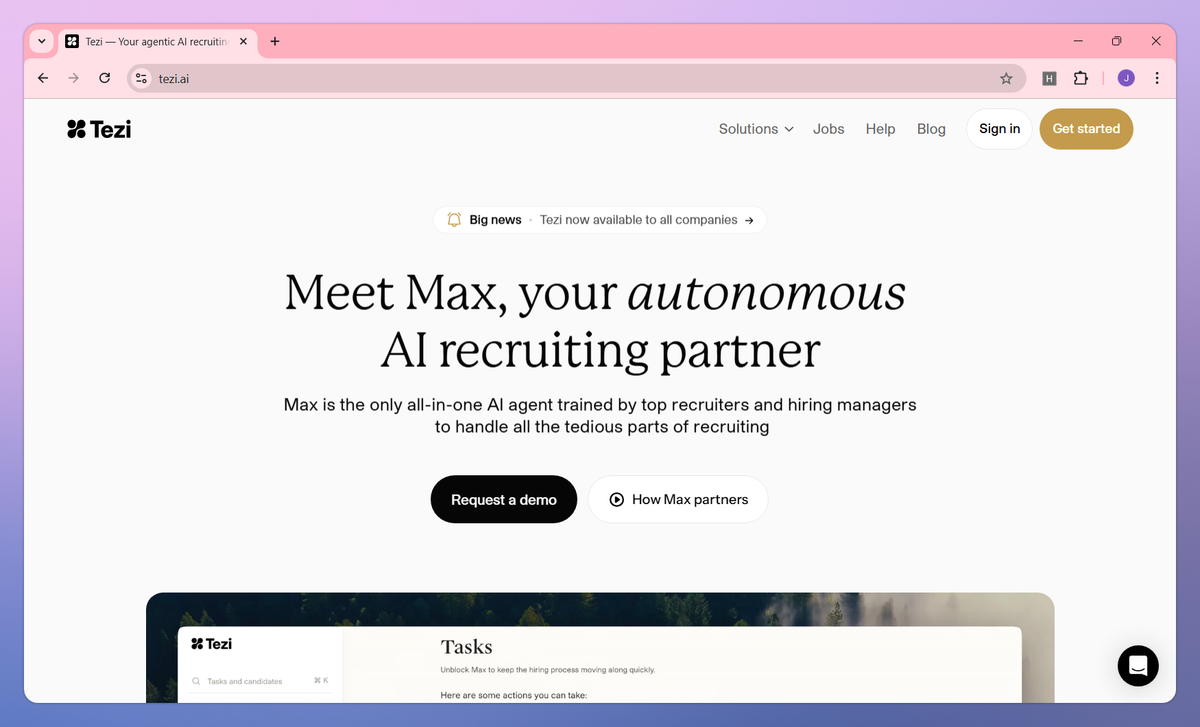
If your recruiting day disappears into resume triage, calendar Tetris and polite follow-ups to people who forgot their scorecards, Tezi's pitch was almost indecently well aimed. Give Max a role, teach it what good looks like, then let the agent find prospects, review applicants and keep interviews moving. The hiring manager could spend the reclaimed hours on the only parts candidates remember: a useful conversation, a credible vision and a clear decision.
That is why Tezi still deserves attention even though nobody can buy it now. Headway acquired the team on March 31, 2026, folded its engineers, designers and data scientists into the mental-health company's product organization, and put cofounder Raghavendra Prabhu in a vice-president-of-engineering role. Contemporary shutdown coverage reported that customer accounts remained accessible for export until Max went offline on April 12. This is therefore a buyer's guide with an obituary folded inside.
Who Max was really for
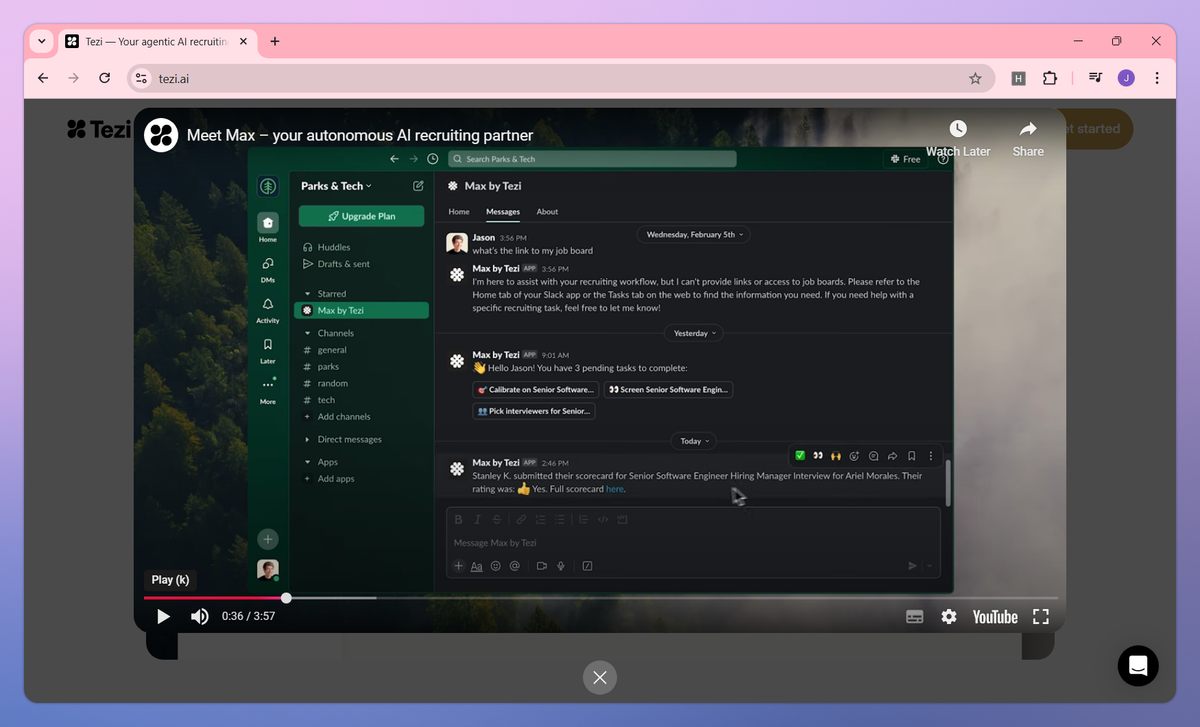
The cleanest fit was a founder with several open roles and no wish to build a recruiting department. The second was a stretched talent team that already had an applicant tracking system but needed elastic help during a hiring burst. Tezi could work alone or sync activity into Greenhouse, Ashby and, later, Lever. Slack made it feel less like another dashboard and more like the colleague who nudged you before a candidate went cold.
A good customer also needed an opinion. Max learned through calibration: show it examples, accept and reject profiles, spell out must-haves, and refine the pool. In August 2025, Tezi added AI evaluation criteria for clues that ordinary filters miss, such as implied skills or unusually fast promotions. Natural-language requests could become editable structured filters. The result was not "press button, receive perfect hire." It was a machine that turned a fuzzy hiring brief into an inspectable search.
A recruiter made of smaller recruiters
Tezi presented one character, Max, but described the machinery as dozens of specialized agents orchestrated behind the curtain. One job called for logical matching; another needed a convincing email; another watched calendars. The company later said it used different models for different tasks. That choice is more interesting than slapping one chat box across an entire hiring funnel. Resume evaluation and cold outreach are plainly different forms of work.
| Job on the desk | What Max handled | Where a human stayed useful |
|---|---|---|
| Sourcing | Search, filters, profile evaluation and campaign queues | Define the target and reject bad calibration |
| Inbound | Rank a crowded applicant pile and write summaries | Advance or reject each person |
| Communication | Personalize sequences, draft replies and chase routine answers | Handle nuance, sell the job and resolve escalations |
| Screening | Run a fixed chat questionnaire, then return transcript and summary | Interpret context and conduct the real interview |
| Scheduling | Find time, juggle panels and repair reschedules | Set the interview plan and interviewer roster |
The candidate boundary mattered. Tezi's own guidance said Max could make a recommendation, but a recruiter or hiring manager made every advance or reject decision. Chat screens asked configured questions in a fixed order rather than improvising around each answer. That consistency can aid comparison, though it can also make an unusual career story harder to surface. Anyone buying a successor should ask to see the exact handoff, not settle for a hazy promise of "human in the loop."
“Max replaced our need to source at all for some roles.”Mackenzie Tuller, then Head of Operations at Mutiny, in Tezi's launch post
The receipts, with a small asterisk
At general availability in March 2025, Tezi said dozens of companies had used Max on nearly 100 roles. It reported tens of thousands of sourced profiles and reviewed applications, more than 1,000 candidates screened or scheduled, and over 10,000 recruiting hours saved. Those are company figures rather than an independent benchmark, so they show traction and ambition, not a controlled verdict.
Funding was led by 8VC and Audacious Ventures. Usage, profile-pool and time-saved numbers were reported by Tezi.
Named customers provided the more useful texture. Point's talent leader praised fast setup, targeted sourcing, scheduling and inbound filtering. Mutiny said a role closed a little over a month after Max pulled 29 promising people from an application backlog. Pocus supplied the necessary caveat: the system required ongoing oversight, even while it captured a nuanced candidate profile. That is the balanced sentence every autonomous-software demo needs.
What got better before the lights went out
Tezi's 2025 release trail shows a product becoming less chat-dependent and more controllable. Recruiters gained direct pipeline actions, editable outreach templates, sourcing reports and a dense table view. Nested filters could express conditions such as time at a funded startup. A sourcing-list redesign exposed all matching candidates before outreach and let users switch automatic approval on only after the search looked sane. AI-assisted replies started in draft mode; teams could later enable agentic replies for routine traffic and keep escalations for themselves.
That progression is a quiet admission worth admiring. Early agent products often treat conversation as the whole interface. Tezi gradually added lists, previews, switches and explicit states because consequential work benefits from visible controls. The mundane interface bits were not a retreat from AI. They were how the AI became governable.
Security, fairness and the uncomfortable bit
Recruiting software touches identity, employment and a large pile of personal data. Tezi said Max was SOC 2 compliant and met CCPA and New York City Local Law 144 requirements. In late 2025 it said Warden AI ran monthly bias audits across 18 protected-class dimensions, with external audits also covering Colorado and California rules. Buyers would still have needed the reports, retention terms and model details during diligence. A badge is the start of that conversation.
There is also a candidate-experience question. Tezi said Max signed messages as an AI recruiter, and its help center offered a support route for anyone wanting a person. Yet one customer recalled prospects who had not realized AI conducted the initial outreach. Transparency should survive channel changes, forwarded threads and send-on-behalf-of campaigns. If the candidate needs detective work to know who is speaking, the disclosure has failed.
The replacement-shopping checklist
Tezi's shutdown turns vendor stability from procurement boilerplate into the main event. Former customers had roughly a month to export data and remap workflows. A replacement should be judged on continuity as hard as matching quality. Ask where every transcript, evaluation and consent record goes if the vendor disappears.
Historically, third-party buyer research listed Max Lite at $49 per month after a 14-day trial, covering two active roles and 250 monthly outreach credits. Larger plans used annual custom pricing and added deeper ATS support. Those are archival numbers, not an offer. Compare current alternatives such as Findem, Fetcher, Moonhub, Paradox, Eightfold, Gem and newer screening tools by workflow, not by the number of times their sites say "agentic."
Two founders who knew the queue
Prabhu and Jason James met at Thumbtack, where one ran technology and the other led product and design. Their combined management careers included Google, Microsoft, Twitter, Intercom, Pinterest, Instacart and Covariant, plus hundreds of hires. Tezi began in 2024, announced its seed funding that July, onboarded paid customers in the autumn and took Max generally available in March 2025. The compressed history explains the product's confidence: it came from executives who had personally felt recruiting capacity become a company bottleneck.
It also makes the Headway deal logical. Headway did not announce plans to keep selling recruiting software. It wanted a team that had paired agents with human judgment inside a messy operational system. Mental health care has different stakes, but it shares the paperwork, scheduling, fragmented information and need for a clear human authority. The asset that survived was the method, carried by the builders.
A good product lesson, not a purchasing option
Tezi made a persuasive case for treating recruiting as a chain of small jobs rather than one magical prompt. Max was strongest where volume meets repetition: sourcing, triage, outreach logistics, calendars and reminders. Its own evolution toward previews and controls showed where autonomy needed rails. The acquisition is an achievement for the team and a hard ending for customers. Buy the lesson: automate the queue, preserve the judgment, and make sure your data can leave before your vendor does.
Five quick answers
Can I use Tezi now?
No. Headway acquired the team in March 2026, and reporting tied to Tezi's customer notice placed the product shutdown on April 12, 2026.
Did Max make hiring decisions?
Tezi said it did not. Max summarized and recommended; a human decided whether a candidate advanced or was rejected.
Was Max an ATS?
It could run alone, but it also connected to established systems. Greenhouse, Ashby and Lever were publicly documented ATS integrations.
What made it different?
The scope. Max connected sourcing, screening, communication, scheduling and follow-up through one agent identity, while specialized agents handled individual tasks underneath.
What should buyers copy from Tezi?
Calibrate on real examples, keep recommendations explainable, disclose AI clearly to candidates, preserve human decisions and insist on a tested data-export plan.
Keep digging
Read the surviving paper trail, including the founders' launch notes, product documentation and Headway's account of the acquisition.